Balanced Crypto Exchange Review: Top Platforms for Security, Fees, and Features in 2026
 Aug, 29 2026
You want a balanced crypto exchange that doesn't make you choose between safety and speed. It sounds simple, but the market in 2026 is a minefield of hidden fees, regulatory gray areas, and security risks that can wipe out your portfolio overnight. You are likely tired of reading reviews that sound like marketing brochures, so let's cut through the noise. We analyzed the major players based on hard data from late 2025 and early 2026 to see which platforms actually deliver a balanced experience.
What Makes an Exchange "Balanced"?
A balanced exchange isn't just about having low fees. It’s about equilibrium across four critical pillars: security infrastructure, regulatory compliance, liquidity depth, and user accessibility. If an exchange has rock-bottom fees but gets hacked every year, it’s not balanced; it’s risky. If it’s ultra-secure but takes three days to verify your account and charges 4% per trade, it’s not balanced; it’s inefficient.
In 2026, the definition has shifted slightly due to global regulations like the EU’s MiCA framework. A truly balanced platform now must prove its reserves transparently while offering competitive execution speeds. For instance, OKX maintains a perfect trust score by publishing monthly proof-of-reserves, verifying 100% backing of user funds. This transparency balances the risk inherent in centralized custody. Meanwhile, Kraken offers a different kind of balance: a ten-year track record without major breaches paired with institutional-grade tools that remain accessible to retail traders.
Security and Trust: The Non-Negotiables
Security is the foundation. Without it, nothing else matters. When we look at the top contenders, Kraken stands out for its longevity. They have operated since 2011 without a catastrophic loss of customer funds. Their approach is conservative, often delaying new feature rollouts to ensure stability. This appeals to users who prioritize capital preservation over flashy interfaces.
On the other hand, Bybit faced a significant hurdle in February 2025 when a $1.4 billion breach attributed to the Lazarus hacker group exposed vulnerabilities in hot wallet management. However, their swift recovery-restoring withdrawals quickly and compensating users-demonstrated operational resilience. Is it perfectly balanced? Not yet. But their commitment to fixing systemic issues shows a maturing platform. In contrast, Coinbase invests heavily in insurance and regulatory compliance, making it the safest bet for US-based beginners who fear regulatory crackdowns more than technical hacks.
Fee Structures: Where Your Money Actually Goes
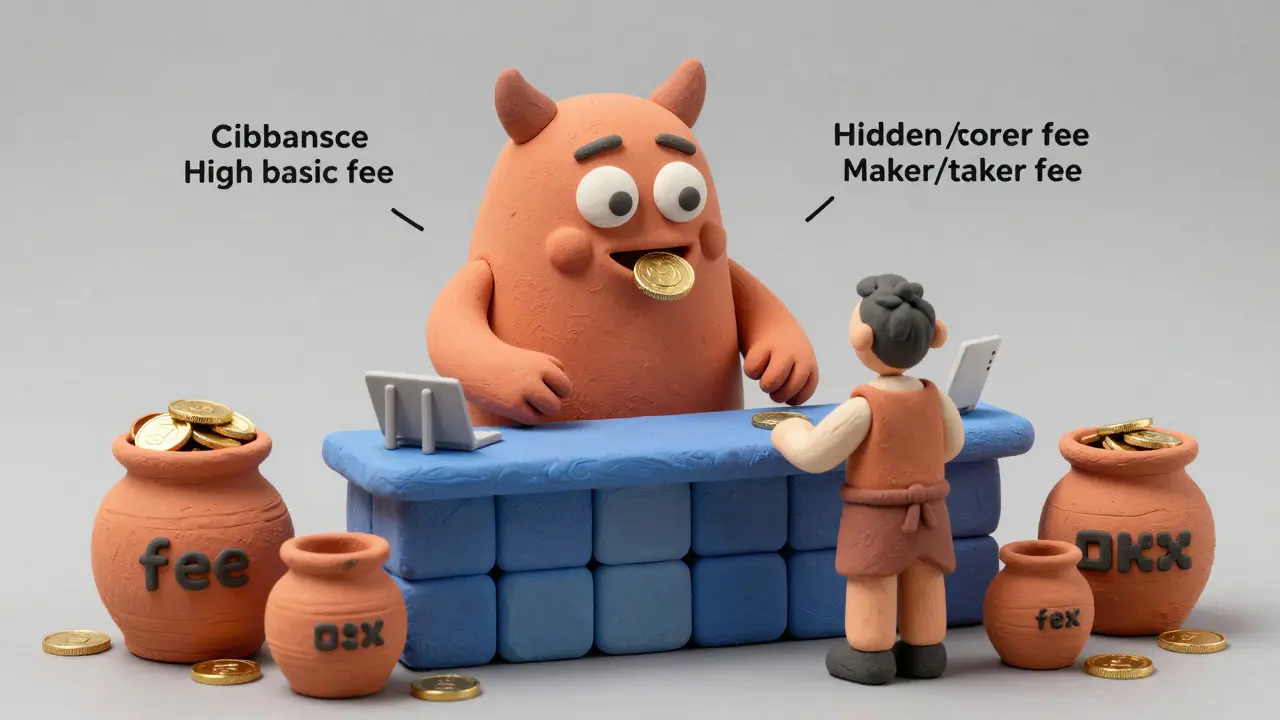
Fees eat into profits faster than you think. Many users focus on the headline "maker/taker" rates but ignore spread costs or withdrawal fees. Let’s break down the real cost of trading on the leading platforms.
| Exchange | Maker Fee | Taker Fee | Hidden Costs/Notes |
|---|---|---|---|
| OKX | 0.08% | 0.10% | Competitive spreads; frequent promos reduce effective fees further. |
| Kraken | 0.00% - 0.26% | 0.00% - 0.40% | Fees drop significantly with higher volume tiers; excellent for active traders. |
| Coinbase | 0.00% - 0.60% | 0.00% - 3.99% | Simple interface carries high fees (up to 3.99%); Advanced Trade is much cheaper. |
| Gemini | 0.50% - 1.00% | 0.50% - 1.00% | Premium pricing for NYDFS regulation; limited asset selection. |
| Robinhood | 0.00% | 0.00% | Zero trading fees, but wider spreads and payment-for-order-flow model may impact execution price. |
Notice the disparity with Coinbase. If you use their basic app, you might pay nearly 4% on small trades. That’s huge. Switching to their "Advanced Trade" interface drops this dramatically, often below 0.6%. This illustrates a key point: many exchanges offer a "balanced" fee structure only if you know how to navigate their tiered systems. Beginners often get stuck paying premium prices for convenience.
Asset Selection and Liquidity
How many coins can you actually trade? And more importantly, can you sell them without moving the market price against yourself? This is where liquidity matters. OKX leads the pack with over 675 trading pairs, giving you access to obscure altcoins and established giants alike. High liquidity means tighter spreads and less slippage. When you place a large order on OKX, the market absorbs it efficiently.
Gemini, conversely, supports only about 73 cryptocurrencies. This curated list reduces risk-you won’t find scammy memecoins here-but it limits growth potential for diversifiers. If you’re looking for exposure to emerging sectors like AI tokens or RWA (Real World Assets) protocols, Gemini might leave you wanting. Kraken sits in the middle with 350+ assets, striking a solid balance between variety and vetted quality.
User Experience and Support Quality
Technical specs don’t matter if you can’t figure out how to deposit money. User experience (UX) varies wildly. Coinbase wins on simplicity. Their interface is intuitive enough for someone who has never bought Bitcoin before. Account setup takes about 1.5 hours on average, according to recent usability tests. However, this ease comes at a cost: customer support. Trustpilot ratings hover around 2.8/5 stars, with complaints about slow email responses averaging 18 hours.
Kraken offers a steeper learning curve but superior support. Their live chat responds in under a minute on average. For advanced traders, this reliability is worth the initial confusion. Decentralized exchanges (DEXs) like Uniswap V3 offer another dimension. They provide censorship resistance and self-custody, but the UX is tough. A recent survey showed 68% of new DEX users struggled with wallet connections and gas fee calculations. Unless you are comfortable managing private keys, stick to centralized exchanges for a smoother start.

Regulatory Compliance and Geographic Access
Your location dictates your options. In the US, the landscape is fragmented. Coinbase and Kraken are fully licensed in most states. OKX entered the US market in April 2025 after settling with the DOJ, but some states still restrict access. Bybit remains unavailable in the US despite its massive global volume.
For European users, the MiCA regulation changed everything. Exchanges with MiCA licenses, like Bybit (licensed in Austria), enjoy passporting rights across the EEA. This regulatory clarity creates a "compliance premium," where users flock to licensed platforms for peace of mind. If you live outside major jurisdictions, you might face restrictions or higher verification hurdles. Always check your local laws before signing up.
Which Platform Fits Your Profile?
There is no single "best" exchange. It depends on your goals. Here is a quick guide:
- The Beginner: Choose Coinbase. Yes, the fees are higher on the basic plan, but the frictionless experience prevents costly mistakes. Use the Advanced Trade mode once you understand limit orders.
- The Active Trader: Go with OKX or Kraken. Both offer deep liquidity, robust API access, and competitive maker/taker fees. Kraken is better if you value proven security history; OKX is better for asset variety and futures trading.
- The Security Paranoiac: Pick Gemini or Kraken. Gemini’s NYDFS regulation is gold-standard in the US. Kraken’s decade-long track record speaks for itself.
- The Cost-Conscious Minimalist: Try Robinhood for zero-fee spot trading, but be aware of wider spreads. Or use MEXC for near-zero fees if you are experienced enough to handle lower regulatory oversight.
The Future of Balanced Trading
The market is consolidating. Smaller exchanges are struggling with rising compliance costs, which now consume 18-25% of revenue for top platforms. Analysts predict only 8-10 major exchanges will survive the next downturn. This means choosing a platform with strong financial health is crucial. Look for exchanges with substantial capital reserves and clear business models beyond just trading fees.
Decentralized exchanges are growing, potentially capturing 20-35% of spot volume by 2027. But for now, centralized exchanges still dominate due to superior liquidity and fiat on-ramps. The ideal strategy for many is hybrid: keep long-term holdings in cold storage or on a highly regulated CEX like Kraken, and use lower-fee platforms like OKX for active trading.
Is Coinbase really too expensive for beginners?
It depends on how you use it. The default "Buy/Sell" interface charges up to 3.99%, which is high. However, switching to the "Advanced Trade" tab lowers fees to under 0.6%. For small, occasional purchases, the convenience may outweigh the cost. For regular trading, always use Advanced Trade.
Which exchange has the best security track record?
Kraken is widely regarded as having the strongest security history, operating since 2011 without a major fund-loss hack. Coinbase also has a strong reputation due to its public listing status and insurance coverage. Both are considered safer bets than newer or offshore platforms.
Can I use Bybit in the United States?
No, Bybit does not currently serve US customers due to regulatory restrictions. While they obtained a MiCA license in Europe, they have not secured full licensing in all US states. US traders typically opt for Coinbase, Kraken, or OKX instead.
Are decentralized exchanges safer than centralized ones?
They are different types of safe. DEXs eliminate counterparty risk (the exchange losing your money) because you hold your own keys. However, they introduce smart contract risk and user error risk (losing your seed phrase). Centralized exchanges have custodial risk but offer better protection against user mistakes like sending to wrong addresses.
What is the biggest hidden fee on crypto exchanges?
The spread. This is the difference between the buy and sell price. Even on "zero fee" exchanges like Robinhood, the spread can be 0.5% to 1.5%. On high-volume exchanges like OKX or Kraken, spreads are often negligible (under 0.1%). Always compare the actual execution price, not just the stated fee.