Bridge Fees and Transaction Times: What You Really Pay and How Long It Takes
 Jan, 26 2026
When you move crypto from Ethereum to Binance Smart Chain, or from Polygon to Solana, you’re not just clicking a button. You’re paying a fee - and waiting. And that fee? It’s not always obvious. The time it takes? It can range from seconds to half an hour. If you don’t know what you’re getting into, you could lose money before the transfer even finishes.
What Are Bridge Fees, Really?
A bridge fee is the cost to move your crypto from one blockchain to another. It’s not a tax. It’s not a platform profit. It’s the price of getting your assets across chains. Most bridges charge between 0.05% and 0.3% of the amount you’re sending. That sounds small - until you’re moving $10,000 and paying $30 just to get it to another network.
Some bridges, like Wormhole, charge almost nothing - often under $0.01 per transfer. Others, like Stargate, use a flat fee of around 0.06%. Then there are dynamic models like Synapse and Symbiosis, which adjust fees based on liquidity. On quiet days, you might pay 80% less than on a busy one. That’s not magic - it’s smart routing.
Here’s the catch: you usually pay the fee in the same token you’re sending. If you’re moving USDC from Ethereum to Avalanche, you pay the fee in USDC. Some bridges let you pay in their native token (like Symbiosis’ SYMB) for a discount, but that means you need to hold that token - and trust its value won’t crash before your transfer finishes.
Why Do Fees Vary So Much?
Not all bridges are built the same. There are two main types: centralized and decentralized.
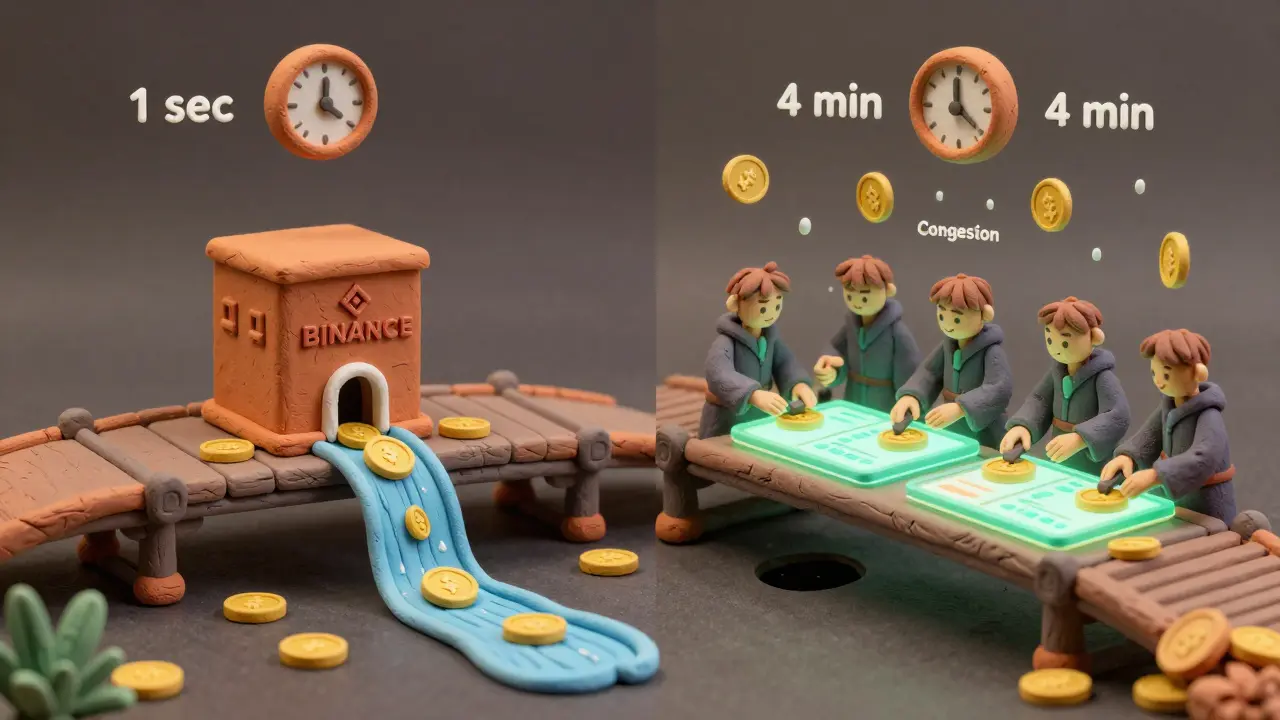
Centralized bridges, like Binance Bridge, act like middlemen. You send your crypto to Binance’s wallet. They lock it, then mint an equivalent on the other chain. It’s fast. It’s cheap. But you’re trusting Binance not to vanish with your funds. If they go down, so does your access.
Decentralized bridges use smart contracts. No company controls them. Your funds go into a locked contract on the source chain. Validators on the destination chain verify the lock, then release new tokens. It’s trustless - but it costs more. Why? Because every step needs multiple signatures, verification, and gas on both chains. More steps = more gas = higher fees.
Network congestion also plays a huge role. On Ethereum, when DeFi traders are swapping, NFTs are dropping, or arbitrage bots are active, gas prices spike. A bridge that normally costs $0.50 can jump to $15 in minutes. That’s why some users wait until late at night - when Ethereum is quiet - to move funds.
How Long Do Cross-Chain Transfers Take?
Time isn’t just about speed - it’s about finality. Some bridges say “instant,” but what does that really mean?
Stargate uses a light-node model. It doesn’t wait for full Ethereum confirmation. It checks block headers and validates quickly. Result? Transfers often finish in under a second. But this relies on trusted data feeds - not full decentralization.
Symbiosis and Synapse are slower. They take 2-5 minutes. Why? They’re optimizing for cost and slippage. They wait for the best price, check liquidity across multiple pools, and route through the cheapest path. If you’re sending $500,000, that delay saves you thousands in price impact.
On the blockchain side, things get messy. Ethereum confirms transactions in 5-20 seconds, but full finality - meaning no reorgs, no rollback - takes about 13 minutes. Binance Smart Chain? 3-second blocks. You get 60 confirmations in about 5 minutes. That’s why many users move from Ethereum to BSC first, then bridge out - it’s cheaper and faster.
Small transfers on exchanges like Binance can take 25 minutes or more. Why? Because exchanges batch transactions to save on fees. Your $10 USDT isn’t moving alone. It’s in a pile with hundreds of others. You’re waiting for the batch to clear.
Unidirectional vs. Bidirectional Bridges
Not all bridges let you go both ways. Some are one-way only.
Unidirectional bridges let you send from Chain A to Chain B - but not back. You lock your ETH on Ethereum, get wrapped ETH on Solana. But if you want to get your original ETH back? You can’t. You have to sell your wrapped token and buy ETH again. That’s two trades, two fees, and two chances to lose money to slippage.
Bidirectional bridges - like Stargate, Symbiosis, and Wormhole - let you move back and forth. You lock ETH on Ethereum, get wETH on Polygon. Later, you burn the wETH on Polygon, and your original ETH is unlocked on Ethereum. It’s seamless. But it’s also more complex. More contracts. More validators. More cost.
The technical setup involves four key contracts: Locking (on source), Release (on destination), Minting (on destination), and Burning (on source). When you send ETH to BSC, your ETH gets locked in a vault on Ethereum. A validator confirms it. Then, a minting contract on BSC creates an equivalent amount of wrapped ETH. To reverse it, you burn the wrapped ETH, and the lock is released.
How to Avoid Getting Ripped Off
Here’s how to save money and time:
- Check fees before you click. Most bridges show an estimated cost. Don’t skip this. If it’s $12 to move $500, walk away.
- Use bridges with slippage control. Synapse and Symbiosis show you exactly what you’ll receive after fees and price impact. Others don’t. You could think you’re sending $1,000 and end up with $850.
- Avoid peak hours on Ethereum. Use tools like Ethereum Gas Tracker to see when fees are low. Weekends after midnight EST are often quietest.
- Don’t use unidirectional bridges unless you’re sure. If you can’t get your crypto back, you’re stuck.
- Use aggregators. Platforms like 1inch or Liquality scan multiple bridges and pick the cheapest, fastest route. They’re not perfect, but they’re better than guessing.

What’s Next for Bridge Technology?
Right now, bridges are the weakest link in crypto’s interoperability story. They’ve been hacked for over $2 billion since 2020. That’s not because the code is bad - it’s because the security model is stretched too thin. Validators are underpaid. Liquidity is uneven. One chain goes down, and the whole bridge freezes.
But change is coming. New bridges are experimenting with single-slot finality - meaning they’ll confirm transactions as fast as the underlying chain, without waiting for extra layers. Ethereum’s shift to rollups and data availability layers could eventually make bridges obsolete. Why bridge when you can just use Layer 2s that talk to each other natively?
For now, though, bridges are here to stay. And the ones that win won’t be the flashiest. They’ll be the ones that keep fees low, speed high, and your money safe.
Bottom Line: Know Before You Move
Bridge fees and transaction times aren’t just technical details. They’re your money on the line. A 0.1% fee on $10,000 is $10. But if you send it during a gas spike on Ethereum, that $10 becomes $80. A 30-second transfer becomes a 20-minute wait. And if you use a one-way bridge by accident? You might never get your crypto back.
Check the fee. Check the time. Check the direction. Use trusted bridges. Don’t rush. And never assume it’s free or instant - because it’s rarely either.
Are bridge fees always paid in the same token I’m transferring?
Most of the time, yes. If you’re moving USDC from Ethereum to Polygon, you pay the bridge fee in USDC. Some bridges, like Symbiosis, let you pay in their native token (SYMB) for a discount, but that requires you to hold that token and accept its price risk.
Why does my transfer take longer than the bridge claims?
Bridges often quote “average” times under ideal conditions. If Ethereum is congested, your transaction might sit in the mempool for minutes before it even gets picked up. Also, some bridges batch transactions or wait for liquidity to align, adding delays. Always check real-time status in your wallet.
Can I cancel a bridge transaction if it’s taking too long?
No. Once you send the transaction, it’s on the blockchain. You can’t undo it. You can only wait. If the fee was too low, it might take hours. If it’s stuck, you can try speeding it up using a wallet’s “replace transaction” feature - but only if the network supports it (like Ethereum). Most bridges don’t offer this.
Is a centralized bridge safer than a decentralized one?
It depends. Centralized bridges like Binance Bridge are faster and cheaper, but you’re trusting one company. If they get hacked or shut down, your funds are at risk. Decentralized bridges don’t have a single point of failure, but they’ve been hacked more often because smart contracts can have bugs. Neither is perfectly safe - just different risks.
What’s the cheapest bridge for moving ETH to BSC?
Binance Bridge is usually the cheapest - often under $0.10 for ETH to BSC. But it’s centralized. For decentralized options, Stargate and Wormhole are low-cost and reliable. Always compare fees on a tool like DefiLlama’s bridge tracker before choosing.
Do bridge fees go to the blockchain or the bridge company?
The gas fees (the part paid to miners/validators) go to the blockchain network. The bridge’s service fee - if any - goes to the bridge operator. Most bridges don’t charge a separate service fee anymore; they bake it into the gas cost or take a small percentage from liquidity pools. Always read the fee breakdown before confirming.
Will Pimblett
January 27, 2026 AT 12:40So let me get this straight - I pay $80 to move $10k because Ethereum’s gas prices are on a caffeine bender, and the bridge says it’s ‘instant’? LOL. I’ve seen toddlers move faster than my USDC on a busy Saturday night. And don’t even get me started on ‘unidirectional’ bridges - that’s not finance, that’s a trapdoor with a smiley face.
Christopher Michael
January 27, 2026 AT 20:36Let me clarify this for everyone - bridge fees are not just 'costs,' they're transactional friction in a decentralized ecosystem that's supposed to be frictionless. The gas fee? That goes to miners - yes, still miners - on Ethereum, even after The Merge. The bridge's slice? That's often a liquidity provider incentive, or a small cut baked into the AMM slippage. And no - you can't cancel it. Once it's signed, it's on-chain. Period. You can, however, use EIP-1559's replace-by-fee if your wallet supports it - but most non-technical users don't even know that exists. Check your wallet settings before you send. Always.
Parth Makwana
January 28, 2026 AT 19:44It is imperative to underscore that the architectural asymmetry between centralized and decentralized bridge models engenders fundamentally divergent risk profiles. Centralized entities, while exhibiting superior throughput and lower latency, introduce systemic counterparty risk - a non-trivial concern in an environment where regulatory arbitrage is the norm. Decentralized protocols, conversely, leverage multi-signature validation and cross-chain consensus mechanisms - thereby enhancing trust minimization, albeit at the expense of capital efficiency and finality speed. The optimal strategy, therefore, necessitates a hybrid approach: utilize centralized bridges for micro-transactions and decentralized for macro-capital movements - with due diligence on liquidity depth and validator set composition.
Elle M
January 30, 2026 AT 00:20Oh, so now we’re pretending Binance Bridge is ‘centralized’ like it’s a bad thing? Wow. You people act like trusting a company with billions in assets and a 10-year track record is somehow riskier than some anonymous validator set on a chain that got hacked for $200M last year. Let me guess - you also think your ‘decentralized’ bridge is safer because it’s run by guys in hoodies who don’t even have LinkedIn profiles. Newsflash: the only thing more dangerous than a centralized bridge is a ‘trustless’ one with 3 validators and a Discord admin who sleeps through alerts.
Rico Romano
January 30, 2026 AT 16:00It’s amusing how the average crypto user conflates convenience with security. You don’t need to ‘check fees’ - you need to understand the underlying economic incentives. The bridges that charge nothing? They’re either rug-pulling or subsidizing with token emissions. The ones with dynamic fees? They’re the only ones with sane liquidity models. And as for ‘unidirectional’ bridges - anyone who uses them without reading the whitepaper deserves to lose their money. This isn’t Web2. It’s not even Web3. It’s crypto tribalism dressed up as finance. If you don’t understand the four-contract architecture of bidirectional bridges, you shouldn’t be touching any bridge at all. Just use Layer 2s. Or better yet - don’t move anything at all.