Canadian Crypto Tax Guide 2026: CRA Rules, Capital Gains & Reporting
 May, 8 2026
You hold Bitcoin. You traded Ethereum last month. Maybe you even received some tokens from an airdrop or staking rewards. If you are in Canada, the Canada Revenue Agency (CRA) is watching those wallets closely. The days of ignoring digital assets on your tax return are over. In fact, with crypto-related audits rising by 37% between 2023 and 2024, the CRA is actively hunting down unreported transactions. But don’t panic yet. Understanding how the system works can save you thousands-and keep you out of trouble.
This guide cuts through the noise. We will break down exactly what the CRA considers taxable, how to calculate your liabilities, and which common mistakes could trigger a penalty. Whether you are a casual holder or an active trader, these rules apply to you.
The Core Rule: Crypto Is Property, Not Currency
The first thing you need to grasp is that the CRA does not view cryptocurrency as money. It doesn't matter if you use it to buy coffee or pay for services. In the eyes of the taxman, Bitcoin, Ethereum, and other digital assets are commodities. This classification, established in their initial 2013 guidance and reinforced in recent updates, changes everything about how you report income.
Because crypto is treated as property, every time you dispose of it-by selling it for CAD, trading it for another crypto, or spending it-you trigger a taxable event. This means you must calculate the difference between what you paid for it (cost basis) and what you got for it (proceeds). That difference is either a gain or a loss, and it falls into one of two buckets: capital gains or business income.
Capital Gains vs. Business Income: Which Applies to You?
This distinction is where most taxpayers stumble, and it significantly impacts your final bill. The CRA uses a "facts and circumstances" test to determine your status. There is no bright line rule, but here is how it generally breaks down.
Capital Gains (The Investor)
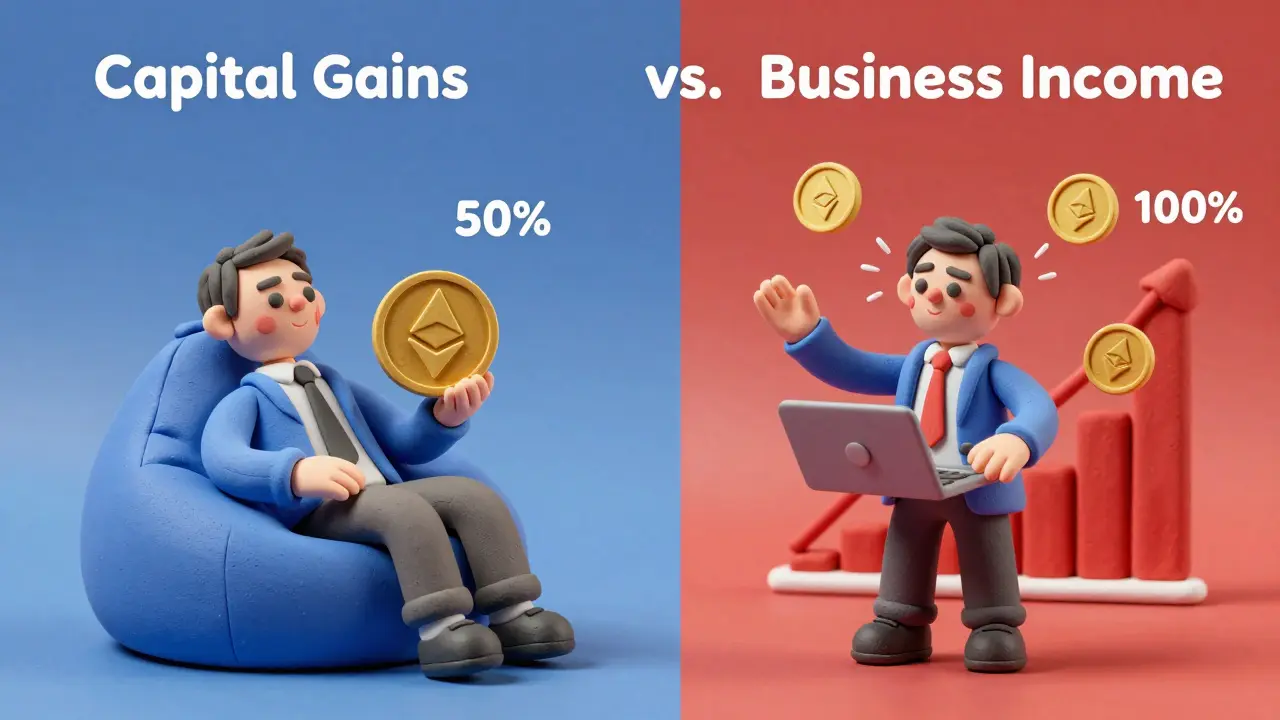
If you buy and hold crypto with the intention of long-term appreciation, your profits are likely considered capital gains. This is the more favorable treatment. Only 50% of your net capital gain is included in your taxable income. For example, if you made $10,000 in profit, only $5,000 is added to your income for tax calculation purposes.
Business Income (The Trader)
If you trade frequently, use leverage, or engage in activities that look like a business operation, the CRA may classify your profits as business income. This means 100% of your gains are taxable at your marginal rate. Factors that push you toward this classification include:
- High frequency of trades (day trading or swing trading).
- Maintaining detailed records akin to a business ledger.
- Using advertising or marketing to promote your trading strategy.
- Having a primary goal of short-term profit rather than long-term investment.
Tax lawyer Kim Kirton warns that the CRA’s aggressive stance on frequent trading can subject many active traders to significantly higher rates than they anticipate. If you are unsure, lean conservative. Treating gains as business income when they might be capital gains is safer than the reverse, though you should consult a professional for complex cases.
Calculating Your Tax Liability: Federal and Provincial Rates
Once you have determined whether your income is capital gains or business income, you need to apply the correct tax rates. Canada uses a progressive tax system, meaning your rate depends on your total income. For the 2025 tax year, the federal brackets are as follows:
| Income Range (CAD) | Federal Tax Rate |
|---|---|
| $0 - $55,867 | 15% |
| $55,868 - $111,733 | 20.5% |
| $111,734 - $173,205 | 26% |
| $173,206 - $246,752 | 29% |
| Over $246,752 | 33% |
To your federal tax, you must add provincial taxes. These vary wildly. Ontario, for instance, adds rates starting at 5.05% up to 13.16%, while Quebec ranges from 15% to 25.75%. A taxpayer in British Columbia earning $100,000 in capital gains would pay approximately $20,300 in combined taxes after applying the 50% inclusion rate. That same amount classified as business income would result in roughly $40,600 in taxes. The difference is stark.
What About Mining, Staking, and Airdrops?
Not all crypto income comes from selling assets. If you receive tokens through mining, staking, yield farming, or airdrops, the CRA treats the fair market value of those tokens at the time of receipt as ordinary income. This is 100% taxable.
For miners, this is reported on Form T2125 (Statement of Business or Professional Activities). You must deduct eligible expenses such as electricity, hardware depreciation, and internet costs before calculating your taxable income. For stakers and airdrop recipients, the value is added to your income on the day you gain control of the assets. Later, if you sell those tokens, any increase in value since receipt is treated as a capital gain (or business income, depending on your overall activity).
Tax-Free Transactions: What Doesn't Trigger a Bill
Good news: not every click is a taxable event. The following actions do not trigger immediate tax liability:
- Buying crypto with fiat: Purchasing Bitcoin with CAD is not a disposal; it is an acquisition.
- Holding (HODLing): Simply owning crypto without selling or trading it generates no tax.
- Transferring between personal wallets: Moving funds from Exchange A to your private wallet B is not a disposition.
- Receiving gifts: If someone gives you crypto, it is not taxable income for you. However, the donor may have a deemed disposition.
- Creating a DAO: Forming a Decentralized Autonomous Organization is generally not a taxable event in itself.
However, be careful with gifting. If you give away crypto that has increased in value, the CRA may deem it a disposition, triggering capital gains tax for the giver. Always document the cost basis and fair market value at the time of the gift.

Tax Loss Harvesting and the Superficial Loss Rule
You can reduce your tax bill by harvesting losses. If you sell crypto at a loss, you can use that loss to offset capital gains. However, Canada has a strict "superficial loss" rule designed to prevent artificial loss creation.
If you sell crypto at a loss and buy back the same or identical property within 30 days before or after the sale, the loss is disallowed. It is added to the adjusted cost base of the new purchase instead. To successfully harvest losses, you must wait at least 31 days before repurchasing the same asset, or buy a different but similar asset (though the CRA scrutinizes this closely).
Remember, only 50% of capital losses are deductible against capital gains. A $10,000 capital loss offsets $5,000 of taxable capital gains. Unused losses can be carried forward indefinitely to offset future gains.
Reporting Requirements and Penalties
Accuracy is non-negotiable. Capital gains and losses go on Schedule 3 of your T1 General Income Tax Return. Business income from mining or trading goes on Form T2125. Failure to report can lead to severe consequences. The standard penalty for late filing is 5% of the tax owing plus 1% per month, up to 12 months. If the CRA determines your failure was due to gross negligence, the penalty jumps to 10% of the tax owing.
The CRA is getting smarter. They now receive data from major exchanges, and cross-border reporting agreements mean international platforms are also sharing information. With 73% of audited crypto returns containing material errors in 2025, mostly due to incorrect cost basis calculations, double-checking your numbers is essential.
Tools and Software to Simplify Compliance
Manual tracking across multiple exchanges is prone to error. Most investors turn to specialized software. Platforms like Koinly and CoinLedger offer CRA-specific reporting templates, helping to automate the calculation of gains, losses, and cost bases. User reviews suggest Koinly averages 4.6 stars for its accuracy with CRA requirements, while TurboTax Canada receives mixed feedback on its crypto features. Given the complexity, investing in reliable software or hiring a tax professional familiar with digital assets is often worth the cost.
Do I pay tax on crypto if I haven't sold it?
No. Simply holding cryptocurrency (HODLing) does not trigger a tax event. You only pay tax when you dispose of the asset, such as by selling it for fiat, trading it for another crypto, or spending it on goods and services.
How does the CRA know if I traded crypto?
Major Canadian exchanges like Wealthsimple and Coinsquare provide CRA-compliant tax statements. Additionally, international reporting agreements and increased data sharing mean the CRA can access transaction data from global platforms. Audits for crypto-related issues have risen significantly in recent years.
Is staking income taxed as capital gains or business income?
Staking rewards are taxed as ordinary income at the time of receipt, based on the fair market value of the tokens. This is 100% taxable. When you later sell those staked tokens, any additional gain is treated as a capital gain or business income, depending on your overall trading activity.
Can I deduct my crypto losses from my salary?
Capital losses cannot be deducted from employment income directly. They can only offset capital gains. If you have excess capital losses, they can be carried forward to future years. However, if your crypto activity is deemed business income, losses can potentially offset other business income, but not typically employment income unless specific conditions are met.
What happens if I forget to report crypto on my tax return?
You risk penalties and interest. The CRA can impose a penalty of 5% of the tax owing plus 1% per month for late filing. If the omission is deemed negligent, the penalty increases to 10%. The CRA also has the authority to reassess your taxes for previous years, potentially leading to significant back-taxes and legal fees.