Crypto Exchange Licensing in Turkey: What You Need to Know in 2026
 Feb, 25 2026
Before 2025, operating a crypto exchange in Turkey was a gray area. Many platforms ran without oversight, users traded freely, and regulators stayed quiet. That changed. In March 2025, Turkey’s Capital Markets Board (CMB) dropped two major communiqués that turned the crypto market upside down. Now, if you want to run a crypto exchange in Turkey, you don’t just need a website-you need a license, millions in capital, and a compliance team that works around the clock. And if you don’t? You’re blocked. Period.
Why Turkey Changed the Rules
Turkey’s economy has been under pressure for years. Inflation hit over 80% in 2023. People turned to Bitcoin and Ethereum not as investments, but as savings. Crypto became a way to protect money from the lira’s freefall. But the Central Bank of Turkey (TCMB) has never liked that. Since 2021, it’s banned using crypto for payments. That didn’t stop people from buying it. It just pushed trading underground. By 2024, unlicensed exchanges were handling billions in transactions. Some were clean. Others? Suspicious. Money flowed out of Turkey. Authorities feared capital flight. So in early 2025, they acted. The goal wasn’t to kill crypto-it was to control it. The new licensing system was designed to bring exchanges into the light, track every transaction, and stop illegal flows.Who Can Get a License? The Hard Rules
You can’t just apply. You need to be a joint-stock company registered under Turkish corporate law with shares issued in cash and held in the company’s name. Foreign companies can’t operate directly. They must set up a Turkish legal entity. No exceptions. The capital requirements are steep. For a standard crypto exchange, you need at least 150 million Turkish Lira (about $4.1 million USD) in paid-in capital. That’s not a deposit-it’s money you lock in. You can’t touch it. If you’re offering custodial services-holding users’ crypto for them-you need 500 million TL (roughly $13.7 million USD). That’s higher than what’s required in most emerging markets. And it’s not just about money. Founders, CEOs, and compliance officers must pass a fit-and-proper test a background check by the CMB that verifies clean criminal records, financial integrity, and no ties to sanctioned entities. If you’ve ever had a bank account frozen, even overseas, that could disqualify you.Compliance: It’s Not Optional
Once you’re licensed, the real work begins. Every transaction over 15,000 Turkish Lira (around $425 USD) requires full KYC. That means government-issued ID, proof of address, and a recorded interview. No anonymous trades. No wallet-to-wallet transfers without identity. You also need:- A dedicated AML monitoring system real-time software that flags suspicious activity and reports it to MASAK
- Transaction logs that include all canceled and unexecuted trades
- A cybersecurity framework certified by a Turkish-approved auditor
- Integration with Turkish banking systems for fiat deposits and withdrawals

The Hidden Costs
Most people think the license fee is the big cost. It’s not. There’s no direct application fee. But you pay 2% of your total revenue every year-1% to the CMB and 1% to TUBITAK the Scientific and Technological Research Council of Türkiye, which oversees tech compliance infrastructure. That’s on top of salaries for compliance officers, cybersecurity teams, legal counsel, and software licenses. A mid-sized exchange with $10 million in annual revenue pays $200,000 just in fees. Add $500,000 in staff, $300,000 in tech, and $1 million in capital. You’re looking at over $2 million in annual costs just to stay legal. Many small operators couldn’t make it.What Happened to the Unlicensed Exchanges?
In July 2025, Turkey moved fast. The CMB and MASAK blocked 46 unlicensed crypto platforms. Some were tiny. Others were big-like PancakeSwap a decentralized exchange that had become popular among Turkish users for low-fee trades. Users lost access overnight. No warning. No grace period. The most shocking moment came on July 28, 2025, when the founder of ICRYPEX a once-popular Turkish crypto exchange that processed over $1 billion in trades was detained. Authorities claimed the platform was used to fund political opposition. The case is still ongoing. It sent a message: compliance isn’t just about rules. It’s about politics.How Long Does It Take to Get Licensed?
If you’re serious, plan for 6 to 12 months. You need to:- Form a Turkish joint-stock company
- Secure the minimum capital and deposit it in a Turkish bank
- Build your KYC, AML, and cybersecurity systems
- Hire a Turkish legal team to prepare your application
- Submit documents to the CMB and wait for reviews
- Pass on-site inspections

Who’s Winning in Turkey Now?
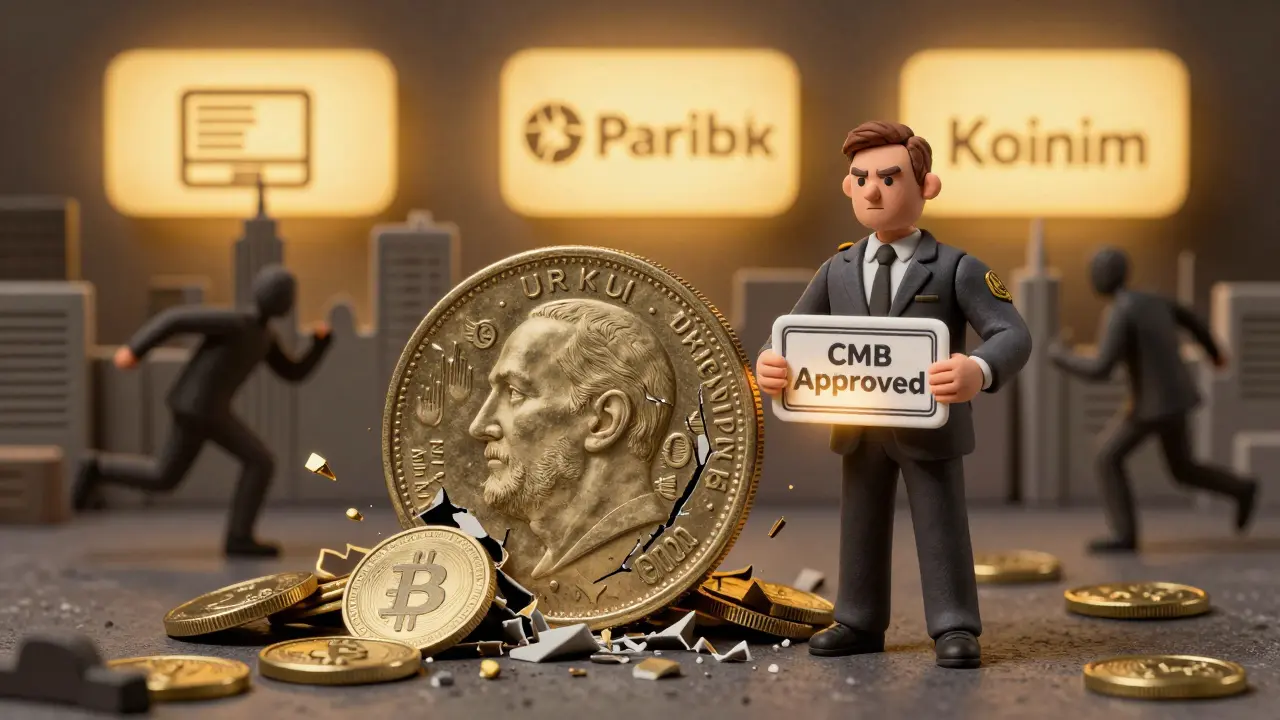
Only a handful of exchanges got licensed by the end of 2025. The big ones? Paribu Turkey’s oldest licensed exchange, now fully compliant and backed by local investors, BtcTurk a long-standing platform that restructured completely to meet CMB standards, and Koinim a newer entrant that raised capital specifically to meet licensing requirements. They’ve all seen a drop in volume-users are still adjusting. But they’ve also gained trust. Banks now work with them. Payment processors accept their fiat on-ramps. Customers feel safer.What’s Next?
The rules aren’t done changing. In late 2025, the CMB started reviewing whether to allow crypto-to-fiat gateways with foreign banks. Right now, you can only use Turkish banks. That limits liquidity. There’s also talk about lowering the capital requirement for smaller exchanges that only serve retail users. But no changes have been made yet. The political climate matters. If inflation spikes again, or if the lira weakens further, Turkey may relax rules to keep money in the system. Or it could double down and ban even more services.Bottom Line
Crypto exchange licensing in Turkey isn’t about innovation. It’s about control. The government wants to know who’s trading, how much, and where the money goes. It’s not friendly to startups. It’s not easy for foreigners. But if you have the capital, the patience, and the legal team, it’s possible. The market is smaller now. But it’s cleaner. And for users who care about safety over freedom, that’s worth something.Can a foreign company run a crypto exchange in Turkey without a local entity?
No. Foreign companies cannot operate directly. They must establish a Turkish joint-stock company with local registration, capital, and management. The CMB requires full legal presence within Turkey.
Is crypto trading banned in Turkey?
No, trading crypto is not banned. You can buy, sell, and hold Bitcoin and other digital assets. But you cannot use crypto to pay for goods or services. That’s prohibited by the Central Bank of Turkey since 2021.
What happens if I trade on an unlicensed exchange in Turkey?
You won’t be arrested. But the exchange you’re using will be blocked. Your funds may become inaccessible. If MASAK flags your account for suspicious activity, your bank and crypto holdings could be frozen without notice.
How much does it cost to get a crypto license in Turkey?
The minimum paid-in capital is 150 million TL ($4.1M) for exchanges and 500 million TL ($13.7M) for custodial services. On top of that, you pay 2% of annual revenue to the CMB and TUBITAK. Legal, compliance, and tech setup costs typically add another $500,000 to $1 million.
Are Turkish crypto exchanges regulated like banks?
Not exactly, but they’re close. They don’t offer loans or FDIC-style insurance. But they must comply with AML/KYC rules as strict as banks, report transactions in real time, and are subject to account freezes by MASAK. Their oversight is more intense than most global jurisdictions.
Ifeanyi Uche
February 26, 2026 AT 21:58Danny Kim
February 28, 2026 AT 07:38Cathy Sunshine
March 1, 2026 AT 14:20Shannon Black
March 3, 2026 AT 05:13Vishakha Singh
March 5, 2026 AT 03:07Don B.
March 5, 2026 AT 18:52Arya Dev
March 5, 2026 AT 18:55Leslie Cox
March 7, 2026 AT 00:08