Cryptocurrency Taxation in Taiwan: What You Need to Know in 2025
 Nov, 16 2025
Taiwan Crypto Tax Calculator
Calculate Your Tax Liability
Based on Taiwan's current tax rules for cryptocurrency trading
When you buy Bitcoin on BitoPro or sell Ethereum on MaiCoin, you might think you're just trading digital assets. But in Taiwan, every trade could trigger a tax bill. The government doesn't treat cryptocurrency like cash, but it also doesn't ignore it. Right now, your crypto gains are taxed under old rules meant for traditional business and income - and that’s causing confusion for thousands of traders.
How Taiwan Classifies Cryptocurrency
Taiwan doesn’t call cryptocurrency money. The Financial Supervisory Commission (FSC) has labeled it a "virtual commodity" since 2014. That classification matters because it means no one can use Bitcoin to pay for coffee legally, but it also means trading it falls under existing tax laws. The Ministry of Finance (MOF) hasn’t created new crypto-specific tax codes. Instead, they’re stretching old ones to fit.
This creates a gray zone. If you’re buying and selling crypto like a business, you’re subject to business tax. If you’re holding and selling for profit, you’re subject to income tax. But there’s no clear line between "hobby trader" and "professional trader." And if you don’t keep records of your purchase price? The tax office has no way to calculate your gain - and neither do you.
Business Tax (VAT): 5% on Sales
Taiwan applies a 5% value-added tax (VAT) to cryptocurrency trading revenue. It’s not about profit - it’s about sales. If you sell crypto for NT$100,000, you owe NT$5,000 in VAT, regardless of whether you made a profit or lost money.
Here’s how it breaks down:
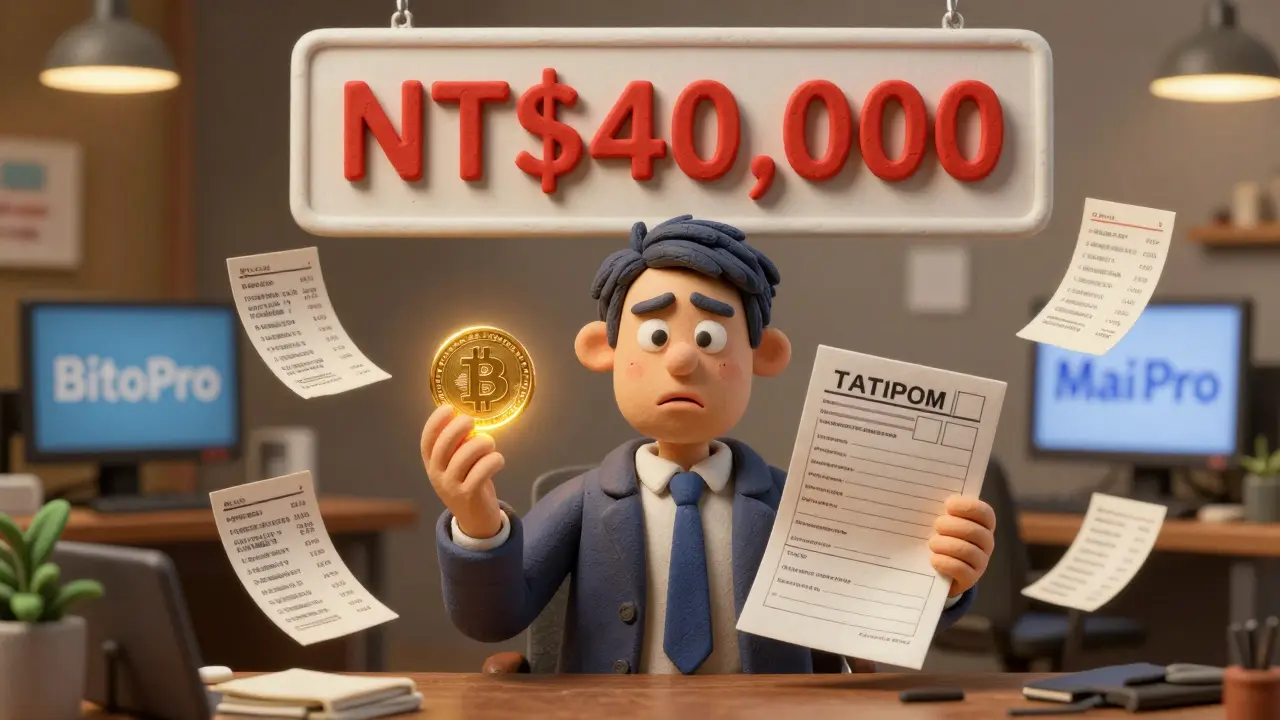
- Taiwanese individuals: If you trade crypto regularly and make over NT$40,000 per month (~US$1,300), you must register as a business and pay 5% VAT on all sales. Below that threshold? You’re exempt.
- Taiwanese businesses: Any company selling crypto on a local platform must charge and remit 5% VAT. No exceptions.
- Foreign sellers: If you’re based overseas but sell to Taiwanese individuals, you must register for VAT if your sales to them exceed NT$40,000/month. If you only sell to Taiwanese businesses, you’re off the hook - because the buyer pays the tax.
Many traders assume they’re safe if they use Binance or another offshore exchange. That’s a myth. If you’re a resident of Taiwan and your monthly sales hit the NT$40,000 threshold, you’re still liable. The tax office doesn’t care where the exchange is located - they care where you live and how much you’re trading.
Income Tax: Up to 20% on Profits
On top of VAT, you might owe income tax. If the tax office decides your crypto activity is a business - or even a serious side hustle - your net profit is added to your annual income and taxed at progressive rates, up to 20% for higher earners.
The real problem? Proving your cost basis.
Let’s say you bought 1 BTC in 2020 for NT$500,000. You sold it in 2024 for NT$3,000,000. Your gain is NT$2,500,000. Simple, right? But what if you lost your transaction history? What if you bought through a peer-to-peer trade with no receipt? What if you swapped one altcoin for another without cashing out?
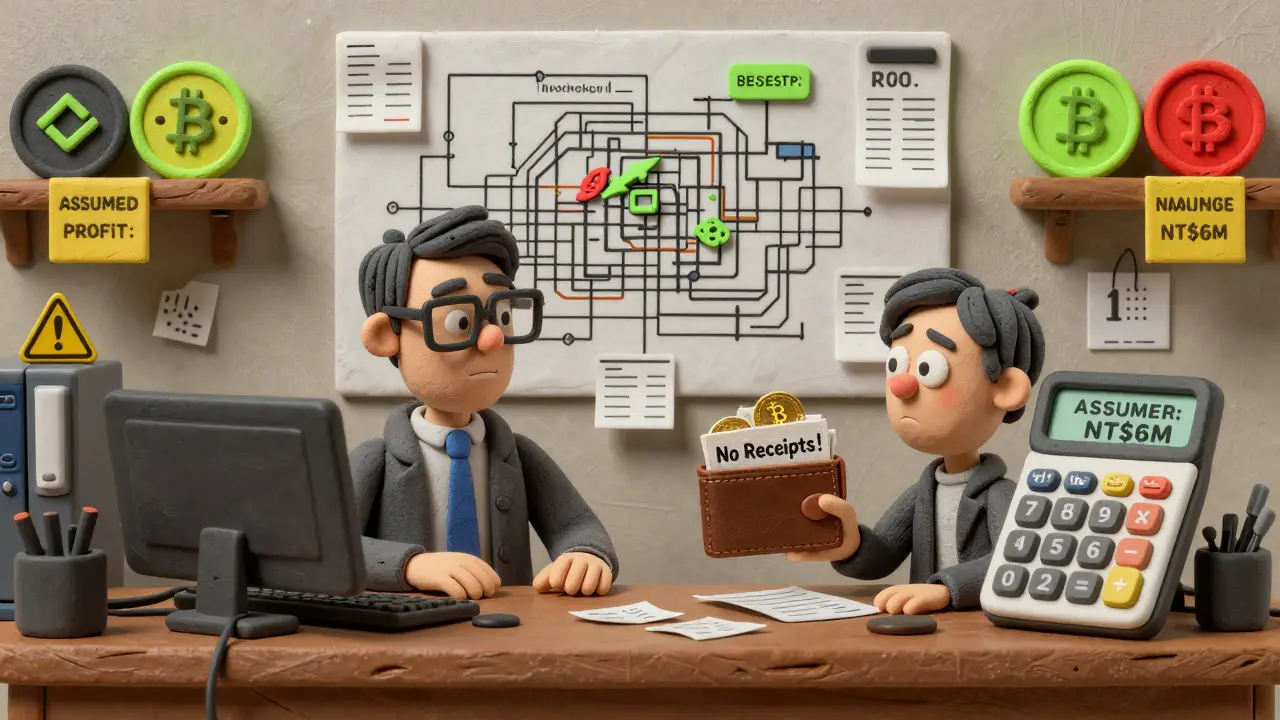
Taiwan’s tax system doesn’t have a built-in way to track crypto purchases. Unlike stock brokers who issue 1099 forms, crypto exchanges in Taiwan don’t automatically report cost basis to the tax authority. That means you’re responsible for keeping every single transaction record - wallet addresses, timestamps, fiat equivalents, and proof of purchase. If you can’t prove what you paid, the tax office can assume your entire sale amount is profit. That’s a nightmare for anyone who’s been trading since 2017.
Who’s Regulating This?
The FSC and MOF are the two main players. The FSC handles licensing and anti-money laundering (AML) rules. The MOF handles the money - meaning taxes.
In 2021, Taiwan adopted FATF guidelines and started requiring all crypto exchanges operating locally to register as Virtual Asset Service Providers (VASPs). Today, 24 platforms are officially approved, including BitoPro, MaiCoin, and Binance’s local operations. These platforms must verify user identities, segregate customer assets, and implement cybersecurity standards.
But here’s the catch: registration doesn’t mean tax compliance. The FSC doesn’t share trading data with the MOF. That’s why the MOF is waiting. They’ve said clearly: once all VASPs fully implement real-name verification systems - which they’re now doing - they’ll introduce specific crypto tax reporting rules.
That change is coming. In November 2024, the MOF publicly announced it was reviewing crypto taxation rules. Why? Because prices surged after the U.S. election, and trading volume in Taiwan jumped 300% in just three months. The old system is crumbling under the weight of activity.
Legal Ambiguities and Court Cases
It’s not just tax law that’s unclear - the whole legal landscape is shifting.
In one high-profile case, a Taiwanese company was prosecuted under the Banking Act for accepting Bitcoin as payment. The court ruled Bitcoin isn’t "funds" under the law, so no banking violation occurred. But in another case, a different court found the same activity illegal. That inconsistency makes it risky for businesses to accept crypto as payment.
Even worse, some crypto-related fraud cases are being prosecuted under old fraud statutes. There’s no specific law for crypto scams. Prosecutors are using whatever fits - and that means you could be charged with fraud for something that’s not even clearly illegal.
Until Taiwan passes a dedicated Virtual Asset Act, the legal status of crypto remains in limbo. And that uncertainty trickles down to tax compliance. If you don’t know if your activity is legal, how can you know if it’s taxable?

What You Should Do Right Now
Don’t wait for the government to send you a letter. If you’re trading crypto in Taiwan, here’s what you need to do today:
- Track every transaction: Use a crypto tax tool like Koinly or CoinTracker. Export all wallet addresses, dates, amounts, and fiat values. Keep screenshots of purchase receipts and trade confirmations.
- Know your threshold: If your monthly sales exceed NT$40,000, register for VAT. File quarterly returns even if you think you’re small-time.
- Report gains: Even if you’re not required to register for VAT, if you made a profit, include it in your annual income tax return. Don’t assume the tax office won’t find out - they will.
- Don’t trust exchanges: Binance, BitoPro, MaiCoin - none of them report your cost basis to the tax office. You are your own accountant.
- Prepare for change: The MOF will soon require VASPs to report user transaction data. When that happens, your records will be cross-checked. If yours are incomplete, you’ll be penalized.
What’s Next for Taiwan’s Crypto Tax Rules?
The writing is on the wall. Taiwan is moving toward full integration of crypto into its financial system. Real-name verification is nearly complete across all major platforms. The FSC is tightening oversight. The MOF is preparing to enforce.
Expect a new tax law by mid-2026. It will likely:
- Require exchanges to report annual transaction summaries to the tax authority
- Define clear rules for calculating cost basis and capital gains
- Introduce a specific crypto tax form
- Clarify whether staking, lending, and DeFi activities are taxable
Until then, you’re operating in a gray zone. But gray zones don’t last forever. The longer you wait to get your records in order, the bigger your risk.
One trader in Taipei lost NT$1.2 million in penalties after the tax office audited his BitoPro account. He had no purchase records. He claimed he "bought crypto years ago" and couldn’t prove it. The tax office assumed his entire sale amount was profit. He paid 20% income tax on NT$6 million - even though his real gain was under NT$1 million.
You don’t need to be a tax expert. But you do need to be organized. Start today. Keep your records. Don’t assume you’re invisible. In Taiwan, the tax office is watching.
Do I have to pay tax if I only trade crypto occasionally?
If your monthly sales from crypto trading are under NT$40,000, you don’t owe VAT. But if you made a profit, you still need to report it as income on your annual tax return. Occasional trading doesn’t mean tax-free - it just means you might not need to register for VAT.
Can I avoid tax by using Binance or another foreign exchange?
No. If you live in Taiwan and trade crypto, the tax office considers you a resident taxpayer. Where the exchange is based doesn’t matter. What matters is your residency and the amount you trade. Using Binance won’t hide your transactions - especially now that Taiwan requires all VASPs to use real-name verification.
What happens if I don’t report my crypto gains?
If the tax office audits you and finds unreported gains, you’ll face penalties of up to 40% of the unpaid tax, plus interest. In cases of intentional evasion, you could be fined or even prosecuted. With new reporting rules coming in 2025-2026, exchanges will be required to share data with the government - so hiding your trades is no longer realistic.
Are crypto-to-crypto trades taxable in Taiwan?
Yes. Swapping Bitcoin for Ethereum is treated as a sale of Bitcoin and a purchase of Ethereum. You must calculate the fair market value of Bitcoin at the time of the swap to determine your gain or loss. Many traders miss this because it doesn’t involve cash, but the tax rule still applies.
Do I pay tax on crypto I received as a gift or from mining?
Yes. If you receive crypto as a gift, you don’t pay tax at receipt - but when you later sell it, you must report the gain based on the original owner’s cost basis. If you mine crypto, the value of the coins when you receive them counts as income. You’ll owe income tax on that amount, and later VAT and income tax when you sell.
Durgesh Mehta
December 5, 2025 AT 08:43Been trading on BitoPro since 2021 and never thought about VAT until now
Turns out I’ve been skating on thin ice
Just started using Koinly to track everything
Wish I’d done this sooner
Sarah Roberge
December 6, 2025 AT 11:53so like… if i swap eth for solana and then sell solana… is that double tax??
like i paid tax on eth when i bought it and now i pay tax again when i sell solana??
but i never even touched fiat??
this system is literally designed to break your soul
Jess Bothun-Berg
December 8, 2025 AT 07:14Let me just say this: if you’re not tracking every single transaction-down to the millisecond and the exact USD equivalent-you’re not just being careless, you’re asking for a financial apocalypse. I’ve seen people lose six figures because they "thought" their 2017 wallet backup was good enough. Spoiler: it wasn’t. And no, your phone screenshot of a Binance trade isn’t evidence. It’s a wish.
Katherine Alva
December 8, 2025 AT 16:50Just wanted to say thank you for this post 🙏
As someone who mines a little ETH on the side and trades occasionally, I felt so lost
Now I know I need to track my cost basis-even for gifts
And yes, crypto-to-crypto trades count 😅
Starting my spreadsheet tonight 💪
Mark Stoehr
December 9, 2025 AT 22:04you people are overcomplicating this
if you made money you pay tax
if you lost money you dont
thats it
stop making it a drama
just keep receipts
and stop using bnb
its not magic
Murray Dejarnette
December 10, 2025 AT 04:16Okay so I’ve been trading since 2018 and never filed a single crypto tax form
And guess what? Nothing happened
Until last month when my bank flagged a $15k deposit from MaiCoin
Now I’m getting a letter from the tax office
So yeah, you’re right
They ARE watching
And I’m screwed
Thanks for the heads up, I guess…
Sarah Locke
December 11, 2025 AT 00:08TO EVERYONE READING THIS: YOU ARE NOT INVISIBLE.
THE TAX OFFICE ISN’T WAITING FOR YOU TO COME TO THEM.
THEY’RE WAITING FOR YOU TO MAKE A MISTAKE.
Start your records today. Not tomorrow. Not next week.
Use a tool. Save screenshots. Write down wallet addresses.
This isn’t about fear-it’s about freedom.
When you’re organized, you stop living in panic.
You start living with power.
And that’s worth more than any crypto gain.