Document Forgery for Crypto Exchange Access: Legal Consequences You Can't Ignore
 Dec, 18 2025
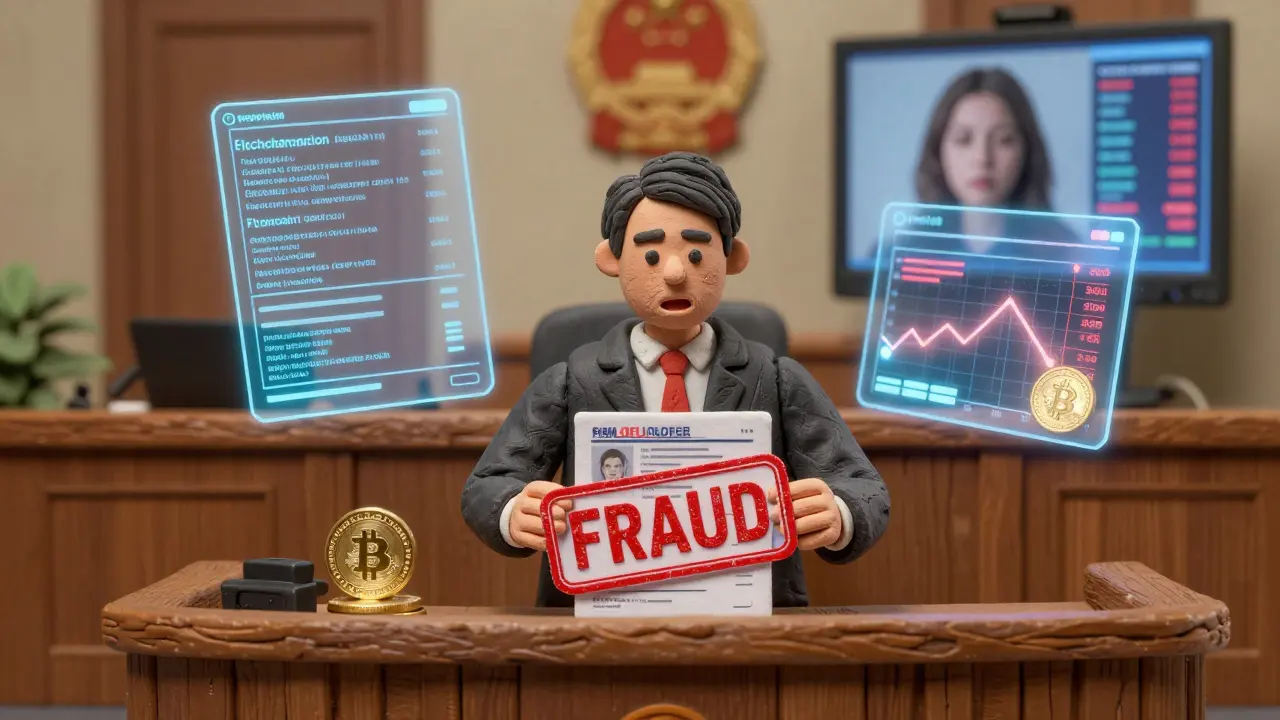
Someone tries to open a crypto exchange account using a fake ID. They upload a photoshopped driver’s license, a fake utility bill, and a deepfake video that blinks just right. They get approved. They buy Bitcoin. Then they vanish. This isn’t a movie plot. It’s happening right now-and the legal fallout is worse than most people think.
Why Document Forgery Is a Federal Crime in Crypto
Cryptocurrency exchanges don’t operate in a legal gray area. They’re regulated financial institutions under U.S. law. That means every account must pass Know Your Customer (KYC) and Anti-Money Laundering (AML) checks. When you forge documents to bypass these rules, you’re not just hacking a system-you’re committing federal fraud.The Department of Justice (DOJ), the Securities and Exchange Commission (SEC), and FinCEN treat this as white-collar crime with teeth. It’s not a misdemeanor. It’s not a fine. It’s wire fraud, securities fraud, or money laundering-all federal offenses. Each count can land you up to 20 years in prison. And if you’re part of a group running these scams? Expect even longer sentences.
What makes it worse? Cryptocurrency transactions are irreversible. Once the coins are moved, they’re gone. That means the fraud isn’t just about lying on a form-it’s about stealing real money from real people or exchanges. The government doesn’t take that lightly.
How Forgery Works Today (It’s Not Just a Fake ID)
Old-school forgery meant printing a fake passport with a glue stick and a printer. Today’s fraud is high-tech. On dark web marketplaces, full identity packages sell for $15 to $500. These aren’t just images-they’re complete digital identities.A typical package includes:
- A government-issued ID (driver’s license, passport) with altered details
- A fake utility bill or bank statement to prove address
- A synthetic video that mimics a real person blinking, speaking, and turning their head
These videos use AI-generated deepfakes. They’re trained on real photos of the person being impersonated. The system analyzes how light hits the eyes, how the lips move, even how often someone blinks naturally. Then it recreates it perfectly-enough to fool basic automated systems.
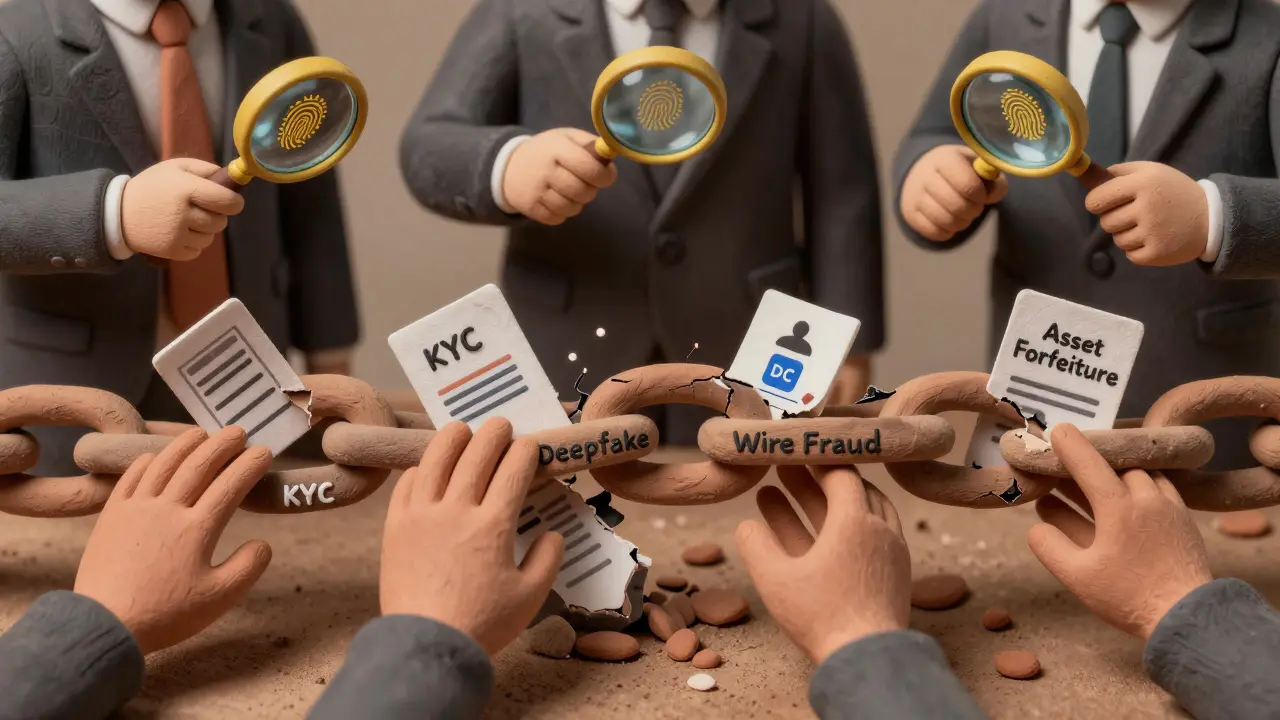
Exchanges that rely only on photo matching or basic document scans are easy targets. But the smart ones? They’ve moved past that. They check for digital fingerprints-like mismatched fonts, inconsistent shadows, or unnatural skin texture in the image. Some even cross-reference your ID with public records or utility databases in real time.
What Happens When You Get Caught
Let’s say you’re caught. You used a fake ID to open an account on a U.S.-based exchange, bought $100,000 in crypto, and transferred it to a mixer. Here’s what’s coming:- Wire fraud charge: You used electronic communication (the exchange platform) to commit fraud. That’s a federal offense.
- Securities fraud: If you used the account to trade tokens that qualify as securities, you’re violating SEC rules.
- Money laundering: Moving crypto through mixers or multiple wallets to hide its origin? That’s a separate charge.
- Asset forfeiture: The government can seize your crypto, bank accounts, even your car or house if they believe it was bought with stolen funds.
There’s no “first offense” leniency here. Federal sentencing guidelines look at the total loss amount, how many people were affected, whether you used technology to hide your identity, and if you were the organizer or just a participant. A $50,000 fraud could mean 3-5 years. $500,000? 10-15 years. And if you’re tied to an international ring? The DOJ will treat you as a major player.
And it’s not just you. If you used a stolen identity, the real person whose documents you copied could face credit damage, IRS audits, or even be wrongly suspected of fraud. You’re not just risking your freedom-you’re ruining someone else’s life.
Exchanges Aren’t Innocent Bystanders
You might think, “It’s not my fault the exchange let me in.” But the law doesn’t see it that way. If you forged documents, you’re still guilty. But here’s the twist: the exchange could be too.Regulators expect exchanges to have layered security. That means:
- Document analysis software that checks for AI artifacts
- Live liveness detection (not just a video, but a real-time challenge)
- External database checks (e.g., verifying your address with USPS or county records)
- Behavioral risk scoring (e.g., multiple accounts from the same IP, sudden large deposits)
If an exchange skips these steps and gets hacked or flooded with fake accounts, they’re vulnerable to lawsuits and fines. Take Kraken in 2022-they paid $30 million to OFAC for failing to block transactions tied to sanctioned users. That’s not a warning. That’s a precedent.
Exchanges now have legal duty to act. If they know someone’s using fake documents and still let them trade, they’re complicit. That’s why top exchanges now hire forensic document analysts and work with AI security firms to stay ahead of fraud.
How Detection Systems Are Fighting Back
The arms race between fraudsters and verification tech is real-and the tech is winning.Modern KYC systems don’t just look at your ID. They analyze:
- Lighting inconsistencies in photos (e.g., shadows that don’t match the claimed location)
- Micro-patterns in printed documents (e.g., printer dots, watermark depth)
- Blinking rhythm in videos (humans blink irregularly; AI blinks too evenly)
- Audio lip-sync errors (voice doesn’t match mouth movement)
- Device fingerprinting (e.g., the phone or browser used to upload documents)
Some systems use “challenge-response” tests. You’re asked to turn your head, read a random number, or tap your screen. A deepfake can’t respond in real time. It’s pre-recorded. That’s how they catch them.
Every time a forgery is detected, the system learns. The AI adds that pattern to its database. The next fraudster using the same trick? They’re flagged before they even finish uploading.
What You Should Know If You’re Considering This
Let’s be clear: there’s no safe way to forge documents for crypto access. Not now. Not ever.Some people think, “I’ll just do it once and cash out.” But:
- Crypto transactions leave permanent records on the blockchain.
- Exchanges share fraud data with other platforms through industry networks.
- Law enforcement uses blockchain analytics to trace coins back to wallets-and wallets back to IPs, devices, and real names.
Even if you think you’re anonymous, you’re not. Your phone’s GPS, your Wi-Fi MAC address, your browser fingerprint-they all leave trails. And once you’re on a watchlist, you’re flagged for life.
There’s no “get out of jail free” card. No appeal that erases a federal conviction. And if you’re not a U.S. citizen? You’ll be deported after prison.
The Bigger Picture: Why This Matters for Everyone
Document forgery isn’t just about one person cheating a system. It undermines trust in the entire crypto ecosystem. When fraud runs rampant, regulators crack down harder. Exchanges raise fees. They add more steps. Legit users suffer.Every time someone uses a fake ID, it makes it harder for real people to access crypto. It pushes exchanges to demand more personal data. It fuels calls for government surveillance. It turns innovation into regulation.
The goal of crypto was decentralization, freedom, financial sovereignty. Forgery doesn’t help that. It makes crypto look like a lawless wild west-and that’s the last thing the industry needs.
If you need access to crypto and can’t pass KYC, the answer isn’t to lie. It’s to wait. It’s to fix your documents. It’s to use a platform that doesn’t require identity verification-like decentralized exchanges (DEXs) that don’t hold your keys. There are legal paths. You just have to choose them.
Can I get away with using a fake ID on a crypto exchange?
No. Modern exchanges use AI-powered detection tools that catch forged documents with over 95% accuracy. Even if you slip through once, your transaction history, device fingerprint, and IP address are logged. Law enforcement can trace you months or years later. Federal charges don’t expire.
What’s the worst that can happen if I’m caught?
You could face up to 20 years in federal prison per count-for wire fraud, securities fraud, or money laundering. Your crypto assets will be seized. You may lose your home, car, or savings if they’re tied to the fraud. Non-citizens will be deported. A conviction follows you for life-it blocks jobs, loans, and travel.
Do all crypto exchanges require ID verification?
Most U.S.-based exchanges do-they’re legally required to. But some decentralized exchanges (DEXs) like Uniswap or PancakeSwap don’t require ID. However, you still need a wallet and crypto to trade. If you’re trying to bypass KYC to access funds, you’re still breaking the law if you used forged documents to get those funds in the first place.
Can I use someone else’s real ID if they give me permission?
No. Even with permission, using someone else’s government-issued ID is identity theft-a federal crime. The person whose ID you used could face serious consequences too-credit damage, IRS audits, or even criminal liability if the fraud is traced back to them. It’s not a favor. It’s a felony.
Are there legal alternatives if I can’t pass KYC?
Yes. If your documents are outdated or you lack proof of address, contact the exchange’s support team-they often help you submit alternatives. You can also use peer-to-peer platforms where you trade directly with others without KYC. Or consider non-custodial wallets and DEXs that don’t require identity verification. The key is working within the system, not breaking it.
Jayakanth Kesan
December 19, 2025 AT 03:24Man, I just saw a guy on Reddit try this last week. Got caught because his deepfake blinked every 3.2 seconds. Humans don't blink like that. AI is scary good, but also stupid sometimes.
Alison Fenske
December 19, 2025 AT 16:57It’s wild how people think they can outsmart the system when the whole damn blockchain is a public ledger. You think you’re slick hiding behind a fake license but your wallet’s got your digital ghost written all over it. I feel bad for the real people whose IDs get stolen too. That’s not just fraud, that’s soul-crushing.
Earlene Dollie
December 21, 2025 AT 01:09the universe is a simulation and they made the KYC system to test our morality 🌌
if you fake your ID are you just playing the game or are you breaking the code?
either way the system wins. always.
Rachel McDonald
December 22, 2025 AT 08:39OMG I KNEW IT 😭 I told my cousin not to do this and he laughed at me. Now he’s got a federal agent knocking on his door and his mom is crying on Facebook. This is why you don’t play with fire, people. Like, seriously. 😔
Grace Simmons
December 23, 2025 AT 19:54This isn’t just about individual fraud-it’s a national security threat. The erosion of identity verification protocols undermines the integrity of our entire financial infrastructure. The DOJ must treat this as an act of economic sabotage, not a petty crime. Every forged document is a bullet fired at the rule of law. We are witnessing the collapse of institutional trust, and it begins with someone lying about their address on a utility bill.
There is no such thing as a victimless crime when the victim is the system itself. Exchanges are not private clubs-they are federally regulated gatekeepers. When you bypass KYC, you are not evading bureaucracy-you are declaring war on the legal architecture that keeps capitalism from collapsing into chaos.
And let’s not pretend that the ‘deepfake’ is some harmless tech novelty. It’s a weaponized counterfeit of human identity. It’s not just photoshopped paper-it’s synthetic personhood. That’s not hacking. That’s identity terrorism.
And yes, I’ve seen the arguments about DEXs. But if you obtained your crypto through fraudulent means, you are still complicit in the theft. The blockchain doesn’t care if your wallet is non-custodial. It records the bloodstain. And the Feds will follow it.
This isn’t about freedom. It’s about accountability. And if you can’t prove who you are, you don’t deserve access to a system built on trust. Period.
Anyone who thinks this is ‘just crypto’ doesn’t understand that crypto is now finance. And finance has teeth.
Collin Crawford
December 25, 2025 AT 09:41Actually, the 95% detection rate is misleading. Most of those are false positives from elderly users with poor lighting or people using older phones. The real issue is that exchanges rely on outdated AI models trained on 2021 datasets. The latest deepfakes, trained on real-time video feeds from TikTok and Instagram, are bypassing even advanced liveness detection. The DOJ is chasing ghosts while fraudsters evolve faster than regulatory frameworks. This is not a crime wave-it’s a systemic failure of institutional inertia.
Also, the claim that ‘crypto transactions are irreversible’ ignores the fact that over 40% of illicit crypto flows are laundered through centralized exchanges that still hold user KYC data. The real criminals aren’t the ones forging IDs-they’re the exchanges that profit from the chaos and then point fingers. Kraken’s $30M fine? That’s a cost of doing business. The real punishment should be executive liability, not corporate settlements.
And for the record, using someone else’s ID with permission is still theft, but it’s not always malicious. Sometimes it’s a parent helping a child without a driver’s license. The law doesn’t distinguish intent. That’s the real injustice here.
Vijay n
December 26, 2025 AT 17:51Dusty Rogers
December 28, 2025 AT 02:32You don’t have to do this. Seriously. If you’re stuck, reach out. Talk to support. Use a DEX. Wait. Save up. Get your docs straight. It’s not worth losing your freedom over. I’ve seen too many smart people throw it all away over a few quick bucks. You’re better than that.