Execution Layers and Settlement Layers Explained: How Modular Blockchains Scale
 Jan, 10 2026
Most people think of blockchains as single, all-in-one systems. You send a transaction, it gets confirmed, and that’s it. But that’s not how the most powerful blockchains work anymore. Today, the real action happens in two separate parts: the execution layer and the settlement layer. These aren’t just buzzwords-they’re the reason blockchains like Ethereum can handle millions of transactions a day without becoming slow or expensive.
What Is an Execution Layer?
The execution layer is where everything happens. This is the part you interact with every time you swap tokens on Uniswap, mint an NFT on OpenSea, or borrow money from a DeFi protocol. It’s where smart contracts run, balances update, and transactions are processed. Think of it as the engine of the blockchain-the part that does the actual work. But here’s the catch: if every single transaction had to be processed on Ethereum’s main chain, the network would be overwhelmed. That’s why execution layers are built as rollups-systems that bundle hundreds or thousands of transactions off-chain and then submit them as one compressed proof to the settlement layer. There are two main types of rollups: Optimistic and ZK-Rollups. Optimistic Rollups, like Arbitrum and Optimism, assume transactions are valid unless someone challenges them. They use something called fraud proofs. If a bad actor tries to submit a fake transaction, anyone can prove it’s wrong within a 7-day window. ZK-Rollups, like StarkNet and zkSync, use mathematical proofs called zero-knowledge proofs to prove transactions are valid right away. No waiting. No challenges. Just instant verification. These systems aren’t theoretical. Arbitrum One handles between 4,700 and 7,000 transactions per second during peak times. That’s over 300 times faster than Ethereum’s main chain, which maxes out at about 15 TPS. And it’s not just speed-it’s cost. A transaction on Arbitrum costs pennies, not dollars.What Is a Settlement Layer?
Now, here’s the key insight: if execution layers are the engine, the settlement layer is the safety net. It doesn’t process transactions. It doesn’t run smart contracts. Instead, it verifies that what the execution layer claims is true. Imagine you’re running a court system. The execution layer is the lower court that hears cases and makes rulings. The settlement layer is the Supreme Court-it doesn’t hear every case, but it has the final say. If someone disputes a transaction on an Optimistic Rollup, the settlement layer steps in to check the fraud proof. If a ZK-Rollup says a batch of transactions is valid, the settlement layer checks the cryptographic proof. Ethereum is currently the dominant settlement layer. It doesn’t just handle its own transactions-it secures the entire Layer 2 ecosystem. As of late 2023, over $25 billion in value across all rollups relied on Ethereum for finality. That’s because Ethereum’s security model-its proof-of-stake consensus, its large network of validators, and its economic incentives-is the strongest in the industry. But settlement layers aren’t just about security. They also act as bridges. If you want to move assets from Arbitrum to zkSync, the settlement layer ensures that the transfer is valid and prevents double-spending. It’s the glue that holds different execution layers together.Why Separate Them?
Before modular blockchains, everything was stuck in one layer. Bitcoin and early Ethereum had to handle execution, consensus, data availability, and settlement all at once. That’s called a monolithic blockchain. It’s simple, but it’s also slow. You can’t make a system faster by just adding more power to one part-you hit a wall. Modular architecture breaks that wall. By separating concerns, each layer can be optimized independently. Execution layers focus on speed and low cost. Settlement layers focus on security and finality. Consensus layers (like Ethereum’s Beacon Chain) focus on ordering transactions. Data availability layers (like Celestia) focus on storing transaction data so it’s always accessible for dispute resolution. This isn’t just theory. It’s working. In Q3 2023, 78% of all Ethereum transaction volume happened on Layer 2 execution layers. Ethereum’s main chain doesn’t even process most of the transactions-it just verifies them. That’s the power of specialization.
Who Uses These Layers?
You don’t need to understand the technical details to use them. If you’ve ever bought a crypto asset on a decentralized exchange, you’ve likely used an execution layer. Platforms like Uniswap, Aave, and dYdX run on rollups like Arbitrum, Optimism, or zkSync. Their users get faster transactions and lower fees without giving up security. Enterprises are catching on too. According to Deloitte’s 2023 survey, 68 of the Fortune 100 companies are testing execution layer solutions. Why? Because they need high throughput for things like loyalty programs, supply chain tracking, and digital receipts-all without paying Ethereum gas fees. Settlement layers are less visible to end users, but they’re critical for developers and institutions. If you’re building a DeFi protocol, you don’t want to rely on a settlement layer that could fail. That’s why Ethereum dominates-it’s battle-tested. But new players are emerging. Espresso Systems and Celestia are building dedicated settlement layers that could one day support multiple blockchains, not just Ethereum.Challenges and Risks
It’s not all smooth sailing. The biggest pain point for users is the 7-day waiting period on Optimistic Rollups. If you want to withdraw your funds from Arbitrum to Ethereum, you have to wait up to a week. That’s because the system needs time for someone to challenge a fraudulent transaction. ZK-Rollups avoid this, but they’re harder to build and require advanced cryptography. There’s also the risk of over-reliance. Right now, 92.7% of all modular blockchain settlement happens on Ethereum. That’s a single point of failure. If Ethereum ever goes down-or gets clogged with its own traffic-all the rollups relying on it could stall. Experts worry this creates a "settlement monoculture," where too much power is concentrated in one place. Another issue is data availability. What if a rollup operator hides transaction data? Without that data, you can’t prove a fraud proof. That’s why dedicated data availability layers like Celestia exist. They store the raw transaction data so anyone can verify it later-even if the rollup itself disappears.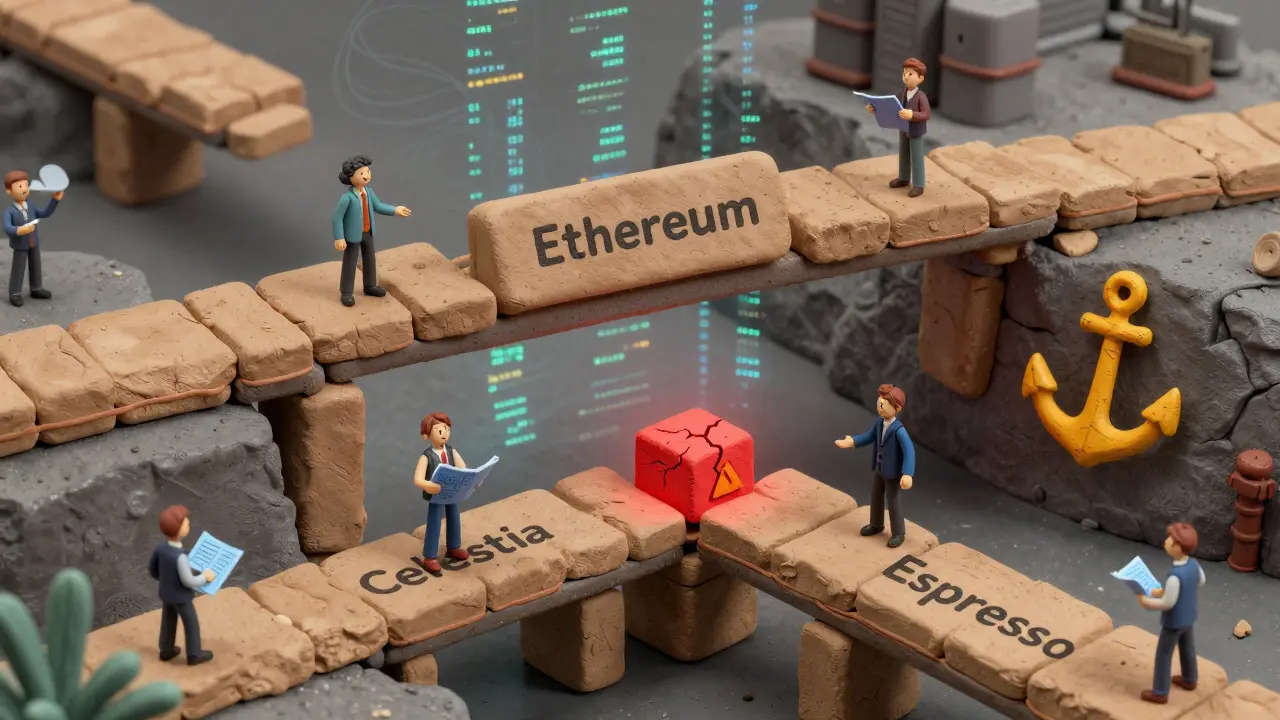
The Future: What’s Next?
The next big leap is Ethereum’s Verkle Tree upgrade, expected in 2025. Right now, verifying state changes on Ethereum requires downloading large amounts of data. Verkle Trees will shrink that data by 40-60%, making settlement faster and cheaper. That could make Ethereum even more attractive as a settlement layer. Meanwhile, rollups are getting smarter. Arbitrum’s AnyTrust technology allows some data to be stored off-chain, boosting speed to 40,000 TPS. ZK-Rollups are improving too-StarkNet now supports general-purpose smart contracts with near-instant finality. By 2027, analysts predict the modular blockchain ecosystem will hit $180 billion in annual transaction volume. Settlement layers alone could capture 35% of that value-not because they process transactions, but because they’re the foundation of trust.What This Means for You
If you’re a user: you don’t need to change anything. Just keep using your favorite dApps. They’re already on execution layers, and they’re already secured by settlement layers. You’re benefiting from modular architecture without even knowing it. If you’re a developer: you have a choice. Build on Arbitrum or Optimism for fast, low-cost apps. Build on StarkNet if you need maximum security and don’t mind higher complexity. Just remember-your app’s security depends on the settlement layer it uses. Don’t pick a rollup without checking its settlement layer. If you’re an investor: look beyond the hype. The real value isn’t in the flashy apps-it’s in the infrastructure. Settlement layers are the backbone. Companies building them are betting on the future of blockchain. And they’re not just betting-they’re building.What’s the difference between an execution layer and a settlement layer?
The execution layer processes transactions and runs smart contracts-this is where users interact with apps. The settlement layer verifies those transactions, resolves disputes, and ensures finality. Think of execution as the factory and settlement as the quality control inspector.
Why does Ethereum dominate as a settlement layer?
Ethereum has the largest network of validators, the most economic security, and the longest track record. It’s the most decentralized and secure blockchain available for settlement. While alternatives like Celestia and Espresso are emerging, none have matched Ethereum’s level of trust and adoption yet.
Are rollups safer than Ethereum mainnet?
Rollups inherit Ethereum’s security because they rely on it for settlement. They’re not more secure than Ethereum, but they’re significantly more scalable. A ZK-Rollup is as secure as Ethereum. An Optimistic Rollup is nearly as secure, but only if fraud proofs are monitored.
Do I need to understand execution and settlement layers to use crypto?
No. Most users interact with execution layers through apps like Uniswap or OpenSea without ever seeing the underlying layers. But knowing how they work helps you make better decisions-like choosing a rollup with fast withdrawals or understanding why your transaction took longer than expected.
What’s the biggest risk in modular blockchains?
The biggest risk is over-reliance on a single settlement layer-especially Ethereum. If Ethereum faces a major outage or congestion, all connected rollups could slow down or freeze. The industry is working on decentralized alternatives, but for now, Ethereum remains the anchor.
Rahul Sharma
January 12, 2026 AT 05:29Wow, this is actually one of the clearest explanations I’ve seen on modular blockchains. 😊 Execution layer = factory, settlement layer = quality control? Perfect analogy. I’ve been using Arbitrum for months and never realized how much I was relying on Ethereum’s backbone. Thanks for breaking it down so simply!
greg greg
January 12, 2026 AT 18:13It’s fascinating how the separation of concerns in modular blockchains mirrors the evolution of computer architecture itself-think of it like the difference between a monolithic kernel and microkernels in operating systems. The execution layer handles the heavy lifting of computation, while the settlement layer offloads the responsibility of trust verification to a more robust, decentralized consensus mechanism. This isn’t just scaling-it’s architectural refinement. And the fact that ZK-Rollups can achieve cryptographic certainty without the 7-day challenge window suggests we’re moving toward a future where finality isn’t a waiting game but an immediate mathematical guarantee. But here’s the kicker: if every rollup depends on Ethereum for settlement, aren’t we just creating a distributed monolith? The real innovation won’t be in the rollups themselves, but in the emergence of truly independent, trust-minimized settlement layers that don’t require Ethereum’s security blanket. That’s the next frontier.
Brittany Slick
January 14, 2026 AT 02:07This gave me chills. Like, I’ve been using DeFi apps like they’re magic, but now I get it-there’s this whole invisible infrastructure holding it all together. It’s like discovering the secret engine behind your favorite song. 🌟 I’m so glad someone finally explained it without jargon. Thank you.
Gideon Kavali
January 14, 2026 AT 10:07Let me get this straight: You’re telling me the entire U.S. financial system is built on a single blockchain that’s run by a bunch of crypto bros in their basements?!?!?!?!? And you call THIS secure?!?!?!?!? Ethereum is a single point of failure wrapped in a blockchain and sold as ‘decentralization’-it’s a socialist fantasy with a whitepaper! If China or Russia ever gets their hands on the validators, it’s game over for the West! And don’t even get me started on ZK-proofs-those are backdoors waiting to be exploited by the globalist elite! This isn’t innovation-it’s a Trojan horse for digital dictatorship!!!
Allen Dometita
January 14, 2026 AT 15:16Bro. Just bro. 😎 I just pulled $500 out of Arbitrum yesterday and it took 3 seconds. Gas was $0.03. Meanwhile, my buddy on mainnet paid $12 and waited 20 minutes. Modular? More like MODERN. 🚀 Ethereum’s not dead-it’s just the boss who lets the interns do the real work. Keep building, keep stacking.
LeeAnn Herker
January 16, 2026 AT 11:34Oh wow, so Ethereum is the ‘settlement layer’ now? Interesting. So… is this just another way to say ‘we’re putting all our eggs in one basket but calling it ‘decentralized’?’ I mean, if Ethereum goes down, all these ‘independent’ rollups just turn into digital tombstones. And who’s to say the ‘fraud proofs’ aren’t just fancy smoke machines run by the same devs who coded the original contract? I’ve seen this movie before-remember the 2018 ICO bubble? Same people, same promises, new buzzwords. Also-did anyone else notice how every single ‘enterprise’ using this is a Fortune 100 company? Coincidence? I think not. 🕵️♀️
Sherry Giles
January 17, 2026 AT 01:12They’re all lying. Ethereum’s not secure-it’s just the only one that hasn’t been hacked… yet. Celestia? Nah. Espresso? No way. They’re all owned by the same VC group that also owns the Fed. This ‘modular’ stuff is just a distraction so you don’t notice that every transaction still gets logged in a single database somewhere in Silicon Valley. You think you’re decentralized? You’re being tracked. Your wallet is a loyalty card. Wake up.
Jordan Leon
January 17, 2026 AT 21:37There’s a quiet elegance here. The separation of concerns isn’t just technical-it’s philosophical. The execution layer is the realm of action, of movement, of human intent made manifest through code. The settlement layer, by contrast, is the realm of stillness, of verification, of enduring truth. One is the dance; the other is the music that holds it together. We don’t need more speed-we need more integrity. And if Ethereum remains the anchor, perhaps it’s not because it’s the fastest, but because it’s the most honest. That’s worth preserving.
Andy Schichter
January 18, 2026 AT 17:30So… we built a system where a bunch of overworked validators in a data center in Iowa get to decide whether your $5 swap is legit? And you call this progress? I’d rather just use PayPal. At least they don’t pretend to be revolutionary while charging you $0.02 in gas fees and making you wait a week to get your money back. This isn’t blockchain. It’s theater. With extra steps.
Michael Richardson
January 19, 2026 AT 17:13They’re all just trying to make Ethereum look like a god. It’s not. It’s a legacy system with a cult following. The real winners will be the ones who build settlement layers that don’t need Ethereum at all. And they’re already doing it. You’re just late to the party.