Future of Digital Art on Blockchain: How NFTs Are Reshaping Creativity and Ownership
 Dec, 30 2025
Imagine buying a piece of art that only you own-no copies, no fakes, no middlemen. And every time it’s resold, the original artist gets paid automatically. That’s not science fiction. It’s happening right now, thanks to blockchain technology. Digital art on blockchain isn’t just a trend; it’s becoming the new foundation for how art is made, sold, and valued.
Why Blockchain Changed Everything for Digital Artists
Before blockchain, digital art was easy to copy. Anyone could right-click, save, and share a JPEG. That made it nearly impossible for artists to earn from their work. Collectors didn’t want to pay for something anyone could download for free. Blockchain fixed that by turning digital files into unique, verifiable assets called NFTs. Each NFT is a digital certificate stored on a blockchain-usually Ethereum or Solana. It proves who owns the original version of a piece, even if millions of copies exist. This isn’t just about ownership. It’s about trust. Artists no longer need galleries or agents to validate their work. The code itself does it. And here’s the kicker: smart contracts built into NFTs can automatically send a percentage of every resale back to the original creator. Some artists earn 10%, 15%, even 25% every time their art changes hands. That’s something no traditional artist has ever had. A digital painter in Indonesia can make more from resales than a painter in New York ever could from one gallery sale.The Market Isn’t Dead-It’s Growing Up
Remember 2021? NFTs were everywhere. Bored Apes sold for millions. People bought JPEGs like lottery tickets. Then the hype crashed. Prices dropped. Many thought it was over. But the market didn’t die. It matured. By 2025, the digital art market on blockchain is projected to hit $5.8 billion-and grow to over $17 billion by 2032. That’s not speculation. That’s real growth driven by real use cases. NFT-specific trading volume might be shrinking, but the broader ecosystem is exploding. Why? Because people aren’t buying NFTs just to flip them anymore. They’re buying them for what they unlock: access to exclusive concerts, private Discord communities, limited-edition merch, or even real-world events. A digital painting isn’t just art anymore-it’s a membership card. Major institutions are catching on. Sotheby’s now regularly auctions NFTs alongside classic paintings. Artnet and Saatchi Art have built full digital galleries. These aren’t experiments. They’re long-term strategies.AI Is Now Part of the Creative Process
The biggest shift since 2023? AI isn’t just a tool-it’s a collaborator. Artists like Refik Anadol use live data streams to create evolving digital installations. Takashi Murakami works with AI to generate thousands of variations, then hand-selects the best ones for NFT drops. Even everyday creators are using tools like Adobe’s Generative Fill to turn sketches into full-color masterpieces in seconds. These aren’t lazy shortcuts. They’re new forms of expression. AI handles the grunt work-color grading, texture generation, layout optimization-so artists can focus on vision and emotion. The result? Dynamic NFTs. Art that changes based on the weather, the time of day, or even the owner’s mood (tracked via wearable data). One collection lets owners vote on how their artwork evolves each month. Another responds to global news headlines, shifting colors and shapes in real time. This isn’t gimmickry. It’s the future of interactivity. Art that doesn’t sit still. Art that grows with its owner.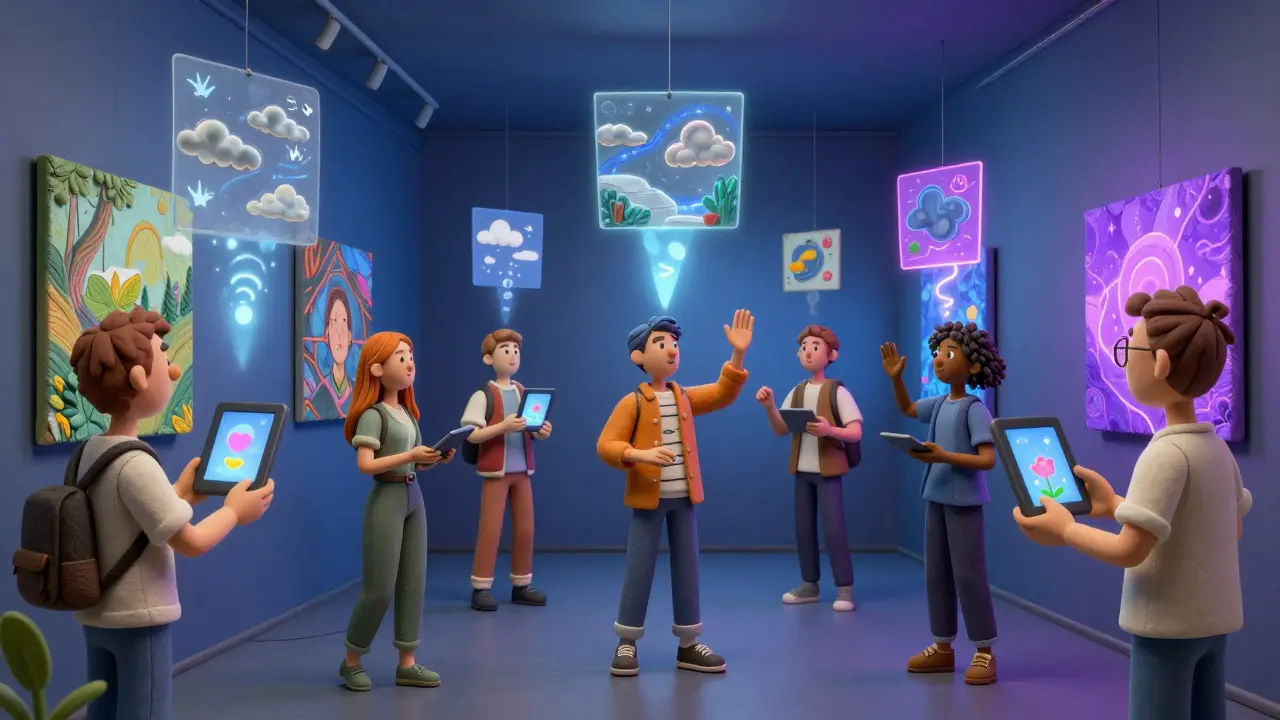
Real-World Assets Are Going Digital
The line between digital and physical is blurring. Now, NFTs aren’t just for JPEGs. They’re being used to represent ownership of real things: a painting in a Paris gallery, a rare sneaker in a warehouse, a fraction of a vineyard in Tuscany. This is called tokenization. You don’t need to buy the whole thing. You can own 0.5% of a $10 million Picasso-and get a share of its rental income if it’s loaned to a museum. Or you can own a slice of a vintage wine collection and earn profits when bottles are sold. DeFi is joining the party too. You can now stake your NFTs to earn interest, borrow money against them, or even lend them out to other collectors. An NFT isn’t just a collectible-it’s an asset class. This isn’t fantasy. It’s happening now. Platforms like Fractional.art and RealT are already tokenizing real estate and fine art. The same tech that powers a pixelated ape can now back a $2 million oil painting.What’s Holding It Back?
Let’s be honest: blockchain art still has problems. Gas fees on Ethereum can cost $50 just to mint a single NFT. That’s a dealbreaker for emerging artists. Some platforms have fixed this with layer-2 solutions like Polygon or Arbitrum, cutting fees to pennies. But not all do. Then there’s the learning curve. Setting up a wallet, buying crypto, understanding private keys-it’s intimidating. Most artists aren’t techies. They’re painters, designers, animators. If the process feels like coding, they won’t bother. And yes, the environmental impact used to be a huge issue. But that’s changing fast. Ethereum switched to proof-of-stake in 2022, cutting its energy use by 99.95%. Solana, Flow, and Tezos were built that way from the start. Today, most major NFT platforms run on clean networks. The biggest barrier? Perception. Outside crypto circles, many still think NFTs are scams or jokes. But that’s shifting. As more museums display digital art and universities offer courses on blockchain creativity, the stigma fades.
What’s Next? The Road Ahead
By 2030, blockchain digital art won’t be a niche. It’ll be standard. Schools will teach it. Designers will include NFT rights in their contracts. Corporations will use branded digital art as part of marketing campaigns. Think Nike’s virtual sneakers-but for art. A luxury brand might release a limited NFT collection tied to a physical runway show. Owning the NFT gives you early access to the real garment. Governments are starting to recognize digital art as cultural heritage. France has already begun archiving NFTs in its national digital library. The U.S. Library of Congress is exploring similar projects. Animation and 3D art are leading the charge. A static image is nice. But a 10-second animated loop that tells a story? That’s worth more. And with better tools, even non-coders can create rich, moving pieces using simple drag-and-drop platforms. The future isn’t just about selling art. It’s about building communities. NFTs are the new album cover, the new fan club, the new backstage pass. They connect creators and fans in ways that were never possible before.How to Get Started (Without Getting Scammed)
If you’re an artist thinking about jumping in:- Start with a wallet like MetaMask or Phantom-free and easy to set up.
- Use low-fee blockchains like Solana, Polygon, or Base. Avoid Ethereum for minting unless you’re selling high-value pieces.
- Choose a reputable marketplace: OpenSea, Blur, or Magic Eden. Avoid random sites with no reviews.
- Read the smart contract before minting. Make sure royalties are locked in and can’t be changed.
- Don’t chase hype. Build a community first. Post your process. Share your story. People buy from people, not just pixels.
- Look for utility, not just aesthetics. Does the NFT give you access to something real?
- Check the artist’s track record. Are they active? Do they release new work?
- Don’t buy just because someone else is. Wait. Watch. Learn.
Final Thought: This Isn’t a Bubble. It’s a Bridge.
Blockchain digital art isn’t replacing traditional art. It’s expanding it. It’s giving voice to artists who were ignored by galleries. It’s letting collectors own something truly unique. It’s merging creativity with technology in ways we’re only beginning to understand. The hype cycle is over. The real work is just beginning.Can anyone create NFT art, or do you need coding skills?
You don’t need to code at all. Platforms like OpenSea, Rarible, and Foundation let you upload your artwork, set a price, and mint an NFT with a few clicks. Tools like Canva, Procreate, and Photoshop with AI plugins make creating the art easier than ever. The only technical step is setting up a crypto wallet-but even that takes less than 10 minutes.
Are NFTs still worth buying, or is it too late?
It’s not about being early anymore-it’s about value. The most successful NFTs today aren’t the ones that sold for millions in 2021. They’re the ones that give ongoing benefits: access to events, membership in communities, royalties from future sales, or utility in games. If an NFT offers something real, it’s worth considering. If it’s just a JPEG with no purpose, it’s probably not.
Do artists still make money from NFTs after the market crash?
Yes-often more than before. Many artists report earning consistent income from royalties on secondary sales, which can add up to thousands per month. One digital illustrator in Brazil made over $120,000 in royalties last year just from resales of her NFTs. That’s more than she ever made from stock sites or commissions. The key is building a loyal audience, not chasing viral trends.
What’s the difference between NFT art and regular digital art?
Regular digital art can be copied endlessly and has no proof of ownership. NFT art is tied to a unique digital certificate on a blockchain that proves who owns the original. That’s it. You can still screenshot it, but only one person owns the verified version. Think of it like owning the original painting vs. owning a poster of it.
Is blockchain art bad for the environment?
Not anymore. Most major NFT platforms now run on blockchains that use proof-of-stake, which uses 99.9% less energy than the old proof-of-work system. Ethereum switched in 2022. Solana and Polygon were designed to be eco-friendly from day one. Today, minting an NFT on these networks uses about as much energy as sending an email.
Rajappa Manohar
December 31, 2025 AT 11:05NFTs are just digital stickers now but at least artists get paid when they resell
Ryan Husain
January 1, 2026 AT 12:17The shift from speculative hype to utility-driven ownership is one of the most significant developments in creative economies this decade. Artists no longer need gatekeepers to validate their work-the blockchain serves as both notary and distributor. This democratization of access, paired with programmable royalties, fundamentally redefines the artist-collector relationship. It’s not merely about ownership; it’s about sustained economic participation in the lifecycle of a piece. The institutional adoption by Sotheby’s and Artnet confirms this isn’t a fad-it’s infrastructure being rebuilt.
Daniel Verreault
January 3, 2026 AT 01:44Yo the AI collaboration angle is wild-Takashi Murakami using generative models to spawn 10k variants then cherry-picking the best? That’s not cheating, that’s evolution. We’re moving into a post-solo-artist era where the human is the curator, not the sole producer. And dynamic NFTs responding to weather or mood? That’s not gimmick, that’s sentient art. The next frontier is NFTs that evolve based on collective community input-like a living mural shaped by 10k owners voting on hue shifts every week. We’re not collecting art anymore, we’re co-creating ecosystems.
Jacky Baltes
January 4, 2026 AT 15:26The philosophical underpinning here is profound. NFTs reintroduce scarcity into a medium that was inherently infinite. But more than that, they restore agency to the creator, not just economically but existentially. The artist’s intent is encoded into the chain-royalties, conditions, evolution rules-making the work a living testament to their vision. This isn’t just ownership; it’s the preservation of artistic intention across time, independent of market whims or institutional bias. It’s a quiet revolution in authorship.
prashant choudhari
January 5, 2026 AT 04:15Gas fees are still a problem on some chains but Polygon and Solana fixed it for most creators
Shawn Roberts
January 6, 2026 AT 23:44Bro I just minted my first NFT last week and made $800 in royalties in 3 weeks from resales 😎 no cap the future is now
Abhisekh Chakraborty
January 7, 2026 AT 08:26you guys are missing the point-this isn’t about art or money it’s about control. Who gets to decide what’s valuable? The market? The gallery? Or the person who made it? NFTs give the creator back their power and that’s terrifying to the old system