Future of Zero-Knowledge Technology in Blockchain and Cryptography
 Dec, 17 2025
Zero-knowledge proofs aren’t just a buzzword anymore. They’re the quiet engine behind the next wave of blockchain adoption. Imagine proving you’re over 18 without showing your ID. Or verifying a bank transfer happened without revealing how much was sent. That’s zero-knowledge proof (ZKP) in action. It’s not magic-it’s math. And it’s solving the biggest problems blockchain has struggled with for years: privacy, scalability, and compliance-all at once.
How Zero-Knowledge Proofs Actually Work
At its core, a zero-knowledge proof lets one party prove they know something without revealing what it is. Think of it like proving you have the password to a safe without saying the password out loud. You could open the safe in front of someone, show them the contents, then close it again. They know you know the code. But they never heard it. That’s the essence of ZKP.
The math behind it is complex, built on elliptic curves, finite fields, and cryptographic hashing. But the outcome is simple: verification without exposure. Early versions like zk-SNARKs needed a trusted setup-a one-time ritual where keys were generated and then destroyed. If those keys were ever leaked, the whole system could be compromised. That’s why zk-STARKs came along. They removed the trusted setup entirely, using transparent cryptographic techniques instead. The trade-off? Larger proof sizes. A zk-SNARK proof is about 200 bytes. A zk-STARK is around 45KB. That’s a big difference when you’re processing millions of transactions.
Why ZKPs Are Taking Over Blockchain Scaling
Ethereum’s base layer can handle about 15 transactions per second. That’s fine for a startup, but not for a global financial system. Enter ZK rollups. These are Layer 2 networks that bundle hundreds of transactions off-chain, then compress them into a single cryptographic proof that’s verified on Ethereum. The result? Throughput jumps to 2,000 transactions per second on zkSync Era, and 1,500 on Starknet. That’s 100 times faster than Ethereum’s base layer.
And it’s not just speed. ZK rollups cut costs dramatically. Visa’s May 2024 pilot showed ZK-based auto-payments reduced verification costs by 87% compared to traditional methods. That’s not theoretical-it’s live. Companies like BlackRock are using ZKPs to tokenize $240 million in U.S. Treasuries. Investors are verified, identities are kept private, and regulators can audit everything. No middlemen. No leaks.
Compared to older privacy tools like Monero’s ring signatures or Mimblewimble’s confidential transactions, ZKPs are more scalable. Ring signatures grow in size with every participant. ZK proofs stay small. And unlike optimistic rollups that rely on a 7-day challenge period, ZK rollups are cryptographically secure the moment the proof is submitted.
The Hardware Revolution Making ZKs Practical
One of the biggest bottlenecks has been proving time. Generating a ZK proof used to take minutes-even hours-on high-end servers. That’s not viable for real-time applications. But hardware is catching up fast.
NVIDIA announced its ZK Coprocessor in August 2024, shipping in Q1 2025. It’s a specialized chip built to accelerate the math behind zk-SNARKs and zk-STARKs. Early benchmarks show it can cut proving times from 90 seconds to under 2 seconds. That’s a 50x speedup. Rumblefish.dev confirmed that hardware acceleration is already reducing proving costs below $0.01 per transaction. Dr. Eli Ben-Sasson, co-founder of StarkWare, predicts costs will drop below $0.001 by mid-2025. That’s cheaper than sending a text message.
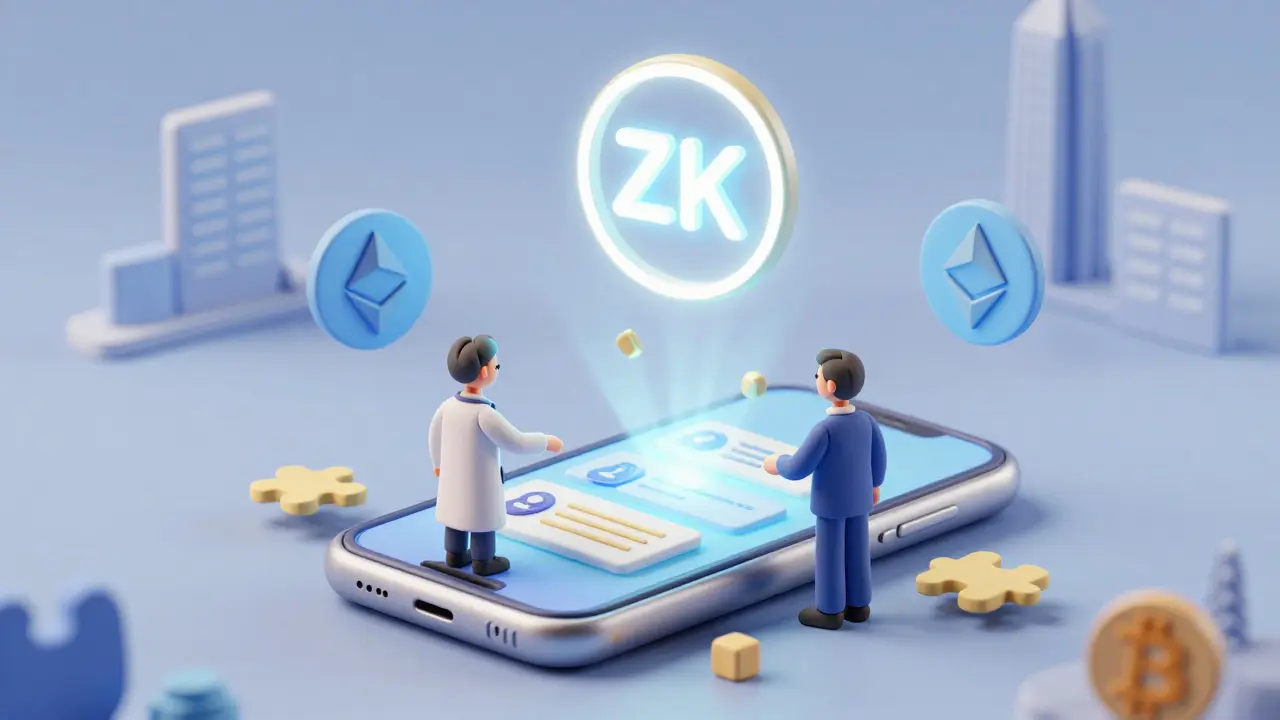
And it’s not just NVIDIA. Startups are building custom ASICs and FPGA-based proving machines. These aren’t just for big players anymore. By 2026, you could be running a ZK verifier on your smartphone. Bitcoin.com’s expert panel forecasts that by the end of 2025, ZK verification will be fast enough for everyday apps-like private digital IDs, anonymous voting, or secure health records on your phone.
Where ZKPs Are Already Being Used
Real-world adoption is accelerating. In Estonia, ZK-based voting processed 217,000 private votes in their July 2024 municipal elections. Every vote was verified, anonymous, and fully auditable. No one saw who voted for whom. But election officials could prove the results were accurate.
HSBC used ZKPs to cut settlement times by 73% on its tokenized gold trading platform. Prices were kept private during negotiations, but the trade was still legally binding and verifiable. The EU’s MiCA regulation now officially recognizes ZK-proofs as compliant privacy technology. That’s huge. It means banks and insurers can use ZKPs without fear of breaking privacy laws.
Meanwhile, the market is exploding. ZK crypto projects jumped from $3.2 billion in 2023 to $21.1 billion by May 2024. Polygon zkEVM leads the ZK rollup race with 38% of transaction volume, followed by Starknet at 29% and zkSync at 22%. Eleven new ZK-focused projects launched ICOs in Q3 2024 alone. One, called the ‘Zero Knowledge Proof’ token, raised $47 million in its private sale.
The Dark Side: Complexity and Vulnerabilities
But ZKPs aren’t easy. They’re like building a nuclear reactor in your garage-possible, but dangerous if you don’t know what you’re doing.
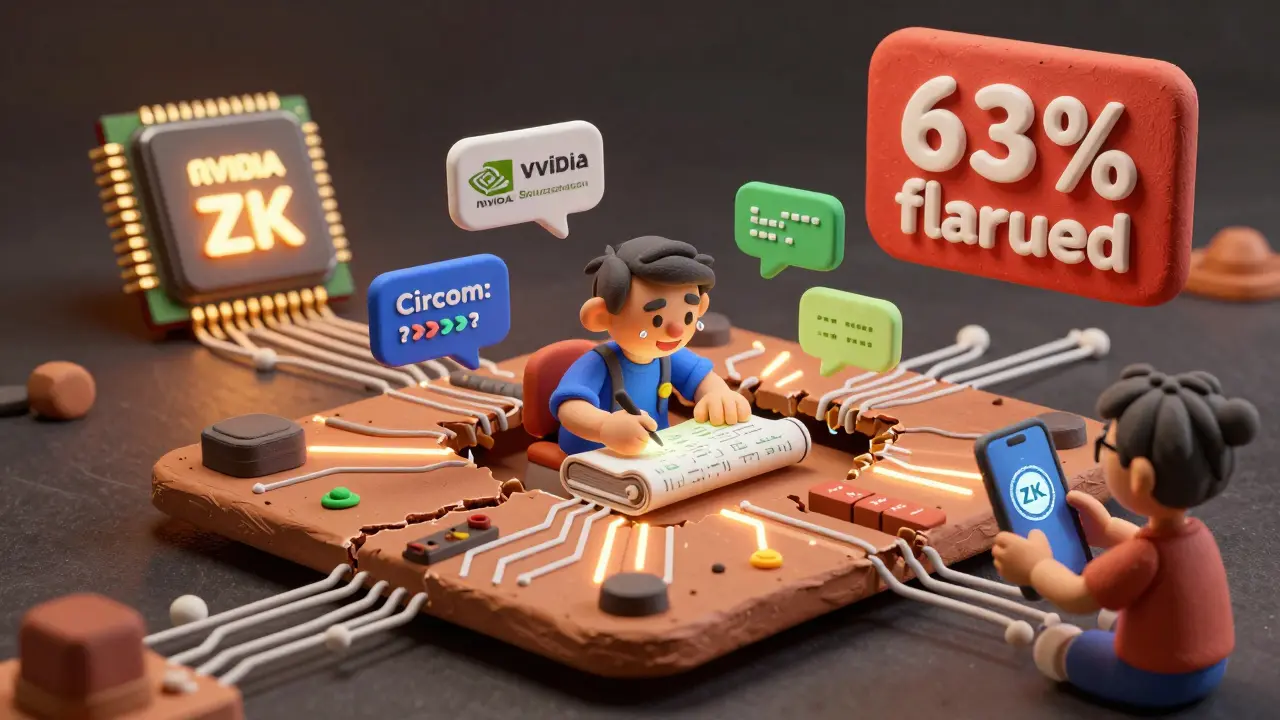
Developers need to learn Circom, a niche programming language for designing cryptographic circuits. GitHub surveys show it takes 3-6 months of extra training for Solidity developers to get comfortable. And it’s not just learning-it’s debugging. One Reddit developer spent 117 hours fixing a single ZK circuit. GitHub has over 427 open issues for zkSync’s circuit compiler, with average resolution times of 14 days.
And the risks are real. Dr. Matthew Green from Johns Hopkins found that 63% of audited ZK circuits had at least one critical flaw. Most were in custom-designed circuits, not standardized ones. Trail of Bits’ 2024 audit report showed that 37% of failed ZK projects in 2023 collapsed because of circuit errors-tiny math mistakes that let attackers forge proofs.
Smaller teams are especially vulnerable. At ETHGlobal London 2024, 68% of ZK startups said the steep learning curve was their biggest hurdle. Only 12% of blockchain developers have the background in finite field arithmetic or elliptic curve cryptography needed to build secure ZK systems. The tools are improving, but the talent gap is wide.
What’s Next? The Next Five Years
The future of ZK technology isn’t about one big breakthrough. It’s about layers.
First, cross-chain privacy. zkBridge launched in July 2024, letting users transfer assets privately between Ethereum and Bitcoin. That’s never been done before at scale. Now, ZKPs are bridging ecosystems, not just scaling them.
Second, regulatory compliance will become baked in. The SEC hasn’t given clear guidance on anonymous ZK transactions in the U.S., but companies are already building “compliance-friendly” ZK systems. Think: private identity verification that still lets regulators see transaction patterns-without seeing personal data.
Third, ZKPs will stop being a “layer.” They’ll become the default. SuperEx News predicts 70% of blockchain applications will use ZK architecture by 2027. That means your wallet, your bank app, your health record system-all of them will use zero-knowledge tech behind the scenes. You won’t notice it. But you’ll feel it: faster, cheaper, safer transactions.
McKinsey warns that energy use could be a bottleneck. ZK proving is computationally heavy. If efficiency doesn’t improve by 90% from current levels, mass adoption could stall. But with hardware acceleration and algorithmic optimizations, that’s becoming realistic. Vitalik Buterin said in June 2024 that ZK-proofs are the single most important cryptographic primitive for scaling Ethereum-and he expects 100x performance gains by 2025.
Should You Care? Yes.
If you use crypto, you’re already interacting with ZK technology. If you work in finance, healthcare, or supply chains, you’ll be using it soon. It’s not about replacing banks or governments. It’s about giving people control over their data without sacrificing security or compliance.
Zero-knowledge proofs don’t make blockchain perfect. But they make it possible. For the first time, we can have privacy, scalability, and trust-all at the same time. That’s not just an upgrade. It’s a new foundation.
What is a zero-knowledge proof in simple terms?
A zero-knowledge proof lets you prove you know something-like a password or a transaction history-without revealing what it is. For example, you can prove you’re over 18 without showing your ID. It’s like opening a locked box in front of someone and showing them the contents, then closing it again. They know you have access, but they never saw the key.
Are zk-SNARKs and zk-STARKs the same thing?
No. zk-SNARKs are smaller and faster but require a trusted setup-a one-time cryptographic ritual that, if compromised, breaks security. zk-STARKs don’t need a trusted setup, making them more secure in theory, but they produce larger proofs (about 45KB vs. 200 bytes), which can be slower to verify. Most projects today use zk-SNARKs for efficiency, but zk-STARKs are gaining ground as hardware improves.
Why are ZK rollups better than other Layer 2 solutions?
ZK rollups bundle hundreds of transactions into one cryptographic proof verified on Ethereum. This makes them faster (up to 2,000 TPS), cheaper, and more secure than optimistic rollups, which rely on a 7-day challenge period. ZK rollups are cryptographically secure the moment the proof is submitted-no waiting. They also compress data better, reducing on-chain storage costs by up to 90%.
Can zero-knowledge proofs be hacked?
The math behind ZKPs is extremely secure. But the code that implements them isn’t. Most hacks come from bugs in the circuit design-not the proof itself. A single mistake in the arithmetic logic can let attackers forge proofs or steal funds. That’s why audits are critical. Studies show 63% of custom ZK circuits have at least one critical flaw. Standardized templates and incremental testing reduce this risk significantly.
Is zero-knowledge tech only for crypto?
No. ZKPs are being used in healthcare to verify patient eligibility without exposing medical records, in supply chains to prove product origin without revealing pricing, and in government voting systems like Estonia’s, where 217,000 votes were cast anonymously in 2024. Any system that needs privacy + auditability can use ZKPs. They’re becoming infrastructure, not just a crypto feature.
What’s the biggest barrier to wider adoption?
The biggest barrier is talent. Only 12% of blockchain developers have the math background needed to build secure ZK circuits. Learning Circom, finite fields, and elliptic curve cryptography takes months. Tools are improving, but the learning curve is still steep. Until more developers get trained, adoption will be limited to well-funded teams with access to specialized engineers.
Will ZK technology make my transactions faster and cheaper?
Yes, if you’re using a ZK-powered app. zkSync and Starknet already process transactions at 10-50x the speed of Ethereum’s base layer. Fees are also lower because the proof is verified once on-chain instead of processing each transaction individually. By 2025, you could be sending private payments for less than a cent. The bottleneck isn’t the tech anymore-it’s getting apps to use it.
Sammy Tam
December 18, 2025 AT 17:26Man, I remember when ZK proofs were just a nerd fantasy. Now my crypto wallet uses them without me even noticing. It’s wild how fast this went from ‘what the hell is this?’ to ‘oh cool, my transaction just got cheaper and private.’ Hardware acceleration is the real MVP here - 2 seconds instead of 90? That’s not progress, that’s a revolution.
Chevy Guy
December 19, 2025 AT 17:26Trustless systems my ass. They just moved the trust from banks to NVIDIA’s secret chip firmware. Next thing you know, your phone’s ZK verifier is phoning home to check if you’re ‘allowed’ to send crypto. They’re not giving you privacy - they’re selling it back to you in a premium subscription.
Amy Copeland
December 20, 2025 AT 07:16Oh please. You’re all acting like this is some divine revelation. ZK rollups are just a fancy way to centralize computation under the guise of decentralization. And don’t get me started on the ‘compliance-friendly’ ZK systems - that’s just regulatory capture dressed up in math. If you need to prove you’re not a criminal to use money, you’ve already lost.
Abby Daguindal
December 20, 2025 AT 08:47It’s not about the tech. It’s about the people. 12% of devs can even touch Circom? That’s not innovation - that’s gatekeeping. If the future of finance requires a PhD in finite fields, then it’s not for the people. It’s for the privileged few who had access to the right professors and the right universities.
Heather Turnbow
December 21, 2025 AT 00:32While I appreciate the technical depth of this post, I must emphasize the profound ethical implications of widespread ZK adoption. The balance between privacy and accountability is not merely a computational problem - it is a societal contract. If we optimize for anonymity without structured oversight mechanisms, we risk eroding the foundations of trust that underpin democratic institutions. The challenge lies not in the mathematics, but in the human frameworks we build around them.
Jesse Messiah
December 22, 2025 AT 05:09Y’all are overthinking this. ZK is just the next step - like when SSL became default on websites. Nobody asked for it, but now you’d never go back. And yeah, the learning curve’s rough, but there’s a ton of free tutorials now. I started learning Circom last month, and I already built a tiny proof for a voting app. It’s not magic, it’s just hard. And hard doesn’t mean impossible. Keep going.
Rebecca Kotnik
December 23, 2025 AT 19:20The evolution of zero-knowledge proofs represents not merely an advancement in cryptographic methodology, but a fundamental recalibration of the relationship between individual autonomy and systemic integrity. The transition from zk-SNARKs to zk-STARKs, while technically significant, is emblematic of a broader philosophical shift: from reliance on trusted third parties to the establishment of verifiable, transparent, and mathematically immutable truth. The scalability gains are undeniable, yet it is the potential for embedding privacy into the architecture of social infrastructure - from healthcare to electoral systems - that renders this development historically significant. We are not merely optimizing transaction throughput; we are redefining the epistemology of trust in digital society. The barriers to adoption are not insurmountable, but they demand interdisciplinary collaboration - between cryptographers, policymakers, educators, and civil society - to ensure that the technology serves human dignity rather than merely corporate efficiency.