German Crypto Exchange Regulations and Licensing: What You Need to Know in 2025
 Dec, 3 2025
German Crypto License Capital Calculator
BaFin Capital Requirements Calculator
Based on MiCAR regulations effective since December 2024
Required minimum capital = €125,000 + 0.05% of transaction volume
Running a crypto exchange in Germany isn’t just about setting up a website and accepting Bitcoin. If you think it’s as simple as launching a platform and letting users trade, you’re already behind. Since December 30, 2024, Germany’s crypto rules have shifted from a national framework to a tightly integrated EU-wide system under MiCAR - and the stakes have never been higher. BaFin, Germany’s financial watchdog, doesn’t just monitor exchanges - it enforces them. And they’ve already shut one down.
Why Germany’s Crypto Rules Are Different
Germany doesn’t treat crypto like a wild west. It’s not a gray zone. It’s not an experiment. Crypto assets are legally recognized financial instruments - and they’re regulated like stocks, bonds, and banking products. The country has spent years building a system that balances innovation with control. That’s why BaFin doesn’t just issue licenses. It demands proof - proof of security, proof of identity checks, proof of tax reporting, and proof that you can keep users’ money safe.Before MiCAR, exchanges operated under patchwork rules. Now, every crypto service provider - whether it’s a trading platform, custody wallet, or staking service - must comply with one unified EU law. That means if you want to serve even one German customer, you need BaFin’s stamp of approval. No exceptions. No loopholes.
The BaFin Licensing Process: What It Actually Takes
Getting licensed by BaFin isn’t a form you fill out in a week. It’s a 6-to-12-month process that requires deep legal, technical, and financial preparation. Here’s what you need to show:- Legal structure: You must be a registered German company or have a legal entity in the EU. Foreign-only operations don’t qualify.
- IT security: Your systems must pass independent audits. Encryption, cold storage, multi-signature wallets, and intrusion detection aren’t optional - they’re mandatory.
- AML/KYC systems: You must verify every user’s identity using government-issued ID and track every transaction. This isn’t just "we checked their ID." You need full audit trails for every deposit and withdrawal.
- Capital requirements: You must hold a minimum of €125,000 in equity capital, plus additional funds based on your expected transaction volume.
- White paper for new tokens: If you’re launching your own token or listing a new one, you must submit a detailed document explaining its purpose, risks, and technology. BaFin reviews it before you can even market it.
And don’t assume your existing license from another country works here. BaFin doesn’t recognize foreign licenses. Even if you’re licensed in France or Estonia, you still need a German authorization to serve German users.
How Crypto Assets Are Classified - And Why It Matters
Not all crypto assets are treated the same in Germany. BaFin classifies them into three main categories, and each triggers different rules:- Financial instrument tokens: These behave like stocks or bonds. Think of tokens that give you dividends, profit shares, or voting rights. They fall under MiFID II and require full securities compliance.
- Security-like tokens: These are similar to traditional securities but issued on blockchain. They require a prospectus approved by BaFin before public sale.
- Capital investment tokens: These are tied to investment funds or projects. They’re regulated under the German Capital Investment Act and need strict investor protection measures.
What does this mean for your exchange? If you list a token that’s classified as a financial instrument, you can’t just let users trade it. You need to comply with trading rules, reporting obligations, and even investor suitability checks. One wrong classification can get you fined or shut down.
Anti-Money Laundering: The Travel Rule Is Live
Germany implemented the FATF "travel rule" in full on January 1, 2025. That means every crypto transfer over €1,000 must include the sender’s and receiver’s full name, address, and account number - even if the receiver is on another exchange.This isn’t just a suggestion. It’s a legal requirement under the KryptoWTransferV regulation. If your platform doesn’t automatically collect and transmit this data, you’re breaking the law. That includes peer-to-peer trades, wallet-to-exchange deposits, and even internal transfers between users.
And it’s not just about big transfers. BaFin requires full transaction logs for every single crypto movement - no matter the size - for at least five years. Audits happen without notice. If your logs are incomplete or missing, you’re at risk of losing your license.
What Happened to Ethena GmbH? A Warning Tale
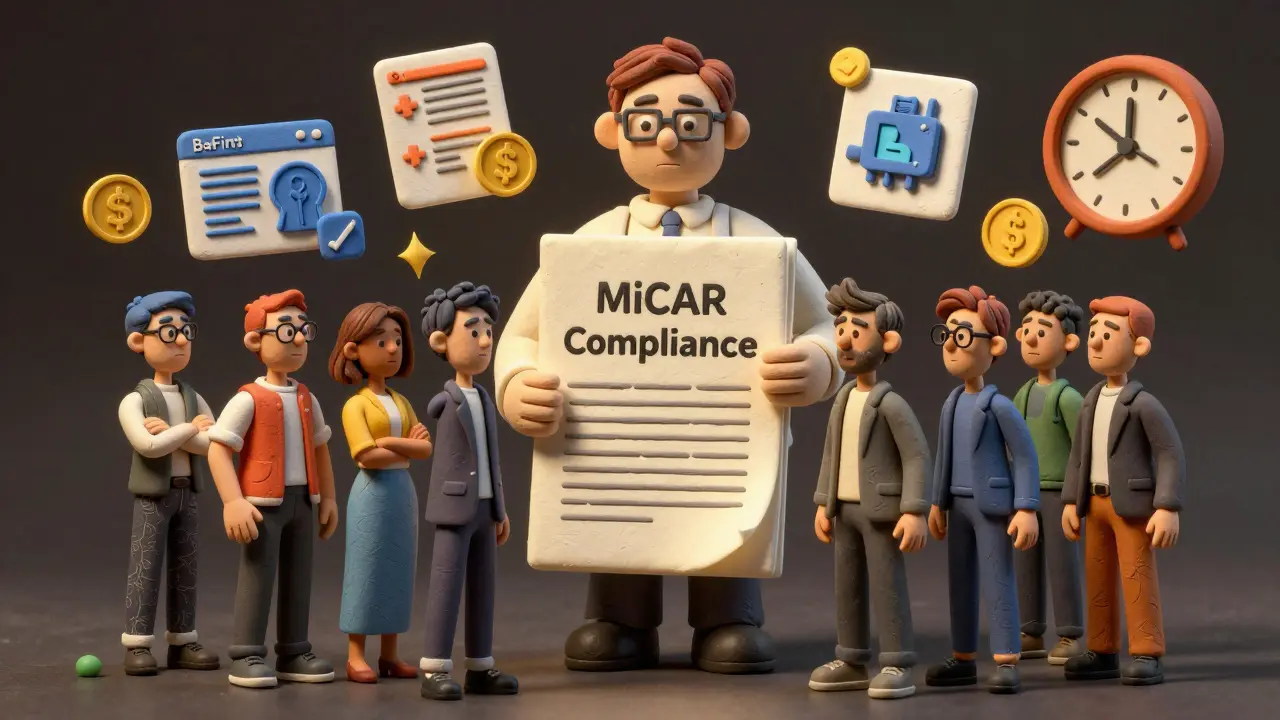
On June 25, 2025, BaFin ordered Ethena GmbH to stop all operations in Germany. Why? Because its USDe stablecoin didn’t meet transparency or reserve backing requirements. Users were given until August 6, 2025, to redeem their tokens through a BaFin-appointed representative. After that, the company was dissolved.This wasn’t a warning. It was a demonstration. BaFin doesn’t just regulate - it removes bad actors. And they’re watching. If your stablecoin doesn’t have daily public audits, clear reserve backing, or legal recourse for users, you’re on thin ice.
Taxes and Documentation: The Hidden Burden
Tax compliance in Germany is brutal. In March 2025, the Ministry of Finance released new rules that changed how crypto gains are taxed:- Staking rewards are now taxed as income - not capital gains - when received.
- DeFi transactions (like lending on Aave or swapping on Uniswap) must be tracked and reported individually.
- You must use daily market prices from reputable sources (like CoinGecko or CoinMarketCap) to calculate gains and losses.
- Every trade, transfer, or conversion needs a timestamp, amount, and value in euros.
Exchanges are expected to provide users with annual tax reports. If you don’t offer this, your users will struggle to file - and you’ll face pressure from BaFin to improve your systems. Many exchanges now integrate with tax tools like Koinly or CoinTracker to automate this.
Grandfathering: What Existing Exchanges Must Do
If your exchange was operating legally in Germany before December 29, 2024, you weren’t immediately shut down. BaFin gave you a grace period - until December 31, 2025 - to transition to MiCAR compliance.But that window is closing fast. By the end of this year, every existing license must be renewed under MiCAR rules. That means reapplying, submitting updated documentation, and proving your systems meet the new standards. No extensions. No delays. If you haven’t started this process, you’re already behind.
Even banks and investment firms that offered crypto services before MiCAR had to notify BaFin by March 2025. If you didn’t, you’re operating illegally - even if you thought you were "grandfathered in."
Why Germany Is Still a Top Market for Crypto
Despite the strict rules, Germany remains one of the most attractive markets in Europe. Why? Because clarity attracts capital. Investors trust a system where rules are clear and enforced. Germany has:- Over 82 million potential users in a single country.
- Access to the entire EU market through MiCAR’s passporting rules.
- Strong R&D support and government grants for blockchain startups.
- 90 international double taxation treaties that reduce cross-border tax burdens.
Companies like Bitpanda and Coinhouse have thrived here precisely because they built compliance into their DNA from day one. They didn’t try to bypass rules - they turned them into a competitive advantage.
What Comes Next? DeFi, AI, and the Next Wave
The March 2025 tax circular was the first time Germany formally addressed DeFi. That means protocols like Uniswap, Compound, or Lido are now in the regulator’s crosshairs. Expect more rules on decentralized lending, yield farming, and automated market makers in 2026.AI-driven trading bots? They’re already under review. If your platform offers algorithmic trading tools, you’ll soon need to prove they don’t manipulate markets or exploit retail users.
Germany isn’t trying to stop innovation. It’s trying to make sure innovation doesn’t hurt people. The message is clear: Build responsibly, or get out.
Do I need a German license if I only serve non-German users?
Yes, if your platform is accessible to German users - even without targeting them. BaFin considers any exchange that allows German IP addresses, accepts EUR deposits, or offers German language support as operating in Germany. You need a license.
Can I use a license from another EU country to operate in Germany?
No. While MiCAR allows passporting for some services, crypto exchanges must still apply for a separate BaFin license. Germany does not recognize foreign crypto licenses. Even if you’re licensed in France or Spain, you need German authorization to serve German customers.
What happens if I don’t get licensed by December 31, 2025?
You’ll be operating illegally. BaFin can freeze your assets, block your website in Germany, fine you up to €5 million, or refer you to criminal prosecution. Your users’ funds may be frozen, and you’ll lose access to German banks and payment processors.
How long does the BaFin licensing process take?
Typically 6 to 12 months. The timeline depends on how complete your application is. Many applicants delay by submitting incomplete documentation. To speed things up, hire a German financial lawyer familiar with MiCAR and BaFin’s expectations.
Are stablecoins regulated differently in Germany?
Yes. Stablecoins must prove they’re fully backed by reserves, undergo monthly audits by independent firms, and provide redemption rights to users. Ethena’s shutdown was a direct result of failing these requirements. No algorithmic or undercollateralized stablecoins are allowed.
Final Thoughts: Compliance Isn’t a Cost - It’s Your Foundation
Germany doesn’t want to ban crypto. It wants to make it safe, transparent, and trustworthy. The rules are strict, but they’re also predictable. If you’re building a crypto business for the long term, Germany’s framework gives you more stability than most countries in Europe.The companies that win here aren’t the ones that cut corners. They’re the ones that treat regulation as part of their product - not a hurdle to overcome. If you’re serious about operating in Europe, start now. The clock is ticking.
Ann Ellsworth
December 4, 2025 AT 07:11Let’s be real-MiCAR isn’t regulation, it’s a bureaucratic chokehold disguised as consumer protection. The capital requirements alone are a cartel tactic to keep startups out while institutional players like Bitpanda cozy up to BaFin like they’re on a board of directors. And don’t get me started on the ‘travel rule’-you’re forcing private wallet-to-exchange transfers to become KYC nightmares. This isn’t innovation-it’s financial surveillance with a German accent. The fact that they’re auditing DeFi protocols next? Please. You can’t regulate permissionless networks without collapsing them. This isn’t compliance. It’s crypto’s slow death by paperwork.
Heather Hartman
December 6, 2025 AT 05:03Okay but-this is actually kind of amazing? 🙌 I know it sounds intense, but having clear rules means real businesses can finally build without fear of getting shut down tomorrow. I’ve seen too many projects vanish overnight because they were operating in gray zones. Germany’s making it hard, yes-but also making it *possible* to trust. If you’re building something legit, this is the blueprint. Tax reporting? Check. Reserve audits? Check. User protection? Double check. This isn’t a wall-it’s a foundation. And honestly? The world needs more of this.
Sarah Locke
December 8, 2025 AT 01:47Y’all are missing the forest for the trees. Yes, the process is grueling. Yes, the paperwork is insane. But let me tell you something-when I helped a Berlin-based DeFi startup get licensed last year, the *first* thing BaFin asked was: ‘How are you protecting the grandmother who just wants to hold ETH for her retirement?’ That’s not bureaucracy. That’s *values*. The fact that they classify tokens by economic function, not tech hype, means retail investors aren’t getting sold snake oil as ‘the next Bitcoin.’ And the stablecoin rules? Ethena got shut down because they were playing financial Jenga with user funds. That’s not a crackdown-it’s a rescue mission. If you’re building for the long game, this isn’t a burden. It’s your competitive edge. The EU passporting means once you clear Germany, you’re golden across 27 countries. That’s not a trap. That’s a launchpad.
Mani Kumar
December 9, 2025 AT 13:40Germany’s rules are correct. Any jurisdiction that allows unbacked stablecoins or unverified DeFi protocols is irresponsible. MiCAR is minimal viable regulation. The 6–12 month timeline is generous. If you cannot meet capital, KYC, and audit standards, you do not belong in financial services. No exceptions. No excuses. The market will filter out the weak. This is not oppression. It is evolution.
Tatiana Rodriguez
December 10, 2025 AT 16:00Okay, I just spent 45 minutes reading this whole thing and I’m honestly emotional. Like-*teary-eyed* emotional. Because for once, someone is saying: ‘We care about people, not just profit.’ I’ve been in crypto since 2017. I’ve lost money to rug pulls, seen friends get scammed by ‘decentralized’ platforms that were just fronted by anonymous devs, and watched entire communities collapse because no one was held accountable. Germany isn’t being harsh-they’re being *honest*. They’re saying: if you want to touch people’s money, you owe them transparency, security, and dignity. The fact that they’re requiring daily audits for stablecoins? That’s not overkill-that’s love. The fact that they’re forcing exchanges to provide tax reports? That’s not bureaucracy-that’s empowerment. And the way they’re treating DeFi like it’s not some magical loophole? Finally. Someone’s grown up. I’m not saying it’s easy. But I’m saying it’s right. And if you’re scared of this? Maybe you’re not building for users. Maybe you’re building for a quick exit. And that’s not crypto. That’s gambling with a blockchain logo.