How Market Makers Use Order Books in Crypto and Blockchain Markets
 Jan, 5 2026
When you buy Bitcoin on an exchange, you might think you're trading directly with another person. But more often than not, the person on the other side of your trade isn't a retail investor-they're a market maker. These firms don't speculate on price moves. Instead, they make money by constantly offering to buy and sell assets, keeping the market flowing. And the tool they use to do it? The order book.
What Is an Order Book?
An order book is a live list of all open buy and sell orders for a specific asset, sorted by price. On a crypto exchange like Binance or Coinbase, you’ll see two sides: bids (buy orders) on the left, and asks (sell orders) on the right. The highest bid and the lowest ask form the current market price. Everything else is depth-how much volume exists at each price level.It’s not just a static list. It updates in real time, sometimes thousands of times per second. Market makers watch this data like hawkers watching a busy street-looking for gaps, imbalances, and opportunities to step in.
How Market Makers Profit from the Spread
The core of market making is the bid-ask spread. Let’s say Bitcoin is trading at $62,000. A market maker might place a buy order at $61,990 and a sell order at $62,010. If both orders fill, they make $20 per Bitcoin, risk-free, just by being the middleman.But it’s not that simple. If they only post these orders and wait, they’ll get picked off by smarter traders. If Bitcoin suddenly surges to $62,500, their $61,990 buy order won’t fill, and they’ll be stuck holding nothing. Meanwhile, their $62,010 sell order might get hit, leaving them short. That’s why market makers don’t just place orders-they manage inventory.
Managing Inventory and Risk
Market makers aren’t just trying to earn the spread. They’re trying to avoid being left with too much of one asset. If they buy more Bitcoin than they sell, they’re exposed to price drops. If they sell more than they buy, they risk missing a rally.To balance this, they use the order book as a real-time diagnostic tool. If they see a sudden flood of buy orders at $62,000 but almost no sell orders above it, they know demand is spiking. They might raise their sell price to $62,050 to avoid selling too cheaply. If they see a wall of sell orders piling up at $61,800, they might lower their buy price to $61,950 to avoid buying at a peak.
They also use algorithms that auto-adjust quotes based on volume patterns, order flow imbalance, and historical volatility. Some systems track how many orders arrive in the last 500 milliseconds and predict where the next price move is likely to go. This isn’t guesswork-it’s math, honed over years.
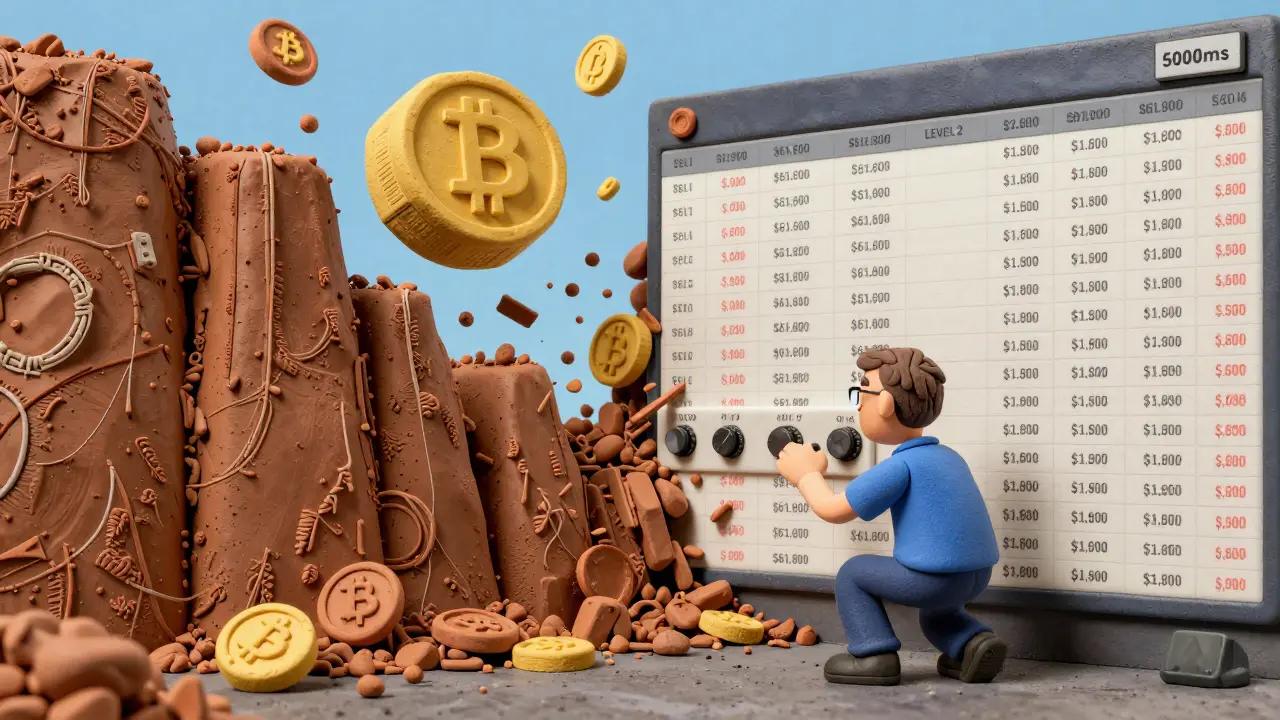
Level 2 Data: The Real Game Changer
Retail traders often only see the top bid and ask. But market makers use Level 2 data-the full depth of the order book. They see not just that $62,000 is the current price, but that there are 1,200 BTC sitting at $61,950, 850 BTC at $61,900, and 3,100 BTC at $61,850.That’s critical. If someone tries to buy 5,000 BTC at market, the system will eat through all those levels. The price will jump. A smart market maker sees that coming and adjusts. They might pull their sell orders slightly before the big buy hits, then re-enter at the new higher price. Or they might aggressively buy before the surge, betting they can sell later at a profit.
Some firms even use order book replay tools to simulate past trades. They load a day’s worth of data and test how their strategy would’ve performed. Did they get filled? Did they lose money on slippage? Did they miss a trend? These simulations are how they improve.
Market Makers on Decentralized Exchanges
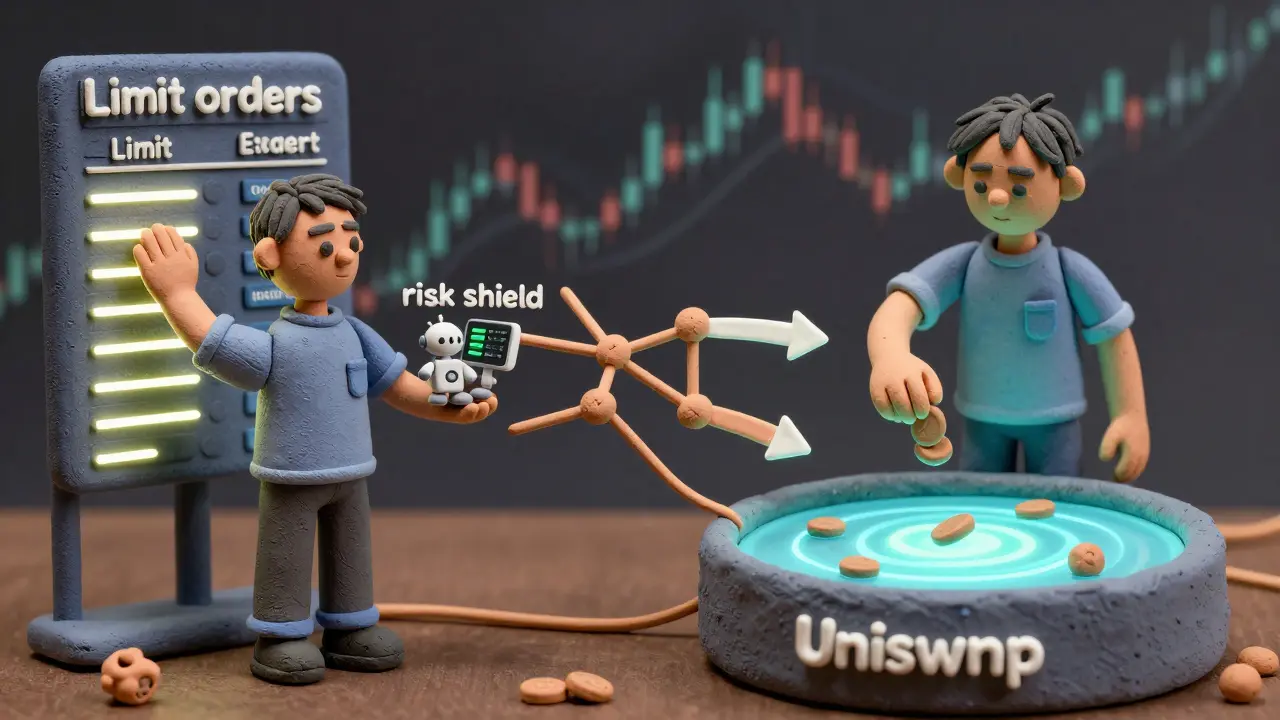
On centralized exchanges, order books are managed by a single entity. On decentralized exchanges (DEXs) like Uniswap or SushiSwap, things work differently. There’s no traditional order book. Instead, automated market makers (AMMs) use liquidity pools and mathematical formulas to set prices.But even here, market makers are adapting. Some firms now operate on both sides: placing limit orders on centralized exchanges while supplying liquidity to DEX pools. They’re not just market makers anymore-they’re liquidity optimizers.
The challenge? On DEXs, trades happen without price discovery. If a big whale dumps 100 ETH into a pool, the price crashes instantly. Market makers on DEXs can’t just adjust quotes-they have to predict when liquidity will be drained and when it will refill. They use tools that track pool reserves, transaction volume, and front-running signals to stay ahead.
Technology Is the Edge
You can’t be a market maker today without serious tech. The fastest firms use co-located servers-physical machines right next to the exchange’s matching engine. Latency matters. A 5-millisecond delay can mean the difference between a filled order and a missed opportunity.They also use:
- Real-time position trackers that update every millisecond
- Automated rebalancing bots that shift inventory across exchanges
- Arbitrage detectors that spot price differences between Binance, Coinbase, and Kraken in under 100 microseconds
- Margin and collateral monitors that prevent liquidations during volatile swings
Some even use machine learning to predict order flow. If a pattern shows that every time a large buy order hits at $61,900, the price spikes 0.8% in the next 30 seconds, the system learns to place buy orders just before that level. It’s not luck. It’s pattern recognition at scale.
Why Market Makers Matter
Without market makers, crypto markets would be choppy and slow. Imagine trying to buy 10 BTC and having to wait 20 minutes because no one’s willing to sell. Or seeing the price jump 5% because one big order drained the liquidity. That’s what happens without market makers.They reduce slippage. They tighten spreads. They keep markets stable during panic sells or FOMO rallies. In crypto, where retail traders dominate and news can move prices in seconds, their role is even more critical.
They’re not the heroes of crypto. They don’t get headlines. But every time you trade smoothly, without a surprise spike or dip, you’re benefiting from their quiet, constant work.
What Happens When Market Makers Pull Out?
When liquidity dries up, prices become erratic. In 2022, during the TerraUSD collapse, some DEXs saw bid-ask spreads widen from 0.1% to over 10%. Traders couldn’t exit positions without massive losses. Market makers had pulled back, overwhelmed by risk.That’s the flip side. Market makers aren’t charities. They’ll walk away if the risk outweighs the reward. When volatility spikes, when regulations tighten, or when fees rise too high, they reduce activity. That’s when retail traders feel the pain.
So the next time you trade, remember: you’re not just buying or selling. You’re interacting with a complex, high-speed system designed to keep everything running-even when no one’s watching.
Do market makers manipulate prices?
Market makers don’t manipulate prices in the illegal sense. They don’t spread false rumors or fake trades. But they do exploit small inefficiencies. If they see a large buy order coming, they might slightly raise their sell price to capture more profit. That’s not manipulation-it’s how markets work. The key difference is they provide liquidity, not misinformation.
Can retail traders use order books like market makers?
Yes, but it’s hard. Retail traders can view Level 2 data on most major exchanges. But without real-time algorithms, co-location, or automated risk tools, they’re at a disadvantage. Trying to scalp spreads like a pro firm is like racing a Formula 1 car with bicycle tires. You can try, but you’ll lose more often than not. Better to focus on longer-term strategies.
How do market makers handle sudden price drops?
They have stop-gaps built into their systems. If an asset drops 5% in under 10 seconds, their risk engine triggers. They may cancel all sell orders, pause new buys, or shift inventory to less volatile assets. Some firms have pre-programmed “circuit breakers” that shut down trading for 30-60 seconds during extreme moves. It’s not panic-it’s protocol.
Are market makers the same as liquidity providers on DEXs?
Similar, but not the same. On centralized exchanges, market makers place limit orders and earn from spreads. On DEXs, liquidity providers deposit assets into pools and earn fees from trades. Market makers on DEXs often do both: they supply liquidity and also place limit orders on centralized platforms to hedge risk. Their goal is the same-profit from liquidity-but the tools and risks differ.
What’s the biggest mistake new market makers make?
Overleveraging. Many think they can make big profits by posting huge orders. But if the market moves against them, they get stuck with too much inventory and can’t exit. Successful market makers keep positions small, adjust constantly, and never bet their entire capital on one asset. It’s not about how much you trade-it’s about how well you manage risk.
Tiffani Frey
January 6, 2026 AT 19:39I've been watching order books on Binance for months now-especially during volatile hours. What's fascinating is how subtle the adjustments are. A market maker might nudge a bid up by 50 cents just because they saw three large buy orders cluster at $61,900 in the last 200ms. It's not manipulation; it's pattern recognition. I used to think spreads were just static, but now I see them as living things-breathing, shifting, reacting.
And Level 2? It's like seeing the hidden layers of a city. Most people only notice the main roads. But the real action's in the alleys-the hidden liquidity pools, the silent sell walls, the ghost orders that vanish the second you try to hit them.
I don't trade like this. I'm not fast enough. But understanding it? That's made me a calmer investor. I stop panicking when spreads widen. I know it's not the market collapsing-it's just the makers stepping back to catch their breath.
Also, the fact that they use co-located servers? That's not cheating. It's like having a VIP entrance at a concert. Everyone else waits in line. They walk right in. It's capitalism. It's efficiency. It's just not fair.
Still... I respect it. They're the unsung engineers keeping the whole system from collapsing every time a tweet drops.
Ritu Singh
January 7, 2026 AT 04:50Market makers aren't just making spreads they're the invisible hand that's been holding the puppet strings since day one. You think Bitcoin is price discovered? No. It's priced by algorithms feeding off each other in a feedback loop designed to extract every penny from retail like you. The 'liquidity' they provide? It's a trap. They bait you with tight spreads then vanish when you need them most-like during a crash. And don't get me started on DEXs. Those liquidity pools? They're just sandcastles built on blockchain sand. One whale sneezes and your entire position evaporates. They call it DeFi. I call it financial vampirism. The system isn't broken-it's designed to make you lose. And they're the ones pulling the plug.
Surendra Chopde
January 9, 2026 AT 02:42Jennah Grant
January 9, 2026 AT 11:42What’s often missed is that market makers aren’t just reacting-they’re shaping microstructure. Their algorithms don’t just respond to order flow; they nudge it. A well-placed limit order can trigger a cascade of stop-losses or FOMO buys. That’s not manipulation-it’s structural influence. And yes, retail traders can use Level 2 data, but without real-time risk engines, you’re essentially trying to play chess with a blindfold while your opponent has a full board view. The asymmetry isn’t accidental. It’s baked into the system. That said, understanding this doesn’t make you a market maker-it just makes you less likely to get slaughtered by one.
Becky Chenier
January 10, 2026 AT 13:17After reading this, I finally get why spreads tighten during quiet hours and balloon during news events. It’s not about greed-it’s about risk calibration. Market makers aren’t villains. They’re the shock absorbers. When they pull back, the market jolts. That’s why liquidity matters more than volume. I used to think high volume meant strong market. Now I know: it’s the depth behind the volume that keeps you from getting crushed.