How to Reduce Blockchain Transaction Fees: Proven Strategies That Save Money
 Jan, 1 2026
Blockchain transaction fees can feel like a hidden tax. One minute you're sending $100 in Bitcoin or Ethereum, the next you're paying $15 in fees. That’s not just annoying-it’s unsustainable, especially if you’re making regular payments, running a business, or trading frequently. The good news? You don’t have to accept it. With the right strategies, you can slash your blockchain fees by 70% or more without sacrificing speed or security.
Understand Why Fees Exist
Blockchain fees aren’t arbitrary. They’re payments to validators or miners who secure the network and process your transaction. When demand is high-like during a NFT drop or a major price surge-networks get congested. More people are competing for limited space in each block, so fees go up. Simple transactions cost less. Complex ones-like interacting with DeFi protocols or smart contracts-cost more because they take up more space.On Ethereum, fees are measured in gas. On Bitcoin, they’re based on transaction size in bytes. Solana, by contrast, charges around $0.007 per transaction because its architecture handles thousands of operations per second. Knowing how your chosen blockchain works is the first step to cutting costs.
Time Your Transactions
One of the easiest ways to save money is to avoid peak hours. Network congestion follows patterns. On Ethereum, fees spike during U.S. business hours (9 AM-5 PM ET) and around major crypto news events. The quietest times? Late at night (12 AM-4 AM ET) and weekends.Use tools like Mempool.space or Etherscan’s Gas Tracker to see real-time fee estimates. If you see the recommended fee at $10, wait an hour. It might drop to $2. You don’t need to be perfect-just patient. A 20-minute delay can cut your fee by 80%.
Set up alerts for low-fee windows. Many wallets like MetaMask and Klever let you schedule transactions. You can even automate this with scripts if you’re tech-savvy. The savings add up fast. If you make 10 transactions a week at $5 each, switching to $1 fees saves you $40 a week-over $2,000 a year.
Batch Your Transactions
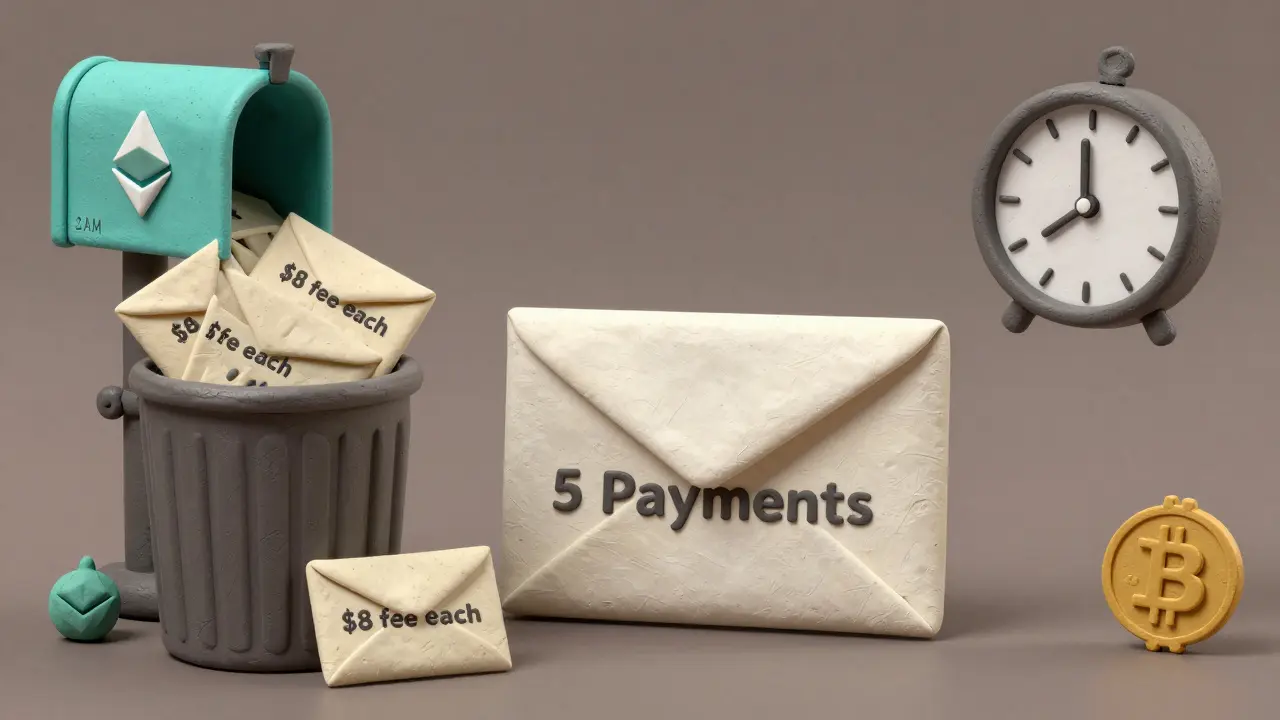
Instead of sending five separate $20 payments, combine them into one transaction. This is called transaction batching. It’s like mailing five letters in one envelope instead of five envelopes.Bitcoin and Ethereum wallets that support batching include BitGo, BlueWallet, and Electrum. Some DeFi platforms like Aave and Compound allow you to batch multiple actions-like depositing, borrowing, and repaying-into a single smart contract call.
Here’s how it works: If you normally pay five suppliers in crypto, each costing $8 in gas, you’re spending $40. With batching, you send one transaction with five outputs. The fee? Around $10-$15. That’s a 60-75% cut.
Businesses using this method report saving hundreds to thousands monthly. A logistics company using blockchain to pay suppliers cut their payment processing fees by 40% in 2024 by switching to batched stablecoin transfers.
Use Layer 2 Solutions
Layer 2 (L2) networks are the biggest game-changer for reducing fees. They run on top of main blockchains like Ethereum or Bitcoin but handle transactions off-chain, then settle them in bulk. The result? Fees drop from dollars to cents.For Ethereum users, Optimism and Arbitrum are the most popular. Sending ETH or USDC on Arbitrum costs less than $0.10-sometimes under $0.01. The Lightning Network does the same for Bitcoin, enabling instant, near-free micropayments.
Switching is simple: Bridge your funds from Ethereum to Arbitrum using a trusted wallet like MetaMask. Once there, you interact with L2 dApps as if you’re on the main chain. When you want to move funds back, you wait a short period (usually 7-24 hours) for the final settlement.
Stablecoins like USDC and DAI are ideal for L2 use. Circle reports average USDC transfers on Ethereum cost less than 1% of the transaction value. On Arbitrum? Less than 0.01%. That’s a 99% reduction.
Pay Fees in Native Tokens
Some wallets and exchanges offer fee discounts if you pay in their native token. Klever Wallet, for example, lets you pay swap fees in KLV-their utility token-and automatically applies a discount of up to 50%. Similar programs exist on Binance (BNB), Solana (SOL), and Polygon (MATIC).It’s not just about discounts. Holding the native token often gives you access to exclusive features: lower withdrawal limits, priority support, or even staking rewards that offset fees over time. The Klever Rewards Hub lets you earn points for daily actions like logging in or swapping tokens. Those points can be redeemed to cover future swap fees.
Don’t just hold tokens-use them. If you’re already trading on a platform, holding its native token isn’t speculation-it’s a cost-saving tool.
Switch to Stablecoins for Payments
Stablecoins like USDC, USDT, and DAI are pegged to the U.S. dollar. They’re the secret weapon for businesses and individuals making frequent payments.Traditional payment processors like PayPal and Stripe charge 2.9% + $0.30 per transaction. For a $1,000 sale, that’s $32.20 in fees. With USDC on Arbitrum? Around $0.05. That’s a 99.8% reduction.
Plus, no currency conversion fees. If you’re paying a vendor in Mexico or Vietnam, traditional banks charge 1-5% to convert USD to local currency. With stablecoins, the recipient gets USD-equivalent value instantly-no middlemen, no hidden spreads.
Companies like Bitwage use stablecoins for payroll. Employees get paid in USDC, settle in seconds, 24/7, and pay almost nothing in fees. One user reported slashing payroll costs from 3.5% to 0.1%-saving $12,000 annually on a $400,000 payroll.
Use Replace-by-Fee (RBF) Wisely
If your transaction gets stuck because you set the fee too low, don’t panic. On Bitcoin and some Ethereum wallets, you can use Replace-by-Fee (RBF). This lets you resend the same transaction with a higher fee to speed it up.It’s not a hack-it’s a built-in safety net. You don’t have to overpay upfront. Set a low initial fee, and if the network gets busy, bump it up only if needed. Tools like Bitcoin Core and Electrum support RBF out of the box.
Don’t use RBF as a crutch. It’s for emergencies. But when used right, it prevents you from wasting money on unnecessarily high fees.

Compare Blockchains Before Sending
Not all blockchains are created equal. Ethereum might be the most popular, but it’s not always the cheapest.Here’s a quick comparison of average transaction fees in early 2026:
| Blockchain | Average Fee | Speed | Best For |
|---|---|---|---|
| Solana | $0.007 | 2-5 seconds | High-frequency trading, NFTs |
| Arbitrum (Ethereum L2) | $0.01-$0.10 | 1-3 minutes | DeFi, stablecoin transfers |
| Bitcoin | $1-$5 | 10-60 minutes | Large-value transfers, long-term holding |
| Ethereum (L1) | $2-$20 | 15-120 seconds | Smart contracts, dApps |
| Polygon | $0.01-$0.05 | 2-4 seconds | Low-cost apps, gaming |
For most users, Solana or Arbitrum are the smartest choices. If you’re sending small amounts frequently, go with Solana. If you’re interacting with Ethereum-based DeFi, use Arbitrum. You’re not abandoning Ethereum-you’re just using a faster, cheaper version of it.
Eliminate Intermediaries
Traditional finance adds layer after layer of fees: banks, payment processors, currency exchangers, clearinghouses. Each one takes a cut.Blockchain cuts that out. When you send crypto directly from wallet to wallet, there’s no bank in between. No intermediary. No hidden fees. That’s why crypto payments are often cheaper than cash.
Even better: smart contracts can automate payments without human intervention. A freelance designer can set up a contract that pays them automatically when a client approves the work. No PayPal invoice. No waiting 3 days. No 3% fee. Just instant, trustless payment.
Real-World Savings
An e-commerce store doing $500,000 in annual sales used to pay $35,000 in PayPal and Stripe fees. After switching to USDC payments via Arbitrum, their fees dropped to $5,000. That’s $30,000 back in profit-enough to hire two new staff members.A small business in Nigeria paying suppliers in the U.S. used to pay $330 in fees to send $10,000 via Western Union. Now they use USDC on Solana. Same amount. Same speed. $2 in fees.
These aren’t hypotheticals. They’re happening right now. And the trend is accelerating. Deloitte predicts blockchain will save corporations over $50 billion in cross-border fees by 2030.
Start Simple, Scale Smart
You don’t need to overhaul your whole system overnight. Start with one change:- Check your next transaction’s fee. Wait 2 hours. Send it during a low-fee window.
- Try sending your next payment in USDC instead of USD via PayPal.
- Use Klever or MetaMask with KLV or ETH to pay fees in native tokens.
Once you see the savings, add another tactic. Batch your next five payments. Bridge to Arbitrum. Set up a recurring payroll in stablecoins.
The goal isn’t to become a blockchain expert. It’s to pay less. And with these tools, you can do that-easily, reliably, and at scale.
Why are blockchain transaction fees so high sometimes?
Fees go up when the network is congested-too many people trying to send transactions at once. Blockchains have limited space per block, so users compete by offering higher fees. This happens during crypto bull runs, NFT launches, or major news events. Waiting for quieter times or using Layer 2 networks can avoid these spikes.
Can I avoid fees entirely on blockchain?
No, you can’t avoid fees entirely. Even the cheapest blockchains like Solana charge a tiny amount-around $0.007-to cover validation and security. But you can reduce fees to near-zero for most use cases. Layer 2 solutions and batching make fees so low they’re practically negligible compared to traditional systems.
Is it safe to use Layer 2 networks like Arbitrum or Optimism?
Yes. Arbitrum and Optimism are built on Ethereum and inherit its security. Funds are locked in a smart contract on Ethereum, and withdrawals are verified by cryptographic proofs. Millions of dollars flow through these networks daily. Major DeFi apps like Uniswap and Aave operate on them. They’re not experimental-they’re the future of scalable crypto.
What’s the cheapest blockchain for daily payments?
For most people, Solana or Arbitrum are the cheapest. Solana handles over 65,000 transactions per second with fees under a penny. Arbitrum is ideal if you’re using Ethereum-based apps like DeFi or NFTs. Both are far cheaper than Ethereum’s main chain or traditional payment processors.
Do stablecoins have lower fees than Bitcoin or Ethereum?
Yes, especially when sent on Layer 2 networks. Sending USDC on Arbitrum costs less than $0.10. Sending the same amount on Ethereum mainnet could cost $5-$20. On Bitcoin, fees vary but often exceed $1. Stablecoins on L2s are the most cost-effective way to move value globally.
How do I know if my wallet supports transaction batching?
Check your wallet’s settings or documentation. Wallets like BitGo, BlueWallet, Electrum, and some versions of MetaMask support batching. If you’re sending multiple payments to different addresses, look for an option like "Batch Send" or "Multiple Outputs." If it’s not there, consider switching to a wallet that offers it-especially if you make frequent payments.
Are there any risks in trying to reduce blockchain fees?
The biggest risk is using untrusted bridges or wallets. Always use official, audited platforms like Arbitrum, Optimism, or MetaMask. Never send funds to a random website promising "free transactions." Also, if you use RBF, make sure your wallet supports it-otherwise you might accidentally double-spend. Stick to proven methods and avoid gimmicks.
Vernon Hughes
January 1, 2026 AT 08:38Been using Arbitrum for all my stablecoin swaps for six months now. Fees are literally pennies. I used to hate sending ETH because of the gas spikes, now I just do it without thinking. No more stress about timing or waiting. It’s like switching from a horse carriage to a Tesla.
Alison Hall
January 3, 2026 AT 07:36Batching saved me over $300 last year. I pay five freelancers weekly and used to pay $50 in fees. Now it’s $5. Game changer. Seriously, if you’re doing recurring crypto payments, this is step one.
Amy Garrett
January 4, 2026 AT 20:40solana is the real MVP frfr. $0.007?! i thought that was a typo. now i just send everything there and forget about fees. also why is everyone still using eth l1 like it’s 2021??
Phil McGinnis
January 5, 2026 AT 11:18It is regrettable that the article presumes the reader is technologically literate. The notion that ordinary individuals should navigate Layer 2 bridges, native token economics, and transaction batching is not merely impractical-it is elitist. The average person cannot be expected to become a blockchain engineer to send $20 to a friend. This is not financial liberation; it is exclusion disguised as innovation.
Ian Koerich Maciel
January 6, 2026 AT 03:05Thank you for this exceptionally well-researched and clearly articulated guide. The inclusion of concrete, real-world examples-particularly the Nigerian supplier case and the e-commerce store’s $30,000 savings-is profoundly persuasive. I have shared this with my accounting team, and we are implementing stablecoin payroll next quarter. The precision of the data, the absence of hyperbole, and the emphasis on security protocols (e.g., audited bridges) reflect a rare level of integrity in crypto content. Kudos.
Andy Reynolds
January 7, 2026 AT 05:27Let me tell you, I used to think blockchain was just a fancy way to waste money on fees. Then I tried sending USDC on Arbitrum to pay my buddy for his podcast editing. Paid $0.03. He got it in 90 seconds. He didn’t even know what a Layer 2 was. He just saw his balance go up. That’s the magic. It’s not about tech jargon-it’s about making money move like water, not molasses. Now I batch all my crypto bills like I’m sending one big digital envelope to the universe. And it just… works. No drama. No panic. Just clean, quiet, cheap money flow. This isn’t the future-it’s the present. And it’s beautiful.
Alex Strachan
January 8, 2026 AT 09:17Wow. So we’re supposed to be impressed that you figured out how to not pay $15 to send $100? 🤡 I’ve been doing this since 2017. Also, why is everyone suddenly acting like Solana isn’t just a meme with a blockchain? Next you’ll tell me the Lightning Network is ‘revolutionary.’ Newsflash: it’s been around longer than most of you have had smartphones. But hey, at least you’re not paying $20 in gas anymore. Congrats. 🎉