iCE3 Crypto Exchange Review: What Happened and Why Users Lost Trust
 Dec, 10 2025
Crypto Exchange Safety Checker
How Safe Is Your Crypto Exchange?
Based on the iCE3 collapse, this tool helps you verify if an exchange meets minimum security standards. Never trust exchanges that don't control their own keys.
Exchange Information
Security Criteria
When you’re new to cryptocurrency in South Africa or Nigeria, finding a local exchange that lets you deposit with a credit card or bank transfer feels like a lifeline. That’s what iCE3 promised - a simple way to buy Bitcoin and Litecoin without needing a foreign bank account. But by early 2025, that lifeline vanished. iCE3 didn’t just shut down. It froze every Bitcoin and Litecoin withdrawal, citing "discrepancies in balances" with its payment partners. And now, over a year later, users still don’t know if their money is coming back.
How iCE3 Got Started - And Why It Mattered
iCE3 launched with a clear mission: make crypto accessible in regions where traditional banking doesn’t reach. Most global exchanges like Binance or Coinbase don’t support direct wire transfers from Nigerian or South African banks. iCE3 filled that gap. You could deposit Naira or Rand using credit cards or local bank transfers. For someone without a Visa card linked to a foreign account, that was huge. It wasn’t fancy. No advanced trading tools. No margin trading. No API for bots. But it did one thing well - it let people in Africa buy crypto without jumping through hoops. That’s why it gained traction. Especially among younger users who saw crypto as a way to protect savings from inflation.The Red Flags No One Noticed (Until It Was Too Late)
iCE3 claimed to have two-factor authentication (2FA), manual reviews for suspicious transactions, and regular security updates. Sounds good on paper. But here’s what they didn’t say:- They didn’t store user funds in cold wallets - the industry standard for security.
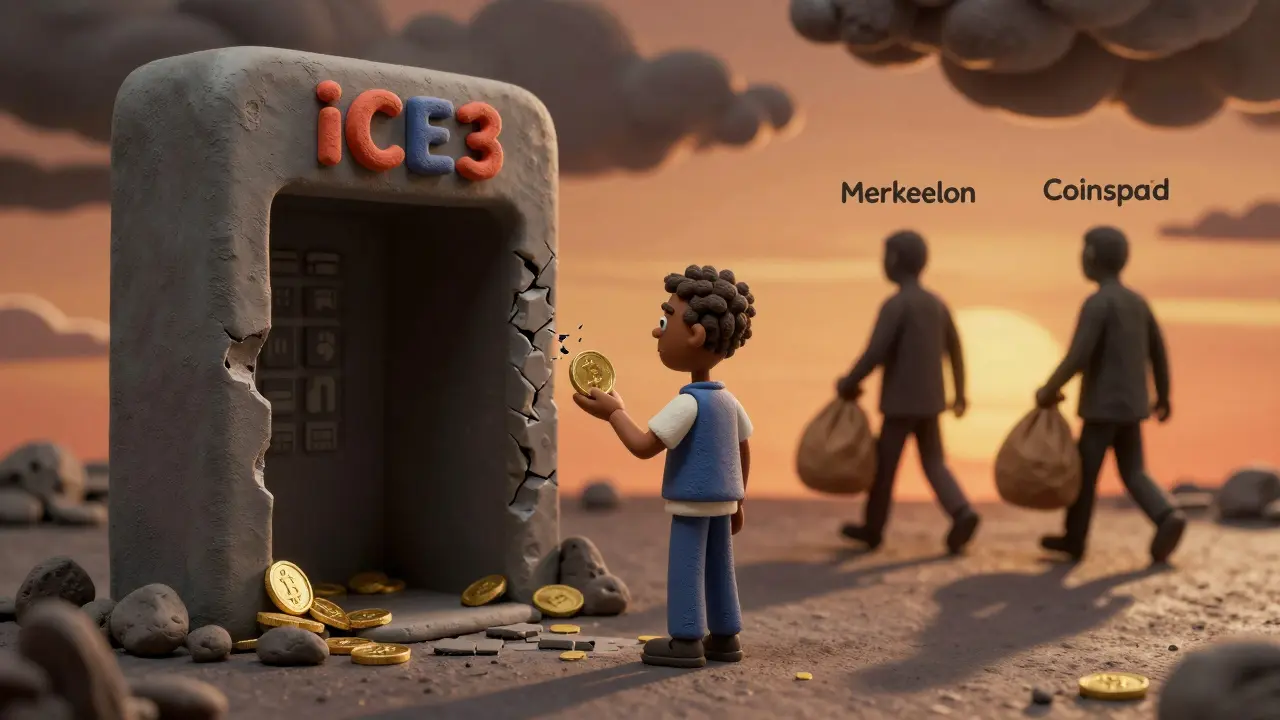
- They relied entirely on two third-party partners: Merkeleon.com and Coinspaid.com to hold and manage Bitcoin and Litecoin.
- There was no public proof they used multi-signature wallets or conducted independent audits.
The Suspension: What Actually Happened?
In late 2024, iCE3 quietly stopped all BTC and LTC withdrawals. Their official statement was vague: "Discrepancies in balances." No numbers. No timeline. No explanation of whether it was a technical glitch, human error, or fraud. They blamed Merkeleon.com and Coinspaid.com. But here’s the problem: those partners aren’t regulated financial institutions. They’re payment processors. They don’t have the infrastructure to hold billions in crypto. They’re not designed to be custodians. And yet, iCE3 put all their users’ Bitcoin and Litecoin there. This isn’t a hack. It’s a custody failure. A classic case of an exchange outsourcing the most critical part of their business - holding user funds - to someone who shouldn’t be holding them at all.
Why This Isn’t Just a "Technical Issue"
If iCE3 had used cold storage with multi-sig wallets and daily reconciliation checks, they’d have caught the discrepancy within hours - not months. Top exchanges like Kraken and Bitstamp audit their balances daily. They use hardware security modules. They track every movement of funds in real time. iCE3 had manual checks. That means a single employee had to look at spreadsheets and hope nothing slipped through. No alerts. No automation. No backups. Just hope. And when the discrepancy showed up? No public update. No user communication. No hotline. No timeline. That’s not how you handle a crisis. That’s how you lose trust forever.What Users Lost - And What They Can’t Get Back
Thousands of people had Bitcoin and Litecoin on iCE3. Some were holding small amounts for learning. Others had saved months of income. Now, they’re stuck. No refunds. No refunds. No official recovery plan. There’s no lawsuit. No regulator stepping in. No public ledger showing where the funds went. The partners involved - Merkeleon and Coinspaid - have no public statements. No transparency. Just silence. Compare that to what happened with Mt. Gox. Even after a decade, users got some money back because there was a court process, a trustee, and public filings. With iCE3? There’s nothing. Just a website that says "services suspended" and a link to a legal notice no one understands.How iCE3 Compared to Other African Exchanges
Other exchanges serving African users - like Luno, Paxful, and Yellow Card - have different models. Luno stores 95% of funds in cold storage. Paxful uses peer-to-peer trading so users hold their own keys. Yellow Card partners with regulated financial institutions in South Africa. None of them outsource custody to unverified payment processors. None of them rely on manual reviews. All of them publish clear security policies. iCE3 didn’t. And now, they’re the cautionary tale.
What You Should Do If You Used iCE3
If you had funds on iCE3:- Save every email, transaction ID, and screenshot you have.
- Check if your country’s financial regulator has issued any guidance (South Africa’s FSCA or Nigeria’s SEC).
- Join user groups on Telegram or Reddit - even if there’s no official update, others may have legal advice.
- Don’t fall for scams promising to "recover your funds" for a fee. They’re targeting people in desperation.
How to Pick a Safe Crypto Exchange Today
If you’re still trading crypto in Africa, here’s what to look for:- Cold storage: At least 90% of user funds must be offline.
- Multi-signature wallets: Requires multiple approvals to move funds.
- Regular audits: Look for public reports from firms like CertiK or Hacken.
- Regulatory compliance: Does the exchange mention licensing from FSCA, SEC Nigeria, or other authorities?
- Transparency: Do they post updates during incidents? Or do they disappear?
The Bigger Lesson
iCE3 didn’t fail because crypto is risky. It failed because it ignored the most basic rule of crypto: if you don’t control it, you don’t own it. The African crypto market is growing fast. In 2023, Africa received $132.5 billion in crypto transactions. That’s real demand. But without trust, that growth stalls. iCE3’s collapse didn’t just hurt its users. It made it harder for honest exchanges to earn trust. The next time you choose a platform, ask: "Who holds my money?" If the answer is "I don’t know," walk away.Is iCE3 still operating?
No. iCE3 suspended all Bitcoin and Litecoin withdrawals in late 2024 and has not resumed trading. Deposits and withdrawals remain blocked with no official timeline for restoration.
Can I get my Bitcoin or Litecoin back from iCE3?
There is no confirmed recovery plan. iCE3 has not disclosed the cause of the balance discrepancies or the status of user funds. Without regulatory oversight or public audits, the chances of recovering funds are extremely low.
Why did iCE3 use Merkeleon and Coinspaid to hold user funds?
iCE3 likely used these partners to simplify deposit processing and avoid the cost of building their own custody infrastructure. But this violated core crypto security principles - user funds should never be held by third-party payment processors without independent verification and cold storage.
Was iCE3 regulated?
iCE3 never publicly disclosed any regulatory licensing from authorities like South Africa’s FSCA or Nigeria’s SEC. This lack of transparency is a major red flag, as legitimate exchanges in regulated markets are required to disclose their compliance status.
What should I use instead of iCE3 in Africa?
Consider Luno (regulated in South Africa), Yellow Card (licensed in Nigeria), or Paxful (P2P model where you hold your own keys). All three use cold storage, provide clear security policies, and have public track records of handling user funds responsibly.
Albert Chau
December 10, 2025 AT 14:48This is why I tell everyone: if you don’t control your keys, you’re just renting crypto. iCE3 wasn’t an exchange-they were a middleman with a shiny website and zero backbone. And now? Users are left holding digital bagged potatoes. Classic.
It’s not even surprising. Anyone who uses credit card deposits without cold storage is basically saying, ‘Hey, steal my users’ money.’
I’ve seen this script play out a dozen times. The only difference this time? The victims were people who actually needed it. That’s the real tragedy.
And don’t get me started on those ‘payment processors’-Merkeleon and Coinspaid? They’re not custodians. They’re glorified PayPal for crypto junkies. Why would any sane person let them hold billions?
It’s like trusting your life savings to a guy who runs a pop-up stand at a flea market. You don’t ask for receipts-you just pray.
And now? Silence. No emails. No updates. Just a ghost site with a legal disclaimer written in 12-point font no one can read.
They didn’t get hacked. They got lazy. And now Africa’s crypto trust just took another bullet.
Next time someone tells you ‘it’s just a small exchange,’ walk away. The smallest ones are the deadliest.
Also-why are people still using credit cards to buy crypto? That’s like using a credit card to buy a house. You’re asking for trouble.
Save your money. Buy on P2P. Hold your keys. Or don’t bother at all.
Rest in peace, iCE3. You were a bad idea with a good marketing team.
Madison Surface
December 12, 2025 AT 12:13I just want to say-I know so many people who put their entire savings into iCE3. Some were students. Some were single moms. Some were retired teachers trying to hedge against inflation.
They didn’t want to be traders. They just wanted to protect what little they had.
And now? They’re sitting there, staring at a frozen balance, wondering if they’ll ever see their money again.
I’m not mad at them for trusting iCE3. I’m mad at the system that lets these things happen.
No one warned them. No one regulated them. No one even bothered to check if the ‘partners’ could actually hold crypto securely.
It’s heartbreaking.
And the worst part? The people who lost the most? They’re the ones who can’t afford to lose it.
If you’re reading this and you’ve got even a little crypto-please, please, please-use Luno or Yellow Card. Or better yet, buy directly from someone you trust and store it in your own wallet.
We don’t need more ‘convenient’ platforms.
We need safer ones.
And we need to stop pretending that ‘easy’ means ‘safe.’
It doesn’t.
Not even close.
Tiffany M
December 13, 2025 AT 13:00Okay, but let’s be real-why did anyone think this was a good idea??
They used TWO random payment processors to hold user funds?? Who approved this? A 19-year-old intern with a Canva account??
And then they had the nerve to call it ‘2FA’ and ‘manual reviews’ like that’s a security feature??
Manual reviews?? In 2025??
That’s like saying your house is safe because you check the front door once a week.
And now they’re blaming Merkeleon and Coinspaid?? Bro. THEY WERE THE ENTIRE SYSTEM.
It’s not a ‘discrepancy.’ It’s a total collapse.
And the fact that no one’s talking about this? That’s the real scandal.
Meanwhile, people in Lagos and Cape Town are still checking their apps every hour, hoping the balance magically reappears.
It’s not going to.
And the worst part? This is going to make it harder for REAL African crypto startups to get traction.
Because now everyone’s gonna think ‘all African exchanges are scams.’
And that’s the real loss.
Not the Bitcoin.
The trust.
Jessica Petry
December 15, 2025 AT 05:57Look, I’m not surprised. This is exactly what happens when you let ‘accessibility’ override security.
People want to buy crypto with a credit card? Fine. But don’t pretend that’s ‘financial inclusion.’ It’s financial recklessness.
And now you want me to feel bad for them? No.
They ignored the basic tenets of crypto: custody, decentralization, self-sovereignty.
They chose convenience over control.
And now they’re crying because the house of cards collapsed.
It’s not a tragedy.
It’s a lesson.
And if you’re still using an exchange that doesn’t publish its cold storage proofs? You’re not a victim.
You’re a participant.
So stop pretending you were innocent.
You weren’t.
You just didn’t do the homework.
And that’s on you.
Scot Sorenson
December 17, 2025 AT 04:26Let me get this straight-iCE3 didn’t get hacked.
They just… forgot to secure their users’ money?
That’s not incompetence.
That’s negligence dressed up as ‘innovation.’
And now they’re hiding behind ‘discrepancies in balances’ like it’s a technical glitch?
Bro. You outsourced custody to two sketchy payment processors.
That’s not a glitch.
That’s fraud by omission.
And the fact that no one’s calling this out as a scam? That’s the real scam.
Where’s the SEC? Where’s the FSCA? Where’s the media?
Because if this was a Wall Street firm doing this? They’d be in court by now.
But it’s Africa? Eh. Let ‘em figure it out.
Classic.
And now users are being told to ‘join Telegram groups’ like that’s a solution?
That’s not community.
That’s a support group for people who got scammed.
And the worst part? This isn’t even rare.
It’s the norm.
So yeah. Congrats, iCE3.
You didn’t just fail.
You defined the new standard for crypto mediocrity.
Caroline Fletcher
December 18, 2025 AT 22:23They’re all in on it. The whole thing. iCE3, Merkeleon, Coinspaid-they’re all the same people. This was a pump-and-dump. The ‘discrepancies’? Fake. The ‘suspension’? A cover-up. The website still up? To keep people calm while they move the funds to offshore wallets. I’ve seen this before. They always do. The ‘legal notice’? A distraction. They’re using AI bots to reply to comments so it looks like they’re still active. Don’t believe the silence. That’s the loudest lie of all.
Steven Ellis
December 20, 2025 AT 11:06Let’s not lose sight of the forest for the trees here.
iCE3 didn’t just fail-it exposed a systemic flaw in how we’ve been selling crypto to emerging markets.
We told people, ‘Just click here, deposit your Rand, get your Bitcoin.’
We didn’t say: ‘Understand custody. Learn about key management. Know who holds your assets.’
We treated crypto like a mobile app. Not a financial revolution.
And now, when the platform vanishes, people don’t just lose money-they lose faith in the entire concept.
This isn’t just about iCE3.
This is about the responsibility of every educator, influencer, and platform that told African users, ‘It’s safe because it’s easy.’
It’s not.
And if we keep doing this, we’re not building a crypto future.
We’re building a graveyard of broken dreams.
So yes-use Luno. Use Yellow Card. Use P2P.
But more importantly-teach people why those choices matter.
Because knowledge isn’t just power.
In crypto, it’s the only thing that keeps you alive.