Immutability in Smart Contracts: Weighing the Risks and Benefits
 Jul, 26 2026
Imagine signing a contract that literally cannot be changed. No lawyers can rewrite the terms. No CEO can add a hidden clause. Once it’s on the blockchain, it stays there forever. That is the promise of smart contract immutability, which ensures code deployed on a blockchain remains unalterable after deployment. It sounds like the ultimate guarantee of trust. But what happens when you find a bug? Or when laws change? This double-edged sword defines modern decentralized finance (DeFi) and enterprise blockchain adoption.
We often hear that blockchains are 'immutable.' But that word hides a complex reality. The code might be frozen, but the data inside can shift. The rules stay the same, but the outcomes evolve. Understanding this distinction isn't just for developers; it's crucial for anyone putting money into DeFi protocols or relying on blockchain for business settlements.
The Core Promise: Why Immutability Matters
At its heart, immutability solves the problem of counterparty risk. In traditional banking, you trust the bank to keep your records accurate. In blockchain, you trust the math. When Vitalik Buterin launched Ethereum in July 2015, he positioned this unchangeable nature as a core security feature. It means no single party can unilaterally alter the agreement.
This creates a 'trustless' environment. You don’t need to know the developer personally. You just need to verify the code hasn’t changed since the audit date. Take Uniswap V2, for example. Its immutable contracts have facilitated over $1.2 trillion in trading volume since May 2020 without any code modifications. Users deposit funds knowing the logic governing their trades is fixed and transparent. This certainty is why JPMorgan uses fully immutable contracts for its JPM Coin system, processing $1.2 billion daily with settlement finality that traditional systems struggle to match.
Harvard Law School noted in 2018 that because the code is replicated across multiple nodes, it benefits from the permanence that blockchain offers. For legal agreements, this reduces enforcement costs significantly. If the code says 'transfer X when Y happens,' it will do exactly that, every time, unless the entire network agrees otherwise.
The Hidden Risk: Bugs Are Permanent
If immutability is so great, why do developers worry about it? Because humans make mistakes. And in an immutable world, mistakes are expensive. When a vulnerability is discovered in truly immutable code, it cannot be patched. The only fix is a hard fork-a controversial process requiring community consensus-or accepting the loss.
Consider the Parity Wallet hack in July 2017. A bug in the code allowed attackers to freeze $60 million worth of Ether. Because the contracts were immutable, the funds remained stuck. There was no 'admin key' to unlock them. The Cambridge Centre for Alternative Finance quantified this risk: while protocols using immutable contracts experienced 37% fewer security incidents overall, 100% of the vulnerabilities that *were* found remained permanently exploitable.
For developers, the pressure is immense. One senior developer on Ethereum Stack Exchange documented spending 147 hours debugging a timestamp issue in an immutable contract. The gas cost to redeploy was $12,000, but the real cost was the reputational damage and user panic. As he put it, 'Immutable contracts demand perfect pre-deployment testing.' There is no second chance.

The Workaround: Proxy Contracts and Upgradeability
To solve the 'bug trap,' developers created a workaround: proxy contracts. These act as a routing layer. The proxy itself is immutable, but it points to an implementation contract that *can* be upgraded. This gives the illusion of mutability while keeping the core address stable.
| Feature | Truly Immutable Contracts | Proxy Pattern Contracts |
|---|---|---|
| Code Modification | Impossible after deployment | Possible via admin keys |
| Security Incidents | 37% fewer incidents (Cambridge study) | 63% more incidents due to complexity |
| Vulnerability Patching | 0% patchable without hard fork | 82% of critical bugs patchable |
| Gas Cost | Lower (direct execution) | 15-25% higher (delegatecall overhead) |
| Legal Status | Clearer definition of property | Ambiguous regulatory liability |
Today, 78.3% of top DeFi protocols use these upgradeable patterns, according to Chainalysis. OpenZeppelin’s framework dominates this space, used in 92.7% of the top 100 DeFi protocols. However, this convenience comes with a trade-off. The Van Loon v. US Treasury case in September 2023 highlighted the legal gray area. The court ruled that proxy contracts create ambiguity because they allow developers to change behavior post-deployment, potentially subjecting them to regulatory liability that truly immutable contracts avoid.
Performance also suffers. ConsenSys reported that proxy contracts incur 15-25% higher gas costs-averaging 125,000 additional gas per transaction. For high-frequency trading apps like 0x, which processes 1.2 million trades daily, this inefficiency is unacceptable. They stick to fully immutable infrastructure to keep costs down.
Who Should Use Which Model?
Choosing between immutability and upgradeability depends on your use case. There is no one-size-fits-all answer. Here is how different sectors approach it:
- Finance & Settlements: Prefer true immutability. Banks and payment processors value finality above all. JPMorgan and many lending protocols use immutable cores to ensure transactions are irreversible and secure.
- Complex DeFi Protocols: Often use proxies. Lending platforms like Aave or Compound need to adjust interest rates or add new features. They accept the higher gas costs and legal risks to remain flexible.
- Social dApps: Show mixed preferences. Gitcoin surveys indicate only 32.7% of developers consider immutability 'critical' for social applications, where user experience and iteration speed matter more than absolute code permanence.
- Supply Chain: High adoption of immutability (28.3% of usage). Tracking goods requires a permanent, tamper-proof record. Changing history here would destroy the chain of custody.
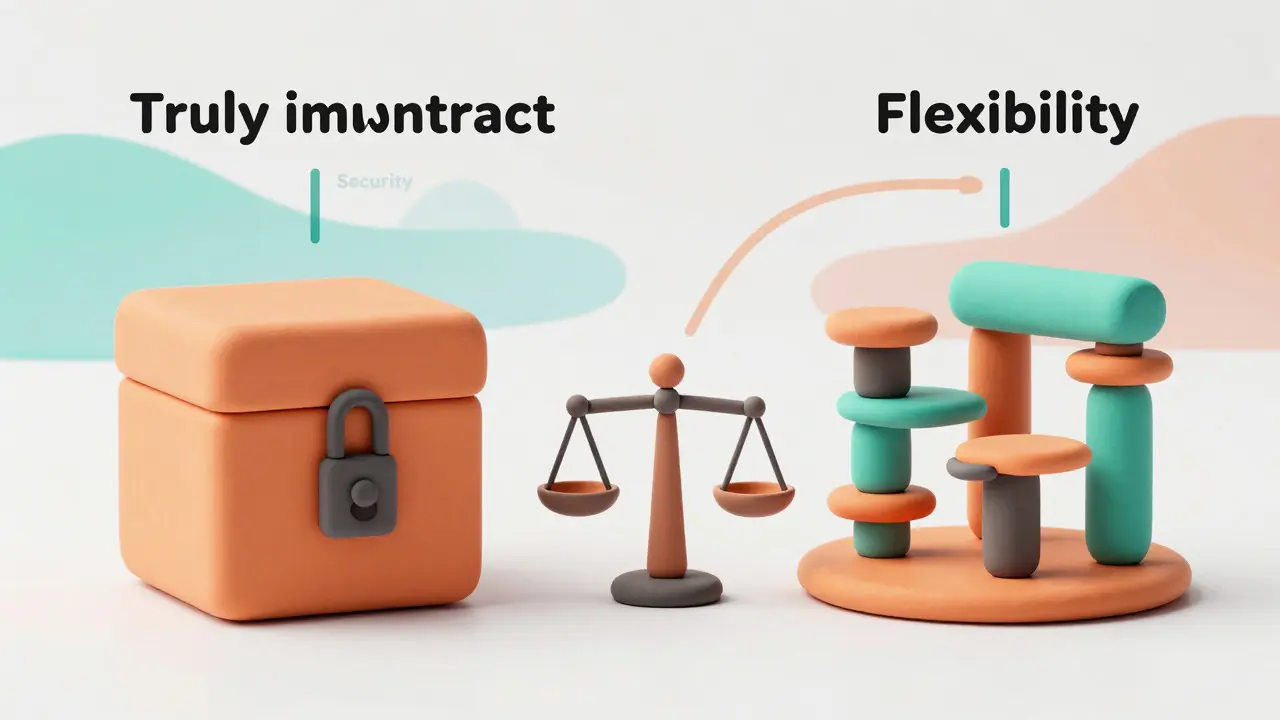
Enterprise hesitation is real. Deloitte’s 2023 survey found 68% of companies avoid immutable contracts due to the 'lack of remediation pathways.' They fear getting locked into bad code. Yet, Gartner notes that 73.4% of enterprise blockchain RFPs still cite immutability as a 'critical factor.' This contradiction shows the industry is still figuring out how to balance security with flexibility.
Future Trends: Parameterized Immutability
The debate isn't ending; it's evolving. Gavin Wood, co-founder of Ethereum and creator of Polkadot, proposed 'parameterized immutability' in late 2023. This model allows creators to specify which parameters can be modified at deployment. Imagine locking the core logic but allowing a governor to update fee structures or oracle addresses. This could address 78% of current upgrade requirements without compromising core security.
Regulations are also catching up. Wyoming’s SB0122 legally recognizes immutable smart contracts as binding agreements. Meanwhile, the EU’s MiCA regulation, effective December 2024, requires 'mechanisms for critical vulnerability remediation.' This may force pure immutable projects to adopt hybrid models or face compliance issues. Forrester predicts that by 2026, 65% of enterprise blockchain implementations will use these hybrid models to balance security with regulatory needs.
Long-term, quantum computing poses a threat. MIT estimates a 68% probability that current ECDSA signatures could be compromised by 2031. Immutable contracts written today might become insecure tomorrow if cryptography advances. This 'time-dependent vulnerability' is a risk that even the best audits can't fully mitigate.
Practical Steps for Developers and Users
If you are building or investing in smart contracts, here is what you need to know:
- Audit Rigorously: For immutable contracts, testing must be exhaustive. Expect to spend 287+ hours achieving production-ready competency, according to ConsenSys Academy. Use formal verification methods to prove correctness mathematically.
- Understand the Oracle Problem: Immutable contracts can't access external data directly. This caused the $35 million Harvest Finance exploit in 2020. Use decentralized oracle networks like Chainlink, which reduce external data risks by 83% but add 15-20% to development time.
- Check for Proxy Patterns: Before depositing funds, check if a protocol uses a proxy. Tools like Etherscan can show you if a contract has an 'implementation' address. If it does, remember that the developers *can* change the rules.
- Monitor Legal Developments: Keep an eye on cases like Van Loon v. US Treasury. Regulatory definitions of 'property' and 'agency' are shifting based on whether a contract is mutable or not.
- Plan for Gas Costs: If you choose proxies, budget for the 15-25% higher gas fees. For high-volume applications, this can significantly impact profitability.
Immutability is not a binary switch; it's a spectrum. As Vitalik Buterin stated, 'Immutability is a spectrum, not a binary property.' The goal is to preserve core guarantees while allowing for necessary evolution. Whether you prioritize the absolute security of frozen code or the flexibility of upgradeable proxies, understanding the trade-offs is essential. The blockchain doesn't forgive errors, but it does reward precision.
What is the main benefit of immutable smart contracts?
The primary benefit is trustlessness and security. Since the code cannot be altered after deployment, users can verify that the contract terms will never change. This eliminates counterparty risk and ensures that no single entity can manipulate the rules post-launch, making it ideal for financial settlements and supply chain tracking.
Can immutable smart contracts be hacked?
Yes, if there is a bug in the code at the time of deployment. Unlike traditional software, these bugs cannot be patched easily. The Parity Wallet hack froze $60 million because the vulnerable code was immutable. While immutable contracts have 37% fewer security incidents overall, the ones that do occur are often catastrophic and permanent.
What are proxy contracts?
Proxy contracts are a design pattern that allows for upgradeable smart contracts. The proxy itself is immutable, but it forwards calls to an implementation contract that can be replaced. This enables developers to fix bugs or add features without changing the contract address, though it introduces higher gas costs and potential centralization risks.
Do proxy contracts cost more in gas fees?
Yes, proxy contracts typically incur 15-25% higher gas costs compared to fully immutable contracts. This is due to the overhead of 'delegatecall' operations, which route transactions through the proxy to the implementation contract. For high-frequency applications, this extra cost can be significant.
How does immutability affect legal liability?
Recent legal cases, such as Van Loon v. US Treasury, suggest that truly immutable contracts may have clearer legal standing as property. In contrast, proxy-based systems that allow upgrades may expose developers to greater regulatory liability, as they retain control over the contract's behavior, blurring the line between code and centralized management.
Is immutability good for enterprise blockchain adoption?
It is a double-edged sword. While 73.4% of enterprise RFPs cite immutability as critical, 68% of companies avoid pure immutable contracts due to the lack of remediation pathways. Many enterprises prefer hybrid models that offer some level of upgradeability to meet regulatory requirements and handle unexpected errors.
What is parameterized immutability?
Proposed by Gavin Wood, parameterized immutability allows contract creators to specify which parts of the contract can be modified at deployment. This aims to provide the security of immutability for core logic while allowing flexibility for specific parameters, potentially solving 78% of current upgrade needs without full proxy complexity.
How do I know if a DeFi protocol uses proxy contracts?
You can check on blockchain explorers like Etherscan. Look for a section labeled 'Read as Proxy' or 'Implementation Address.' If present, the contract is likely upgradeable. Additionally, reviewing the protocol's documentation or GitHub repository for references to UUPS, Transparent Proxy, or Beacon Proxy patterns will confirm this architecture.
Marcia Albert
July 27, 2026 AT 03:01It is wild to think that we are betting our life savings on code that literally cannot be changed once it hits the chain. I mean, sure, trustless systems sound all shiny and new, but have you ever tried explaining to your grandma why her crypto is stuck because a developer sneezed while typing? It feels like playing Russian roulette with your portfolio. The whole concept of immutability is just a fancy way of saying 'good luck if we mess up.'
Emma Smith
July 28, 2026 AT 19:15the paradox of the immutable contract is that it seeks to impose order upon chaos yet relies entirely on human fallibility for its genesis... which is ironic really. we build these digital cathedrals of logic only to realize the foundation is cracked before the first stone is laid. is it truly trustless if the architect holds the blueprints? or are we merely shifting the locus of control from the bank manager to the github commit history? the boundary between code and law is dissolving into a gray sludge of technicalities where neither justice nor security can fully reside.
Ed Mitchell
July 30, 2026 AT 03:38Do not be fooled by this narrative of 'trustless' systems. It is a carefully constructed illusion designed to keep the masses compliant while the elites manipulate the backend parameters through proxy contracts. They tell you it is immutable, but they hold the keys to the kingdom in their pockets. The Parity hack was not an accident; it was a demonstration of power. The government wants you to believe in the math so you stop asking questions about who really controls the ledger. Wake up.
Michael Mostyn
August 1, 2026 AT 01:29The distinction between true immutability and the proxy pattern raises profound philosophical questions regarding the nature of property rights in a digital context. If a contract can be altered post-deployment, does it still constitute a binding agreement, or is it merely a subscription service disguised as code? The legal ambiguity highlighted by the Van Loon case suggests that our current frameworks are woefully inadequate for addressing these nuances. We must consider whether flexibility undermines the very essence of what makes blockchain technology revolutionary.
Erica Johnson
August 2, 2026 AT 16:21Sure, whatever. Just check if it has a proxy address before you dump your money in lol. Most of these DeFi projects are just scams waiting to happen anyway :P