Interoperable Gaming NFTs Across Games: How Digital Assets Move Between Titles
 Jan, 24 2026
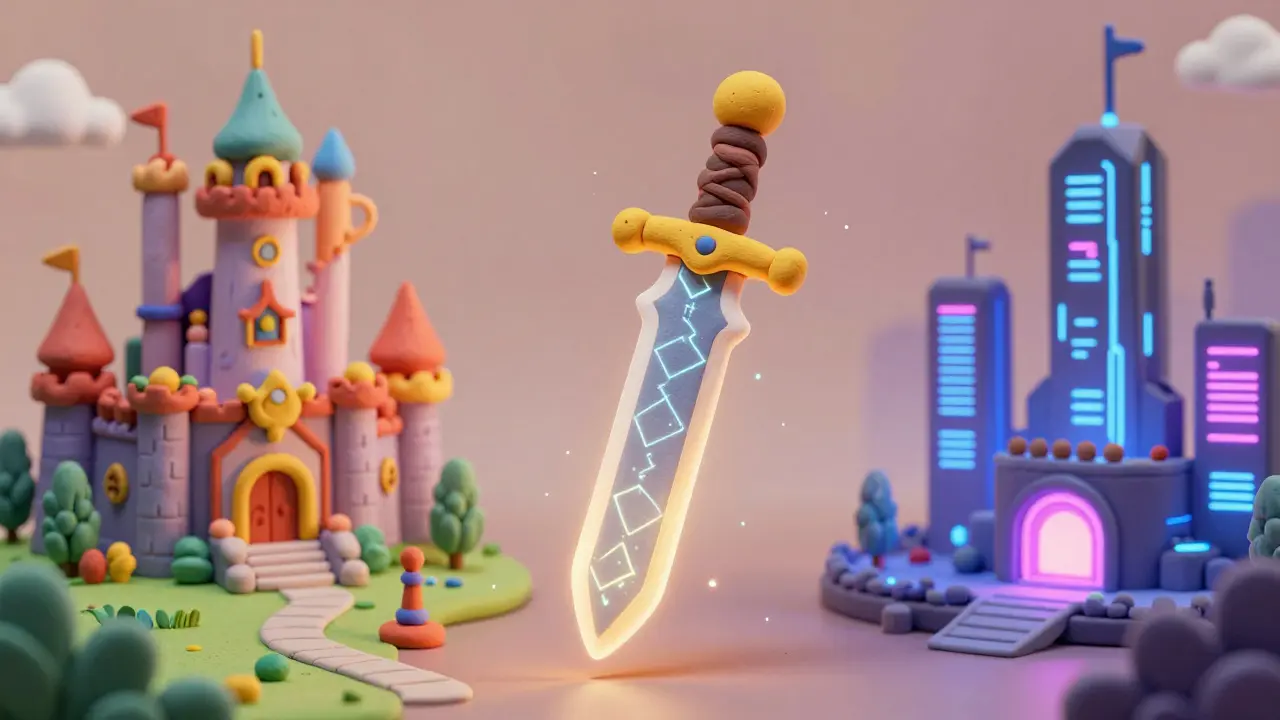
Imagine buying a rare sword in one game, then walking into a completely different game and using that same sword-no re-purchase, no reset, no loss of value. That’s the promise of interoperable gaming NFTs. It’s not science fiction. It’s happening, slowly, messily, and with more hurdles than most people realize.
Right now, if you spend $500 on a skin or weapon in a game like Fortnite or Call of Duty, that item is locked inside that game. If the game shuts down? Gone. If you stop playing? Worthless. But with interoperable NFTs, that item becomes your property, stored on a blockchain, and designed to work across multiple games. The idea sounds simple: own it, move it, use it anywhere. But the reality? It’s a tangled web of tech, design, and economics.
How Interoperable NFTs Actually Work
At its core, an interoperable gaming NFT is just a digital token-like a unique certificate-that proves you own something. But unlike regular in-game items, it’s not stored on the game’s server. It’s on a blockchain, usually Ethereum or Solana. That means you control it through a wallet, not the game company.
To make it work across games, three things must line up:
- Standardized tokens: Most use ERC-721 or ERC-1155 on Ethereum. These are like universal plug types-without them, games can’t even recognize the asset.
- Decentralized storage: The item’s look, name, stats? That data lives on IPFS or Arweave, not the game’s servers. If the game goes offline, the item still exists.
- Smart contracts: These are automated rules that say, “If this NFT enters Game B, here’s how it behaves.” But here’s the catch: Game A might have a sword that does 100 damage. Game B’s balance system only allows 50. The smart contract has to translate that-or the game breaks.
It’s not just about moving a model from one game to another. It’s about making sure it fits the rules, physics, and economy of a completely different world. That’s why most successful cases so far are cosmetic: hats, skins, avatars. You can wear a CryptoPunk as a character in The Sandbox, Decentraland, or another compatible game. But can you bring a battle-ready tank from one game into another? Not yet.
Real Examples That Work (and Those That Don’t)
Some projects have cracked the code-sort of.
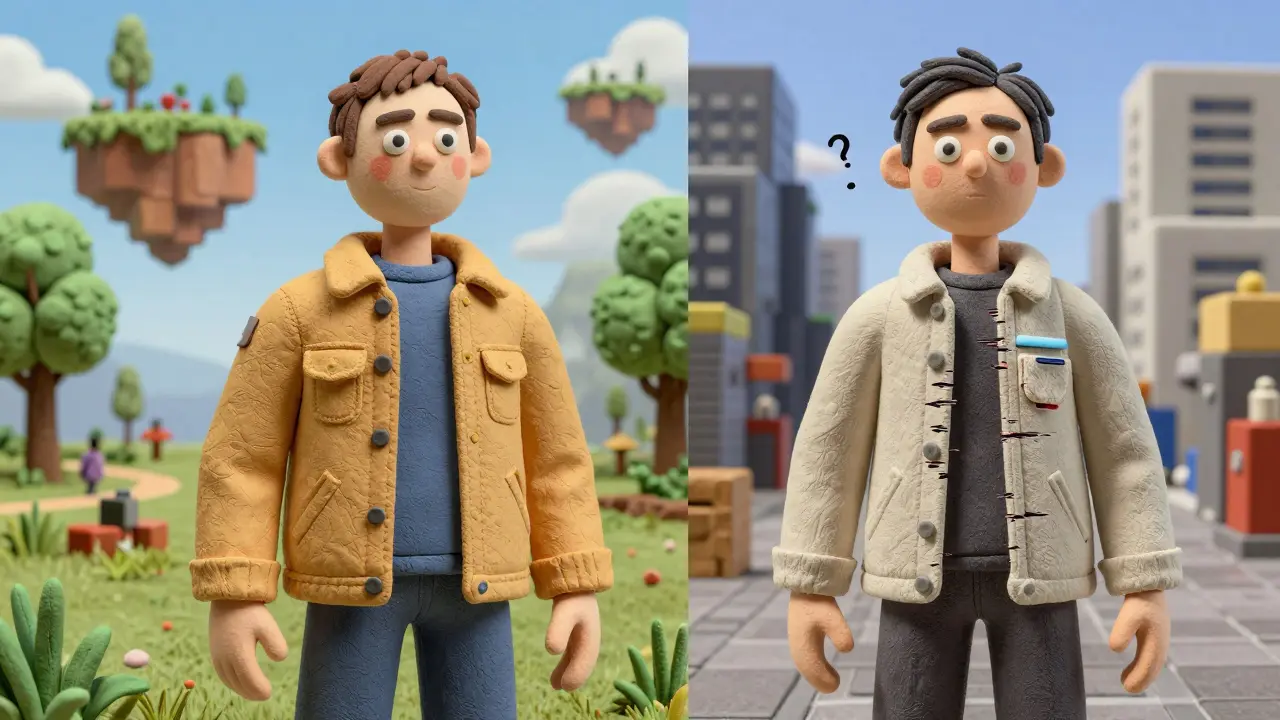
The Sandbox and Decentraland both use ERC-1155 tokens and let users wear the same wearable NFTs across both platforms. If you bought a virtual jacket in Decentraland, you can wear it in The Sandbox. That’s interoperability in action. It’s not perfect-sometimes the textures glitch-but it works.
Axie Infinity took it further. In 2022, they partnered with Overworld, a tactical RPG, so players could use their Axie NFTs as characters in the new game. But this wasn’t plug-and-play. It took six months of custom coding between two teams. The Axie’s stats had to be manually mapped to Overworld’s combat system. It’s a one-off fix, not a standard.
Then there are the failures. In early 2022, The Sandbox tried to connect with Somnium Space. The avatars looked fine in one game, but in the other, they floated through walls because the physics engines didn’t match. It took six months and a custom middleware solution to fix it. And in April 2023, the MetaHero Universe project lost $3.2 million in user assets during a failed cross-chain transfer. No one could recover them.
Success isn’t about tech alone. It’s about collaboration. Most games are built in isolation. Making them talk to each other? That’s like asking two chefs with different cookbooks to share ingredients without changing their recipes.
Why Most Games Won’t Let You Bring Your Stuff In
Game designers hate interoperability. Not because they’re against players owning things-but because it breaks their carefully tuned worlds.
Think about it: If you can bring in a legendary weapon from another game, what happens to the in-game economy? Players stop farming for loot. Bosses become trivial. Progression systems collapse. That’s why most AAA studios avoid it.
Dr. Jane McGonigal, a top game designer, put it bluntly: “Most game balance relies on precisely calibrated economies that break when external assets enter the system.”
And it’s not just balance. Imagine a game where you earn a rare helmet by completing a 20-hour quest. Now someone buys that same helmet on a marketplace and skips the grind. That feels unfair. That’s why even players are divided. On Reddit, 68% support the idea-but the 32% who’ve tried it complain about glitches, lost items, and items losing value when moved.
One user on r/NFTgaming said: “I moved my NFT from Game A to Game B. It looked weird. Then Game B updated, and my item vanished. No refund. No help.” That’s not rare. Trustpilot reviews for interoperable NFT marketplaces average just 2.8 out of 5.
The Real Cost of Moving Your NFTs
Even if the tech worked perfectly, there’s a hidden price tag.
Transferring an NFT on Ethereum costs about $1.27 on average. On Solana? $0.00025. That’s a huge difference. But Solana’s network has crashed before. Ethereum is slow. Both have risks.
And that’s just the transaction fee. What about the time? A 2023 study found 82% of regular gamers need more than three help sessions just to move one NFT between games. Most failures? Wallet mistakes. Sending to the wrong address. Forgetting to approve the transfer. Using the wrong network.
Support? Barely exists. Only 38% of interoperable NFT games have dedicated help channels. Documentation? Some studios publish 247-page guides. Others give you a single paragraph. And 73% of failed transfers? Mistakes in metadata-wrong file formats, missing attributes, broken links to the item’s image.
It’s not just hard. It’s exhausting. For players who just want to enjoy a game, this is a barrier, not a feature.
Who’s Really Building This?
Big studios aren’t leading the charge. Indie Web3 teams are. 87% of current interoperable NFT games come from small studios that built their games on blockchain from day one.
Meanwhile, the top 100 game companies? Only 12% are actively working on it. Why? Lack of standards. Legal uncertainty. Fear of backlash. The EU’s MiCA regulations (effective January 2024) add compliance headaches. In the U.S., there’s no clear law on digital ownership.
But change is coming. The Metaverse Standards Forum-backed by Microsoft, Meta, and Unity-released a new Universal Asset Description Schema in August 2023. It’s the first real attempt at a universal language for NFTs across games. Sequence’s upcoming GameLink Protocol, launching in Q2 2024, promises to solve the physics mismatch problem by translating assets in real time.
And platforms like OpenSea are rolling out new “Interoperable NFT” standards. The Sandbox now connects with 12 games. Decentraland has expanded its compatibility list.
What’s Next? The Realistic Timeline
Will we soon have one NFT that works in every game? No.
Will we see cosmetic items-skins, pets, avatars-move freely between games? Yes. Already happening.
Will you be able to bring your legendary weapon from one RPG into another and have it function perfectly? Not for years.
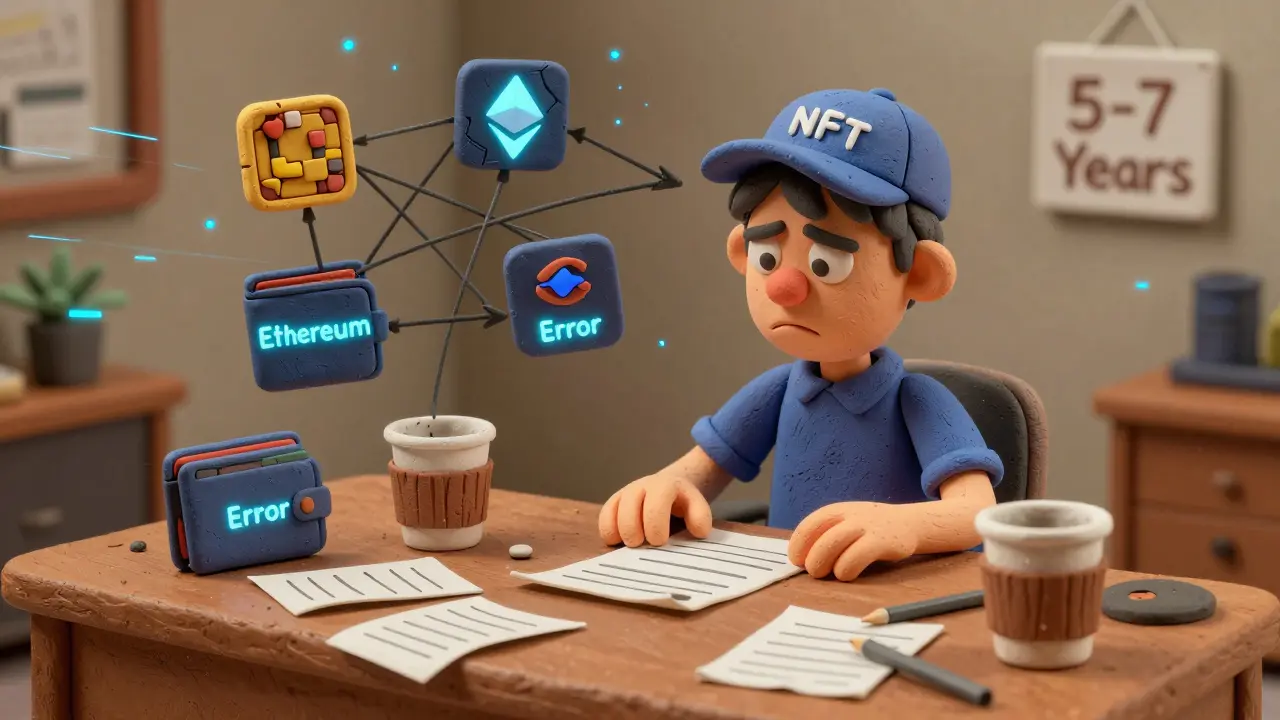
According to the University of Southern California’s 2023 report, full functional interoperability-where items retain their power and balance across games-will take 5 to 7 years. Why? Because it’s not just tech. It’s design. It’s economics. It’s trust.
Right now, interoperable NFTs are like the early internet: promising, messy, and full of potential. The infrastructure is still being built. The rules are still being written. And the people who win? Not the biggest companies. The ones who solve the small, boring problems: better documentation, clearer wallets, fewer crashes, real customer support.
So if you’re thinking of buying an NFT because it’ll work in ten games? Start small. Buy a hat. Test it in one other game. See if it works. Watch the transaction. Track the value. Most importantly-don’t assume it’s permanent. Because right now, it’s still a gamble.
What You Can Do Today
If you want to explore interoperable NFTs without losing money:
- Start with a low-cost cosmetic NFT-something under $20.
- Use it in one game that supports it (like The Sandbox or Decentraland).
- Check if it appears in another compatible game. Don’t expect magic.
- Track the transaction fees. Are they worth it?
- Don’t store your NFT on an exchange. Use your own wallet.
- Read the documentation. If it’s unclear, skip it.
Interoperability isn’t a feature you buy. It’s a system you learn. And right now, you’re still in the pilot phase.
Heather Crane
January 24, 2026 AT 20:11This is actually kind of beautiful-imagine your favorite hat from a game you loved in 2021 showing up in a new game you just downloaded in 2025, and it still feels like yours. It’s not just tech, it’s legacy. I’ve kept physical toys from childhood; why shouldn’t digital things have the same weight?
Yes, the glitches are annoying. Yes, gas fees suck. But we didn’t get smartphones overnight either. This is the early dial-up phase of digital ownership-and I’m here for it.
Let’s not throw the baby out with the bathwater because some companies are lazy or scared. The players are ready. The tech is evolving. Let’s keep pushing.
Shamari Harrison
January 25, 2026 AT 14:32For anyone new to this: start small. Buy a $5 skin in The Sandbox, move it to Decentraland, see how it looks. Don’t buy a $300 sword thinking it’ll work in Elden Ring tomorrow. It won’t.
Interoperability isn’t magic-it’s plumbing. And right now, the pipes are made of duct tape and hope. But the flow is there. You just need patience and a wallet you control.
And always, always read the docs. If the dev team doesn’t explain how to transfer it clearly, walk away.
Deepu Verma
January 25, 2026 AT 23:48I tried moving my Axie from Overworld to another game last year. Took me three days. Three. Help chats were useless. I sent it to the wrong chain. Lost $12 in fees. But when it finally worked? That moment? Worth it.
Most people give up after one fail. But if you stick with it, you start to understand how the pieces fit. It’s like learning to ride a bike-wobbly at first, then suddenly you’re flying.
And yeah, the economy breaks if everyone brings in OP gear. But that’s why we need balance systems that adapt. Not ban interoperability. Fix it.
Indie devs are building this. Big studios? They’re still arguing over who gets the credit. Let the small teams win.
Julene Soria Marqués
January 27, 2026 AT 03:24Wait… so you’re telling me that after spending $2000 on NFTs, I might lose them because a game updated and didn’t update its metadata? And there’s no refund? And the devs say ‘it’s on the blockchain so it’s not our fault’?
Oh, I get it. This isn’t ownership. It’s a scam with extra steps.
Why do you think 73% of transfers fail? Because they’re designed to fail. So you buy more. So they profit off your frustration. Classic.
And the ‘universal standard’? Please. It’s just another way to lock you in. They want you to think you own it… but you’re just renting it from them.
Bonnie Sands
January 27, 2026 AT 09:17Have you seen the SEC filings? The ‘interoperable NFT’ thing is just a Trojan horse for unregulated securities. Every time they say ‘you own it,’ they’re really saying ‘we’ll sue you if you sell it on a non-approved marketplace.’
And the ‘universal schema’? Microsoft and Meta helped write it. That’s not progress. That’s corporate capture. They’re building a walled garden with fancy gates.
Remember CryptoKitties? Remember when everyone thought it was the future? Then it vanished. This is the same story. They’re just using bigger words now.
Don’t believe the hype. The only thing moving between games is your money.
MOHAN KUMAR
January 28, 2026 AT 12:45Gas fees on Ethereum are still too high for most people. Solana crashes too much. The whole system is unstable. Why would I risk $50 on a hat that might vanish next week?
Also, if I buy a sword in Game A, and it works in Game B, then Game B’s devs have to balance everything again. That costs money. Who pays? The player? No one. So they just block it.
Real talk: interoperability sounds cool, but it’s not ready. Not even close. Wait 5 years. Or just play the games you have.
Dave Ellender
January 29, 2026 AT 08:24I appreciate the optimism here, but let’s not ignore the human cost. I helped a friend move an NFT last month. She’s 68. Never used a wallet before. Took us 11 hours. She cried when it didn’t show up in the second game.
Technology should serve people-not confuse them. Right now, it’s doing the opposite.
Maybe the real innovation isn’t in the blockchain. Maybe it’s in making the process simple. A one-click transfer. A clear error message. A live chat that answers in under 20 minutes.
That’s the real hurdle. Not the tech. The humanity.
Arnaud Landry
January 31, 2026 AT 07:11It is my considered and deeply analytical observation that the current state of NFT interoperability represents a profound epistemological crisis within the digital ownership paradigm, wherein the ontological integrity of the asset is subordinated to the contingent, volatile, and often opaque infrastructural frameworks of blockchain-based ecosystems.
Furthermore, the sociopolitical implications of permitting external asset injection into closed economic systems fundamentally destabilize the carefully constructed reward scaffolding upon which modern game design relies, thereby precipitating a cascading failure of experiential legitimacy.
One must also consider the fiduciary liability exposure of developers who, by enabling cross-platform asset mobility, may inadvertently become complicit in the unauthorized transfer of unregistered digital securities under emerging regulatory frameworks such as MiCA and potential SEC enforcement actions.
Therefore, while the aesthetic appeal of this concept is not entirely without merit, the systemic risk profile renders it, in its present form, an intellectually indefensible proposition.
george haris
February 1, 2026 AT 14:26Just tried moving my NFT hat from The Sandbox to a friend’s game. It loaded… but looked like a floating potato. We both laughed. Then I sent it back. No fees. No drama.
It’s not perfect. But it’s fun. And that’s what matters. I don’t need a legendary sword. I want to show off a weird hat I got from a streamer in 2022.
That’s the real win. Not the power. The story.
Mark Estareja
February 3, 2026 AT 11:12Let’s cut through the noise: interoperable NFTs are the ultimate zero-sum game for devs. You either monetize the transfer layer (like OpenSea) or you get cannibalized by asset inflation. The ‘ownership’ narrative is a marketing veneer. The real value is in the transaction fees, the marketplace commissions, and the data harvesting that comes from tracking every asset movement across ecosystems.
And let’s be real-most players don’t care about blockchain. They care if their skin looks good. If it breaks, they blame the game. Not the protocol. Not the wallet. The game.
So who’s really building this? The platforms that profit from friction. Not the players. Not the devs. The middlemen.