Kujira Fin Crypto Exchange Review: What You Need to Know in 2026
 Feb, 20 2026
When you hear "Kujira Fin crypto exchange," you might picture a polished platform like Binance or Kraken, where you can buy, sell, and trade crypto with ease. But here’s the truth: Kujira Fin isn’t a centralized exchange at all. It’s part of the broader Kujira ecosystem - a decentralized finance (DeFi) network built on the Cosmos blockchain. If you’re looking for a traditional exchange to deposit funds and trade KUJI, you won’t find it. That’s not a flaw - it’s a design choice. And understanding that difference changes everything about how you interact with this project.
What Kujira Fin Actually Is
Kujira isn’t a platform you sign up for like Coinbase. It doesn’t have a login page, customer support chat, or fiat on-ramps. Instead, it’s a suite of decentralized applications (dApps) that let users lend, borrow, trade, and earn yield - all without intermediaries. The core of this system is the KUJI token, which powers everything from governance to liquidity mining. Think of it less like a bank and more like a toolkit for DeFi builders. You don’t "use" Kujira Fin - you connect your wallet (like Keplr or Leap) and interact with its smart contracts directly.That means no KYC, no account freezes, and no third-party control. But it also means you’re fully responsible for your funds. If you lose your seed phrase, there’s no reset button. If a contract glitch happens, there’s no customer service to call. This isn’t for beginners who want hand-holding. It’s for users who understand self-custody and are comfortable navigating blockchain interfaces.
How KUJI Token Works
The KUJI token is the engine of the ecosystem. With a circulating supply of 122.35 million tokens and a market cap around $24 million, it’s far from a top-10 coin. Its all-time high was $5.22 - a distant memory now. As of early 2026, KUJI trades around $0.20. That’s down over 95% from its peak, and the recent trend is clearly bearish.Why does it keep dropping? Low liquidity. Most KUJI trading happens on decentralized exchanges within the Kujira network itself - not on Binance, Coinbase, or even major DeFi aggregators. That creates a vicious cycle: low volume means big price swings, which scares off new traders, which keeps volume low. CoinLore reports KUJI has only 8 green days out of the last 30. The 14-day RSI is at 38.5 - technically oversold, but with no buyers stepping in.
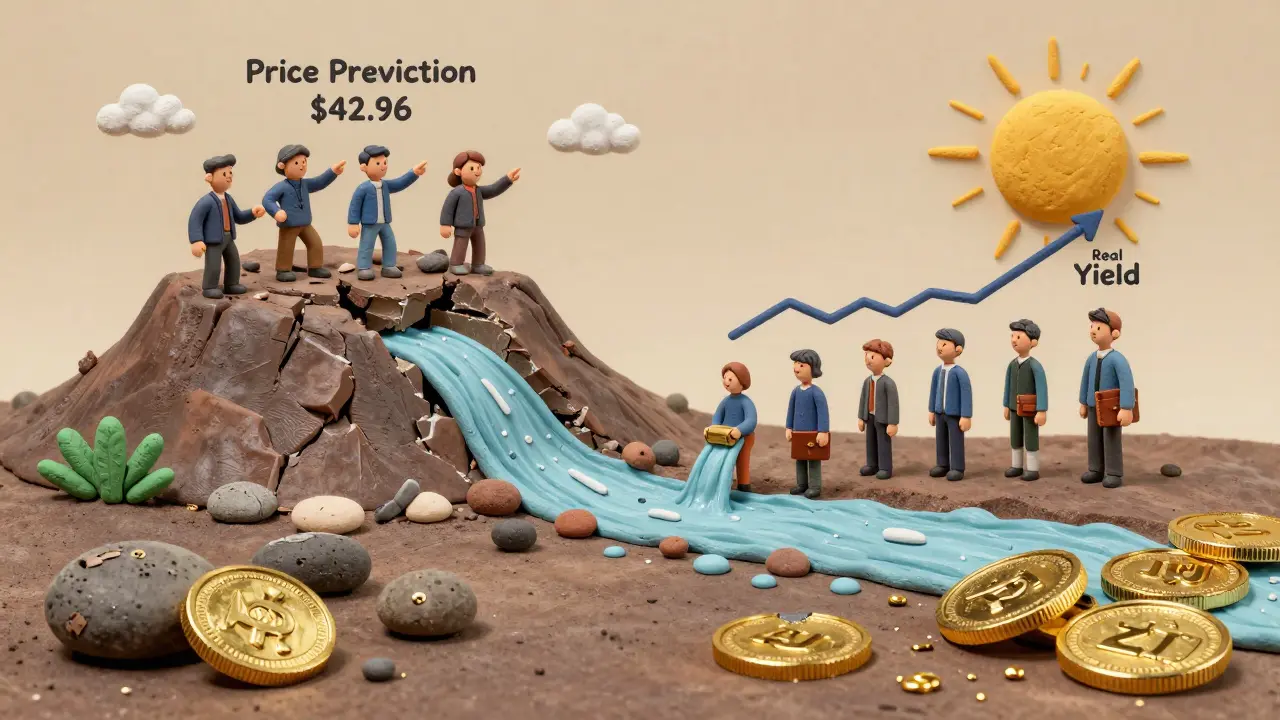
There’s no shortage of price predictions, though. Some analysts say KUJI could hit $1.18 by 2030. Others, like Crypto.ro, predict $6.20 in 2025. CoinLore’s algorithm even suggests $42.96 in ten years. These numbers sound exciting - until you realize they’re based on assumptions about mass adoption, regulatory shifts, and Cosmos ecosystem growth. None of these are guaranteed. In fact, the last three years have seen an 83.48% price decline. History doesn’t promise future performance.
Real Yield vs. Speculative Hype
What sets Kujira apart from hundreds of other DeFi projects is its focus on real yield. Many DeFi platforms promise 20%, 50%, even 100% APY - but those yields often come from token emissions, not actual revenue. Kujira’s approach is different. Its core products - like the KUJI staking pool, the OCEAN lending protocol, and the Kujira Swap DEX - generate income from real trading fees and interest payments. That income is then distributed back to users.For example, if you stake KUJI, you earn a share of the fees from trades on Kujira Swap. If you lend assets through OCEAN, you earn interest from borrowers using those assets. It’s not flashy. It’s not viral. But it’s sustainable. That’s why, despite the price crash, user adoption didn’t vanish overnight. In early 2024, Kujira wallet addresses jumped 53% in just six weeks, from 117,000 to 180,000. That kind of growth doesn’t happen because of hype. It happens because real people are earning real returns.
Why You Can’t Trade KUJI on Major Exchanges
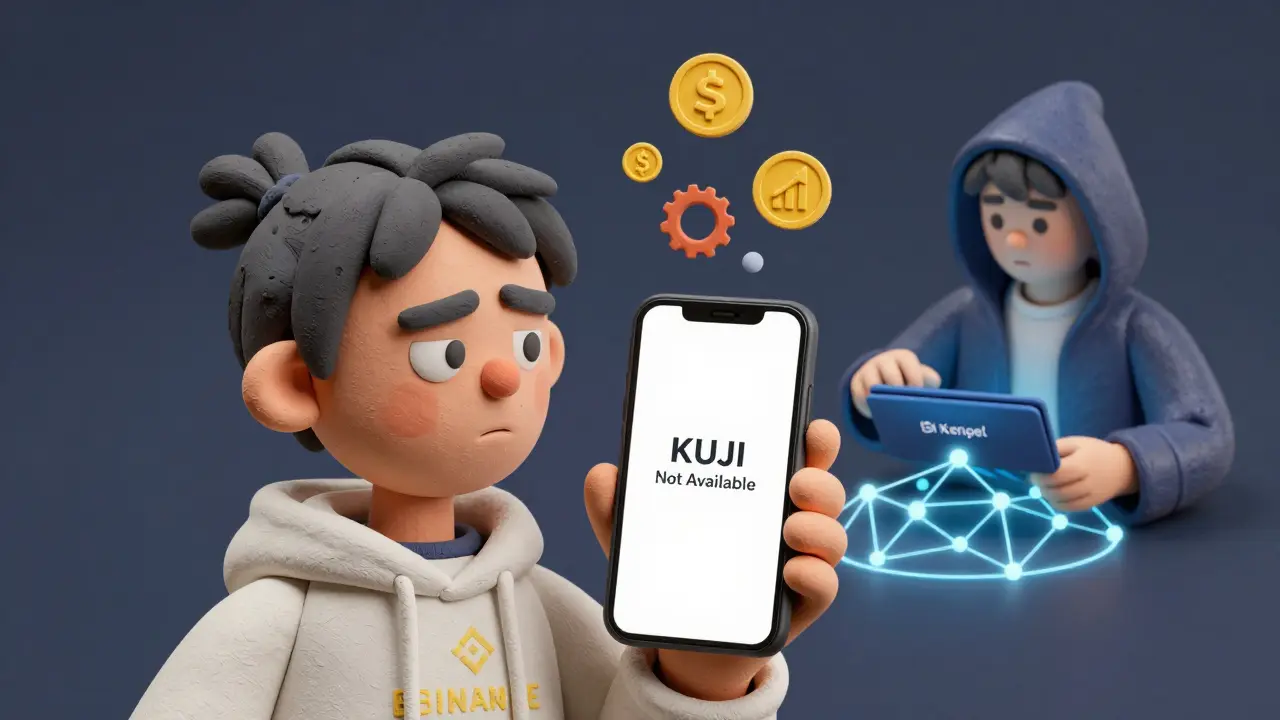
This is a critical point. If you’ve checked Binance, Coinbase, KuCoin, or even smaller platforms like Gate.io, you won’t find KUJI listed. Why? Because the project hasn’t pursued centralized exchange partnerships. That’s not an accident - it’s intentional. Kujira’s team believes that relying on centralized exchanges undermines decentralization. They’d rather build deep liquidity within their own ecosystem than chase listings that come with fees, restrictions, and regulatory risks.But here’s the trade-off: if you want to buy KUJI, you need to use a decentralized exchange. That means connecting your wallet, swapping ETH, SOL, or ATOM for KUJI, and paying gas fees on multiple chains. It’s doable - but it’s not beginner-friendly. And if you’re trying to cash out? You’ll need to swap KUJI back into a major asset first, then transfer it to an exchange that supports fiat withdrawals. That’s two or three steps, with slippage and fees at each turn.
Compare that to Bitcoin or Ethereum. You can buy them in 30 seconds on your phone, and sell them just as fast. KUJI doesn’t offer that convenience. If you’re looking for liquidity, stability, or easy access - Kujira Fin isn’t the answer.
Is Kujira Fin Safe?
Safety here isn’t about whether the platform is "hacked" - it’s about whether the system is built to last. Kujira’s code has been audited by reputable firms like CertiK and Hashed. Its contracts are open-source. That’s good. But audits don’t guarantee safety. They just show the code works as written.The bigger risk is systemic. Kujira runs on Cosmos, which means its fate is tied to the health of the entire Cosmos ecosystem. If Cosmos loses developers, users, or funding, Kujira’s tools will suffer too. There’s no backup plan. No fallback. And because KUJI isn’t listed on major exchanges, there’s no safety net if confidence drops. You’re fully exposed to the volatility of a low-liquidity asset.
Plus, regulatory pressure is growing. While Kujira operates globally, authorities in the U.S., EU, and Asia are tightening rules around DeFi protocols. If regulators decide KUJI is a security - or if they shut down access to the Cosmos network - Kujira’s entire model could be disrupted. That’s not speculation. It’s happening to other DeFi projects right now.
Who Is Kujira Fin For?
Let’s cut through the noise. Kujira Fin isn’t for everyone. It’s not for casual traders. It’s not for people who want to "get rich quick." It’s not for those who need to cash out in 24 hours.It is for:
- Users who already understand DeFi and self-custody
- Investors who believe in Cosmos as a long-term blockchain ecosystem
- People seeking real yield from trading fees - not just token emissions
- Developers building on Cosmos who need liquidity tools
- Those who can tolerate high volatility and low liquidity
If you’re sitting on a small amount of crypto and want to try something new, Kujira’s ecosystem might be worth exploring. But never invest more than you’re willing to lose. The price could drop another 50% tomorrow. Or it could rebound. No one knows.
The Bottom Line
Kujira Fin isn’t a crypto exchange. It’s a DeFi infrastructure project. And its token - KUJI - is a high-risk, low-liquidity asset with a volatile price history. There’s no guarantee it will recover. But there’s also no guarantee it won’t. The ecosystem has real utility. It generates yield. It’s growing slowly. It’s built on a solid blockchain.But none of that matters if you can’t trade it easily or if the market turns against it. If you’re drawn to Kujira because of price predictions, you’re already in the wrong place. If you’re drawn to it because you believe in decentralized finance and want to earn from real activity - then it’s worth a closer look. Just don’t go in blind.
Is Kujira Fin a centralized crypto exchange?
No, Kujira Fin is not a centralized exchange. It’s a decentralized finance (DeFi) ecosystem built on the Cosmos blockchain. You interact with it through your wallet - not by signing up for an account. There’s no KYC, no customer support, and no fiat on-ramps. Trading happens on decentralized exchanges within the Kujira network, not on platforms like Binance or Coinbase.
Can I buy KUJI on Binance or Coinbase?
As of 2026, KUJI is not listed on any major centralized exchanges including Binance, Coinbase, Kraken, or KuCoin. Most trading volume occurs on decentralized exchanges within the Kujira ecosystem, such as Kujira Swap. To buy KUJI, you’ll need to connect a wallet like Keplr or Leap and swap another cryptocurrency (like ATOM or ETH) for it on-chain.
Why is the KUJI token price so low?
KUJI’s price has fallen sharply from its all-time high of $5.22, trading around $0.20 in early 2026. This drop is largely due to low liquidity - most trading happens on small DEXs, not major exchanges. Low volume leads to high volatility and weak buying pressure. Additionally, the broader crypto market has seen a slowdown in DeFi adoption, and Kujira hasn’t yet regained the momentum it had in early 2024 when wallet addresses grew 53% in six weeks.
Is Kujira Fin a good investment?
Kujira Fin is not an investment in the traditional sense. It’s a DeFi ecosystem that offers real yield through staking, lending, and trading fees - not speculation. Whether it’s "good" depends on your goals. If you want high returns with low risk, it’s not for you. If you believe in Cosmos-based DeFi and are comfortable with high volatility, low liquidity, and no safety net, then it’s worth exploring with a small amount of capital. Never invest more than you can afford to lose.
What’s the difference between Kujira and other DeFi platforms?
Unlike many DeFi projects that rely on token emissions to generate yield (which often collapse when emissions stop), Kujira generates income from real sources: trading fees on its DEX, interest from lending protocols, and network usage. This real yield is distributed back to users, making it more sustainable. It also operates entirely within the Cosmos ecosystem, giving it deep integration with other Cosmos chains - unlike projects built on Ethereum or Solana.
How do I start using Kujira Fin?
First, get a Cosmos-compatible wallet like Keplr or Leap. Fund it with ATOM, ETH, or another supported asset. Then visit the official Kujira website and connect your wallet. From there, you can use Kujira Swap to trade, OCEAN to lend or borrow, or stake KUJI to earn yield. Always verify the URL - scams mimic legitimate sites. Never share your seed phrase.
George Suggs
February 20, 2026 AT 13:08Colin Lethem
February 21, 2026 AT 23:28Fiona Monroe
February 22, 2026 AT 10:50Molley Spencer
February 23, 2026 AT 23:56John Fuller
February 24, 2026 AT 00:24Lucy Simmonds
February 25, 2026 AT 03:19Dana Sikand
February 26, 2026 AT 03:53Lilly Markou
February 26, 2026 AT 13:43McKenna Becker
February 27, 2026 AT 13:18precious Ncube
March 1, 2026 AT 05:59