OFAC Cryptocurrency Sanctions: A Compliance Guide for 2026
 May, 17 2026
Imagine you run a cryptocurrency exchange. You process thousands of transactions daily. One day, your platform facilitates a transfer to a wallet linked to a sanctioned entity in Iran or Russia. Did you mean to do it? Probably not. But under OFAC is the Office of Foreign Assets Control, a division of the U.S. Department of the Treasury that administers and enforces economic and trade sanctions based on U.S. foreign policy and national security goals, intent doesn't matter. This is called strict liability. If you touch blocked assets, you violate the law, period.
In 2026, the landscape has shifted dramatically. The days of ignoring digital assets are over. Regulators have moved from vague warnings to aggressive enforcement. With penalties reaching millions of dollars and new task forces dedicated solely to crypto enforcement, understanding cryptocurrency sanctions compliance is no longer optional-it is existential for any business touching the U.S. financial system.
The Core Framework: What OFAC Actually Enforces
To survive in this environment, you need to understand the rules of engagement. The foundation was laid in October 2021 with the publication of the Sanctions Compliance Guidance for the Virtual Currency Industry (also known as VC Compliance Guidance). This document made one thing crystal clear: OFAC regulations apply with full force to all activities involving digital assets.
This applies if you are:
- A U.S. person or entity.
- An entity organized under U.S. laws.
- Physically located in the United States.
Even if you are a non-U.S. company, if your services involve U.S. persons or the U.S. financial system, you fall under jurisdiction. As OFAC Director Andrew E. Hallman stated in May 2025, "There is no such thing as a cryptocurrency business that falls outside OFAC's jurisdiction if it involves U.S. persons."
The primary tool in OFAC’s arsenal is the Specially Designated Nationals (SDN) List. This isn't just a list of names anymore. It includes specific digital currency addresses. As of October 2025, the list contained 27,538 total SDNs, including 1,247 cryptocurrency-related addresses. These addresses act as digital fingerprints. If your system interacts with them, you trigger a violation.
Technical Implementation: Blocking vs. Consolidating
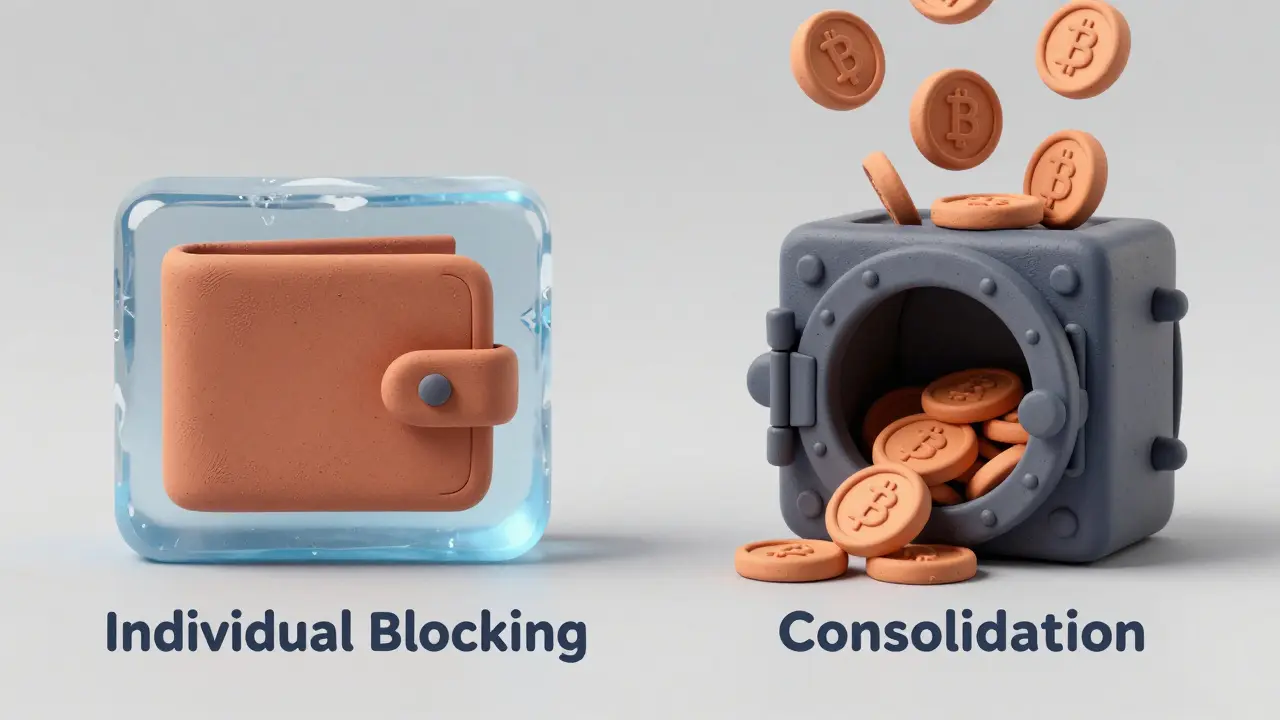
When your system detects a transaction involving a blocked address, you must act immediately. OFAC FAQ 646 outlines two main technical approaches for handling these assets:
- Individual Wallet Blocking: You block each specific digital currency wallet where a blocked person has an interest. This prevents any movement of funds from that specific address.
- Consolidation into Blocked Wallets: You can consolidate blocked digital currency into a single designated wallet titled "Blocked SDN Digital Currency." However, you must ensure robust compliance controls so that these assets remain completely frozen until legal prohibitions cease.
Crucially, OFAC does not require you to convert these blocked digital assets into traditional fiat currency. They stay in digital form, but they are effectively trapped. You must also submit specific reports to OFAC regarding these blocked assets, with reporting requirements varying based on the asset type and value.
| Method | Complexity | Best For | Risk Level |
|---|---|---|---|
| Individual Blocking | High (requires precise mapping) | Low volume, high-value transactions | Lower (precise control) |
| Consolidation | Medium (requires secure vault) | High volume exchanges | Higher (security of consolidated pool) |
The Technology Stack: Blockchain Analytics Are Non-Negotiable
You cannot manually screen thousands of blockchain transactions. You need automated systems. The industry standard now involves integrating blockchain analytics tools directly into your transaction monitoring infrastructure.
Leading firms like Chainalysis, Elliptic, and TRM Labs provide the necessary API connections to screen transactions in real-time against current sanction lists. According to Crystal Intelligence's 2025 analysis, having an automated transaction monitoring tool is not just best practice; it is a requirement for credible compliance.
These tools allow you to create customized risk rules. For example, you can flag transactions that interact with known mixing services or privacy-enhanced coins like Monero and Zcash. In fact, 68% of compliance professionals cite difficulties screening privacy coins as their biggest challenge. Without these tools, your false positive rates can skyrocket to 12-15%, clogging your operations with manual reviews.
Implementation costs vary wildly. A 2025 Deloitte survey found that annual compliance spending ranges from $150,000 to $2 million depending on transaction volume. Smaller exchanges often struggle here, with only 42% implementing dedicated screening tools compared to 98% of large exchanges processing over $1 billion monthly.
Enforcement Reality: Lessons from Recent Penalties
Theory is one thing; enforcement is another. OFAC has been aggressive. Let’s look at two major cases from 2025 that define the current risk profile.
ShapeShift AG ($750,000 Penalty): In September 2025, ShapeShift settled with OFAC for allowing users in Cuba, Iran, Sudan, and Syria to exchange approximately $12.5 million in cryptocurrency. The key failure? Lack of geolocation controls. They processed transactions from 527 unique IP addresses in sanctioned jurisdictions without blocking them. There was no evidence of intentional evasion, yet they were liable. This reinforces the strict liability principle: ignorance or lack of intent is not a defense.
Garantex Europe OU (Designation & Secondary Sanctions): In August 2025, OFAC re-designated Garantex and its successor Grinex, along with six associated companies across Russia and the Kyrgyz Republic. They allegedly processed over $100 million in illicit transactions since 2019. This case highlights OFAC’s willingness to pursue "network sanctions," targeting not just the primary violator but its entire ecosystem, including executives and supporting entities.
Compare this to the UK’s Office of Financial Sanctions Implementation (OFSI), which has issued only three crypto-related enforcement actions since 2018. OFAC has issued 17, totaling $48.7 million in penalties. The message is clear: the U.S. is leading the charge, and the stakes are highest here.
Building Your Compliance Program: The Five Pillars
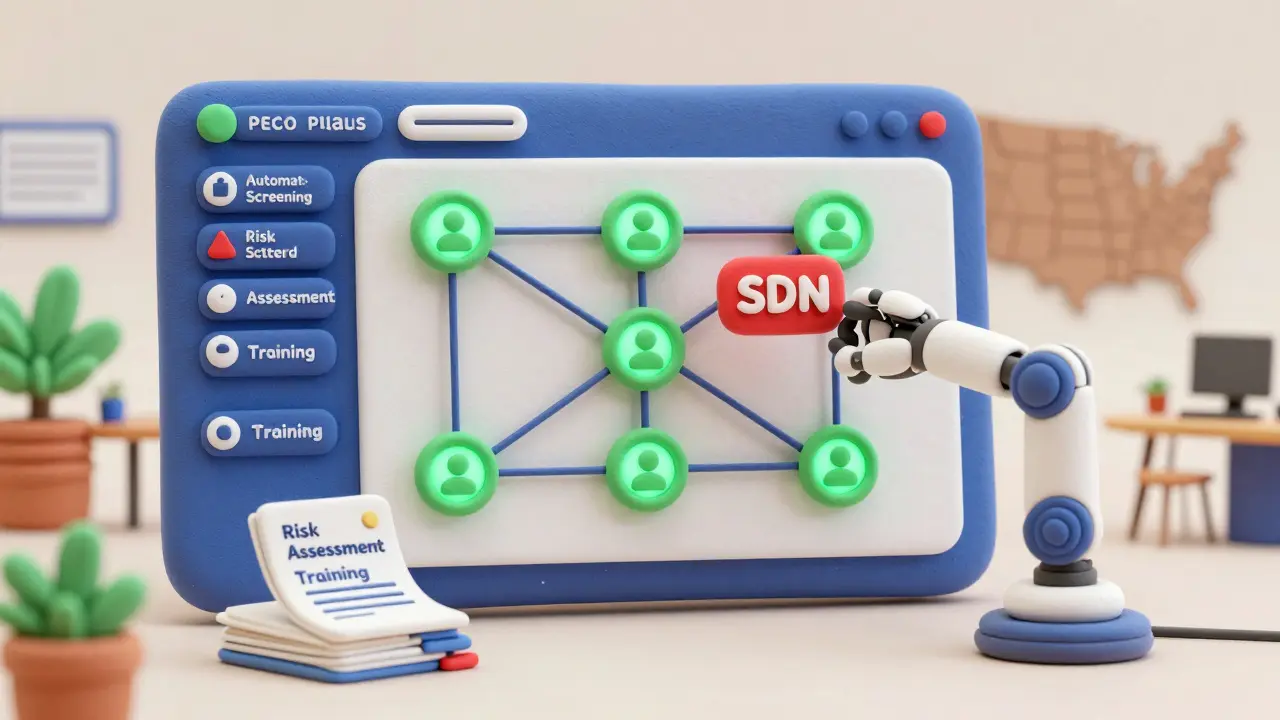
If you are starting from scratch, you need a structured approach. OFAC guidance emphasizes five essential components for a risk-based Sanctions Compliance Program (SCP):
- Management Commitment: This requires documented board-level oversight. Compliance cannot be siloed in IT; it must be a strategic priority.
- Risk Assessment: Conduct a cryptocurrency-specific sanctions risk assessment every quarter. Document your methodology. Identify where your vulnerabilities lie-be it DeFi protocols, stablecoin issuances, or cross-border transfers.
- Internal Controls: Implement automated screening tools at multiple touchpoints: onboarding, transaction processing, and periodic portfolio reviews. Relying solely on initial customer screening is insufficient.
- Testing and Auditing: Have independent third parties audit your program annually. Internal teams may miss blind spots.
- Training: Mandatory training for all relevant staff. The Association of Certified Anti-Money Laundering Specialists (ACAMS) notes that compliance officers need an average of 147 hours of specialized training to effectively implement crypto sanction controls.
A typical implementation timeline spans 22 to 36 weeks. This includes risk assessment (4-8 weeks), tool selection and implementation (8-12 weeks), system integration (6-10 weeks), and staff training (4-6 weeks). Do not rush this phase.
The DeFi Challenge and Future Outlook
Decentralized Finance (DeFi) presents a unique headache. Traditional sanctions screening relies on identifying counterparties. In DeFi, especially with liquidity pools and automated market makers, counterparties are often anonymous or unknown. A Global Legal Insights 2025 report noted that 73% of firms struggle to apply traditional screening to these protocols.
OFAC’s October 2025 update to FAQ 646 acknowledged this difficulty, requiring "reasonable measures" even when counterparty identification is technically challenging. This creates a gray area that regulators are still defining. Meanwhile, the Ethereum Foundation’s proposal of EIP-7594 for on-chain sanction compliance mechanisms faces significant community resistance, suggesting that protocol-level solutions are not imminent.
Looking ahead, the market for crypto sanction compliance is exploding. Gartner projects the sector will reach $1.8 billion by 2026. By 2027, Forrester predicts 65% of cryptocurrency transactions will undergo real-time sanction screening, up from 38% in 2025. The trend is toward greater automation and deeper integration. Ignoring this shift means inviting regulatory scrutiny.
Does OFAC regulate decentralized exchanges (DEXs)?
Yes, indirectly. While DEXs themselves may not have a central operator, any U.S. person or entity interacting with a DEX must ensure they are not facilitating transactions with sanctioned parties. OFAC’s guidance applies to all activities involving digital assets by U.S. persons. If you operate a front-end interface for a DEX and you are based in the U.S., you are subject to OFAC rules.
What happens if I accidentally send funds to a sanctioned wallet?
You must immediately freeze those assets and report the incident to OFAC. Under strict liability principles, the violation occurs upon the transaction. Prompt self-disclosure and remediation can mitigate penalties, but it does not eliminate liability. Do not attempt to reverse the transaction through other means without consulting legal counsel, as this could compound violations.
How often should I update my SDN list screening database?
Daily. OFAC frequently updates the SDN List, adding new names and digital currency addresses. In Q2 2025 alone, OFAC added 37 new crypto addresses. Real-time API connections to providers like Chainalysis or TRM Labs are recommended to ensure your screening is always current.
Is geolocation blocking sufficient for compliance?
No. Geolocation blocking is a helpful layer but not sufficient on its own. Users can use VPNs or proxies to mask their location. You must combine geolocation checks with blockchain analytics to identify the actual source and destination of funds. The ShapeShift penalty demonstrated that relying solely on IP-based geolocation is inadequate.
What are the penalties for violating OFAC crypto sanctions?
Penalties can be severe, ranging from hundreds of thousands to millions of dollars. For example, ShapeShift paid $750,000 in 2025. Civil penalties can exceed $300,000 per violation, while criminal penalties can include fines and imprisonment. Additionally, being designated on the SDN List can effectively shut down your business by cutting off access to the U.S. financial system.