Operation Final Exchange: How Germany Took Down 47 Russian Crypto Exchanges
 Jan, 11 2026
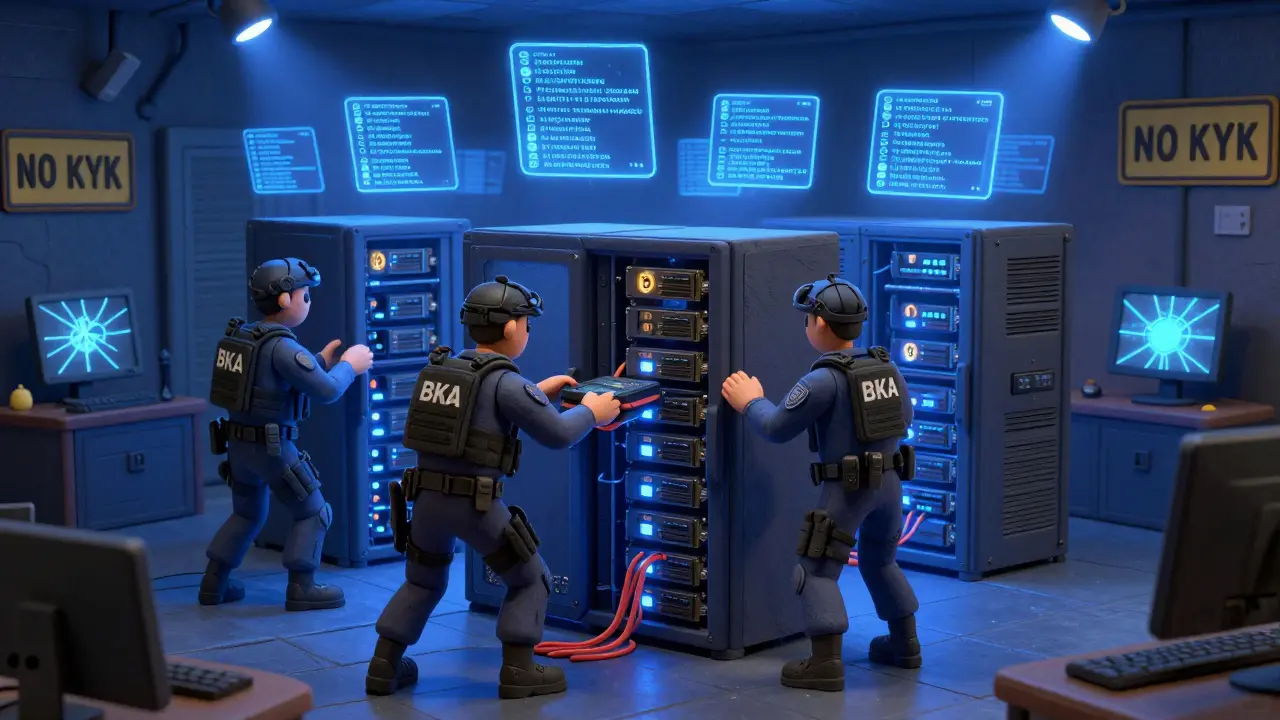
On September 19, 2024, Germany’s Federal Criminal Police (BKA) didn’t just shut down a few shady crypto websites. They erased entire networks - servers, backups, databases, and all. In one coordinated sweep, they took down 47 Russian-language no-KYC cryptocurrency exchanges used by hackers, ransomware gangs, and sanctions evaders. This wasn’t a warning. It was a message: “We have your data. See you soon.”
What Exactly Was Operation Final Exchange?
Operation Final Exchange was a high-stakes law enforcement operation targeting instant-swap crypto platforms that required zero identity verification. These weren’t just anonymous wallets. They were full-service money laundering pipelines. Users could deposit cash from Russian banks, swap it into Bitcoin or Monero, and withdraw it overseas - all without giving their name, phone number, or email. No KYC meant no paper trail. That’s exactly why criminals loved them. The BKA didn’t just freeze accounts or block domains. They physically seized every server: production, development, backup - everything. Over 8 terabytes of data were collected. That included IP addresses, transaction histories, registration logs, and even chat records from admin panels. For the first time, law enforcement didn’t just disrupt a service - they captured its entire digital memory.Why Target Russian-Language Exchanges?
These 47 platforms weren’t random. They were built to serve one purpose: helping Russian entities bypass Western sanctions. After Russia’s invasion of Ukraine, traditional banking channels were cut off. Criminals needed new ways to move money. These exchanges filled the gap. They accepted rubles from sanctioned banks, converted them into crypto, and sent the funds to wallets in Europe, Asia, or the U.S. - all without raising red flags. The exchanges also became lifelines for cybercriminals. Ransomware groups used them to cash out payments from hospitals, schools, and corporations. Darknet drug dealers relied on them to avoid traceability. Botnet operators laundered stolen crypto through these platforms without fear of exposure. The BKA knew: if you cut off the money pipeline, you cut off the crime.How Was This Different From Past Crypto Takedowns?
Previous operations, like the 2023 takedown of ChipMixer (which laundered €90 million), focused on single platforms. Operators would vanish, rebuild on new servers, and come back stronger. Operation Final Exchange changed the game by going after all infrastructure at once. No backup servers. No test environments. No hidden clones. It was a total wipeout. The psychological impact was just as powerful as the technical one. The BKA didn’t just quietly shut things down. They posted a direct message to users: “We have your data.” That sent shockwaves through underground forums. For the first time, users realized their anonymity wasn’t just an illusion - it was a trap.What Did Law Enforcement Learn From This?
This operation proved that coordinated, multi-jurisdictional strikes can work - if done right. The BKA didn’t act alone. They worked with Frankfurt’s Public Prosecutor’s Office, EU partners, and blockchain analytics firms like Chainalysis. Months of intelligence gathering mapped out server locations, admin access points, and transaction patterns. They infiltrated Telegram groups, tracked wallet flows, and identified key infrastructure nodes. The success hinged on timing. All 47 exchanges were taken down within minutes of each other. No time to migrate. No chance to destroy evidence. That level of precision required real-time coordination across time zones and legal systems. It also showed that targeting no-KYC services is more effective than regulating exchanges with KYC. Those platforms already comply with rules. The criminals go where the rules don’t exist.
What Happened After the Takedown?
In the weeks after the operation, Russian-speaking crypto communities went quiet. Telegram channels dedicated to privacy tools saw a 60% drop in activity. Darknet market vendors reported delays in cashing out. Some stopped taking orders entirely. On Reddit’s r/cryptocurrency, users debated whether this was a win for security or a threat to privacy. But here’s the real impact: the seized data is still being analyzed. As of October 2024, German authorities confirmed that investigations were active, with dozens of leads pointing to individuals and groups involved in ransomware, fraud, and sanctions evasion. Arrests haven’t been announced yet - but they’re coming. The operation also triggered a ripple effect. Other EU countries started reviewing their own no-KYC exchange monitoring systems. The U.S. Treasury’s FinCEN cited the operation in internal briefings as a model for future actions. Blockchain analytics firms saw a 300% surge in demand from law enforcement agencies in 2024.Who Got Hurt - and Who Benefited?
It’s easy to assume this was just a crackdown on criminals. But the truth is messier. Legitimate users who valued privacy - journalists, activists, people in repressive regimes - also used these platforms. Some of them now face the same scrutiny as the criminals. That’s the unintended consequence of broad enforcement. On the flip side, compliant crypto businesses breathed easier. Exchanges with KYC saw a spike in new users. CoinGecko ratings for privacy-focused platforms dropped as trust eroded. Mainstream investors saw the operation as a sign that crypto could be cleaned up - without killing innovation.What Does This Mean for the Future of Crypto Enforcement?
Operation Final Exchange didn’t end crypto crime. But it changed the rules. Criminals now know that anonymity isn’t guaranteed. Servers can vanish. Data can be stolen. Your digital footprint might be the thing that catches you. We’re likely to see more operations like this - especially as sanctions enforcement becomes a global priority. The EU is already pushing for a unified crypto enforcement unit. The U.S. is expanding its blockchain tracing capabilities. Even Switzerland and Singapore are updating their rules to allow faster seizures. The next wave will target mixing services, decentralized exchanges (DEXs), and privacy coins like Monero. But the lesson from Germany is clear: if you want to stop crypto crime, don’t just regulate the edges. Go straight for the infrastructure.
Can This Happen in the U.S. or Other Countries?
Technically, yes. But politically, it’s harder. The U.S. lacks a centralized federal police force like the BKA. Enforcement is split between the FBI, FinCEN, IRS, and state agencies. Coordination is slower. Legal hurdles around data access and cross-border seizures are higher. Still, the U.S. has the tech. The FBI has partnered with Chainalysis for years. The Treasury has frozen crypto wallets linked to North Korea and Iran. What’s missing is the will to strike simultaneously across dozens of targets - and the public support to do it. Germany showed it’s possible. Now the question is: who will follow?What Should Crypto Users Do Now?
If you’re using a no-KYC exchange - even for “legitimate” reasons - you’re at risk. Your data could be seized. Your IP could be logged. Your transactions could be traced back to you. Here’s what to consider:- Use only regulated platforms with clear compliance policies.
- Avoid services that don’t require any identification - even if they claim to be “private.”
- Understand that blockchain is not anonymous. It’s pseudonymous - and law enforcement is getting better at connecting identities to addresses.
- If you’re in a high-risk jurisdiction, consult a legal expert before moving large amounts of crypto.
Is This the End of Crypto Privacy?
No. But it’s the end of the illusion that you can hide completely. Privacy tools still exist - coinjoin, Zcash, Tor networks. But they’re no longer enough on their own. The days of relying on unregulated exchanges as a shield are over. The future belongs to users who understand that compliance isn’t the enemy - ignorance is. The most secure crypto users aren’t the ones hiding the most. They’re the ones who know how the system works - and play by its rules.What exactly did Germany seize in Operation Final Exchange?
Germany’s Federal Criminal Police seized all server infrastructure - production, development, and backup systems - belonging to 47 Russian-language no-KYC cryptocurrency exchanges. They also collected over 8 terabytes of data, including user registration details, transaction records, IP addresses, and internal admin communications.
Why were these exchanges targeted specifically?
These exchanges were targeted because they enabled sanctions evasion by allowing Russian users to convert rubles into crypto without identity checks. They were used by ransomware gangs, darknet drug sellers, and cybercriminals to launder money and avoid detection. Their no-KYC model made them ideal for illegal activity.
Did Operation Final Exchange lead to any arrests yet?
As of early 2026, no public arrests have been announced. However, German authorities confirmed that investigations are ongoing using the 8+ terabytes of seized data. Prosecutions are expected in the coming months as leads are verified.
How did this operation differ from previous crypto takedowns?
Unlike past operations that shut down single platforms, Operation Final Exchange took down 47 exchanges simultaneously - including all backup and development servers. This prevented operators from quickly rebuilding. It also included direct messaging to users, warning them their data was now in law enforcement’s hands - a psychological tactic rarely used before.
Is this operation legal under EU data protection laws?
Yes. The operation was conducted under EU legal frameworks for cross-border criminal investigations. Data was seized as part of a formal criminal probe, not for mass surveillance. The BKA operated with judicial authorization and worked with prosecutors to ensure compliance with EU legal standards, even when dealing with encrypted or anonymized data.
Will other countries copy Germany’s approach?
Yes. The EU is already discussing creating a unified crypto enforcement unit. The U.S. Treasury and FBI have referenced this operation in internal briefings as a model. Countries like France, the Netherlands, and Canada are increasing their blockchain analytics budgets and training officers in server seizure techniques.
Can I still use no-KYC crypto services safely?
No. The risks far outweigh any perceived benefits. These services are now high-value targets for law enforcement. Your transaction history, IP address, and device fingerprints can be traced and used against you - even if you think you’re anonymous. Regulatory compliance isn’t optional anymore - it’s the only way to avoid being caught in a future takedown.
Allen Dometita
January 12, 2026 AT 17:36Bro, this is wild. Germany just pulled off the ultimate crypto heist - not by stealing, but by wiping out the whole damn underground bank. 8 terabytes of dirt? That’s not data, that’s a digital confession booth. Criminals thought they were ghosts. Turns out they just left their fingerprints all over the servers. 🤯
Rahul Sharma
January 13, 2026 AT 04:15Operation Final Exchange is a landmark moment in digital law enforcement. The precision of simultaneous takedowns, coupled with the psychological impact of direct messaging users, demonstrates a sophisticated understanding of criminal behavior. This approach may serve as a blueprint for global anti-crypto crime initiatives. 🙏
greg greg
January 13, 2026 AT 10:40Let’s be real - this isn’t just about shutting down exchanges. It’s about dismantling an entire ecosystem that was designed to operate outside any legal framework. These no-KYC platforms weren’t just anonymous; they were engineered to be invisible. And now, thanks to coordinated intelligence, blockchain analytics, and server seizures, they’re not invisible anymore. The fact that they got every backup, every dev server, every chat log? That’s next-level. It means they didn’t just disrupt - they annihilated. And the real kicker? The data they collected isn’t just for prosecution. It’s a map. A map of who funded who, who laundered for whom, who was connected to which ransomware gang. This isn’t the end of crypto crime - it’s the beginning of a new era where every transaction leaves a trail, and every ghost has a name now.
LeeAnn Herker
January 13, 2026 AT 20:42Oh wow, so now the government gets to decide what ‘privacy’ means? Cool. So if I use Monero to send money to my cousin in Venezuela because his bank froze his account? Guess what - I’m now a ‘sanctions evader.’ Meanwhile, the same people who shut this down are probably still letting big banks move billions in dirty cash through shell companies. Classic. 🤡
Brittany Slick
January 13, 2026 AT 20:55There’s something beautiful about justice that doesn’t scream - it just shows up, takes everything, and whispers, ‘We know who you are.’ I’m not saying I agree with all of it… but for the first time, the people who thought they were untouchable? They’re shaking. And honestly? That’s kinda poetic.
Calen Adams
January 14, 2026 AT 16:42Let’s cut through the noise - this is the first time law enforcement didn’t just react to crypto crime, they anticipated it. Chainalysis + BKA + EU coordination = a new standard. The days of ‘just move to a new exchange’ are over. This is the new paradigm: total infrastructure eradication. If you’re still using no-KYC, you’re not being private - you’re being suicidal. The game changed. Adapt or get deleted.
Valencia Adell
January 15, 2026 AT 06:368TB of data? That’s not evidence - that’s a surveillance empire in the making. You think this was about justice? Nah. This was about control. They didn’t just take servers - they took your digital DNA. Now they have your IP, your chat logs, your transaction history. Who’s to say they won’t sell it? Or leak it? Or use it to profile activists next? This isn’t a win. It’s a warning. The state just proved it can erase your anonymity. And the worst part? You’re supposed to be grateful.
jim carry
January 15, 2026 AT 14:00So… they got the data. Now what? When are the arrests? Or is this just a performance for the media? I’ve seen this movie before - big takedown, zero convictions, everyone just moves to a new platform. Don’t celebrate yet. This is theater, not justice.