Peanut.Trade (NUX) Airdrop Details: How It Worked and What Happened to the Tokens
 Dec, 11 2025
NUX Token Value Calculator
See how much your NUX tokens are worth at different price points. Calculate potential gains or losses based on when you acquired your tokens.
At the time of the airdrop (August 2021), NUX was trading at approximately $0.31 per token. Today (2025), it trades at around $0.0042, representing a 99.99% price drop from its peak.
Value Summary
Initial value
$0.00
Current value
$0.00
Percentage change
0.00%
This shows a 99.99% price drop from peak value. The NUX token has lost nearly all its value since the airdrop.
Back in 2021, if you were active in crypto communities, you probably saw ads for the Peanut.Trade airdrop. It promised free NUX tokens just for following a few social media accounts and adding the token to your CoinMarketCap watchlist. Thousands signed up. Some even held on, hoping the token would rebound. But here’s the truth: that airdrop didn’t lead to wealth. It led to a lesson.
What Was the Peanut.Trade Airdrop?
The Peanut.Trade airdrop wasn’t some secret giveaway. It was a structured, public campaign run through CoinMarketCap in August 2021. A total of 71,000 NUX tokens were distributed across 2,000 winners. That meant each winner got up to 35.50 NUX tokens. The total value of the airdrop was $22,000 USD at the time - which put the token price around $0.31 per NUX. Not bad, but nowhere near its peak. To qualify, you had to do four things:- Add NUX to your CoinMarketCap watchlist
- Join the official Peanut Telegram group (t.me/peanuttrade)
- Join the Peanut announcement channel (t.me/peanutann)
- Follow @PeanutTrade on Twitter
- Fill out the registration form on CoinMarketCap
What Was Peanut.Trade Trying to Do?
Peanut.Trade wasn’t just another DeFi token. It was built as a price balancer. Its goal? To fix the mess that Automated Market Makers (AMMs) like Uniswap create for traders. Most DEXs suffer from slippage - when your trade price changes because the order book is shallow. Peanut tried to solve this by splitting assets: 90% went to Uniswap, and 10% was held in a special mechanism that monitored prices on centralized exchanges like Coinbase or Binance. It would then adjust trades on the DEX to match CEX prices, reducing the gap. It also had anti-bot features. DeFi bots are the reason you can’t get a good price on a new token launch. They front-run your trades, buy before you, and sell right after. Peanut’s system tried to detect and block those bots. It sounded smart. But tech alone doesn’t make a token valuable.What Happened to the NUX Token?
The NUX token launched on February 15, 2021. At first, things looked promising. It raised $7.96 million across five funding rounds, including an IEO. The token’s all-time high hit $31.69. That’s a lot for a small DeFi project. But by August 2021, when the airdrop happened, the market had already started crashing. Bitcoin had peaked in April. The broader crypto sell-off was in full swing. So even though the airdrop was marketed as a big opportunity, the token was already down 90% from its peak. Fast forward to October 2025: NUX trades at $0.0042. That’s a 99.99% drop from its peak. The same 35.50 NUX tokens you got in the airdrop? Worth about $0.15 today. If you bought in at the airdrop price of $0.31, you lost over 95% of your value. If you held from the peak? You lost 99.98%. The token’s market cap is now around $210,000. It’s ranked #6594 on CoinGecko. Trading volume is low - mostly on Gate.io, with a little on Uniswap and LATOKEN. The community has all but vanished. The Telegram group is quiet. The Twitter account hasn’t posted in months.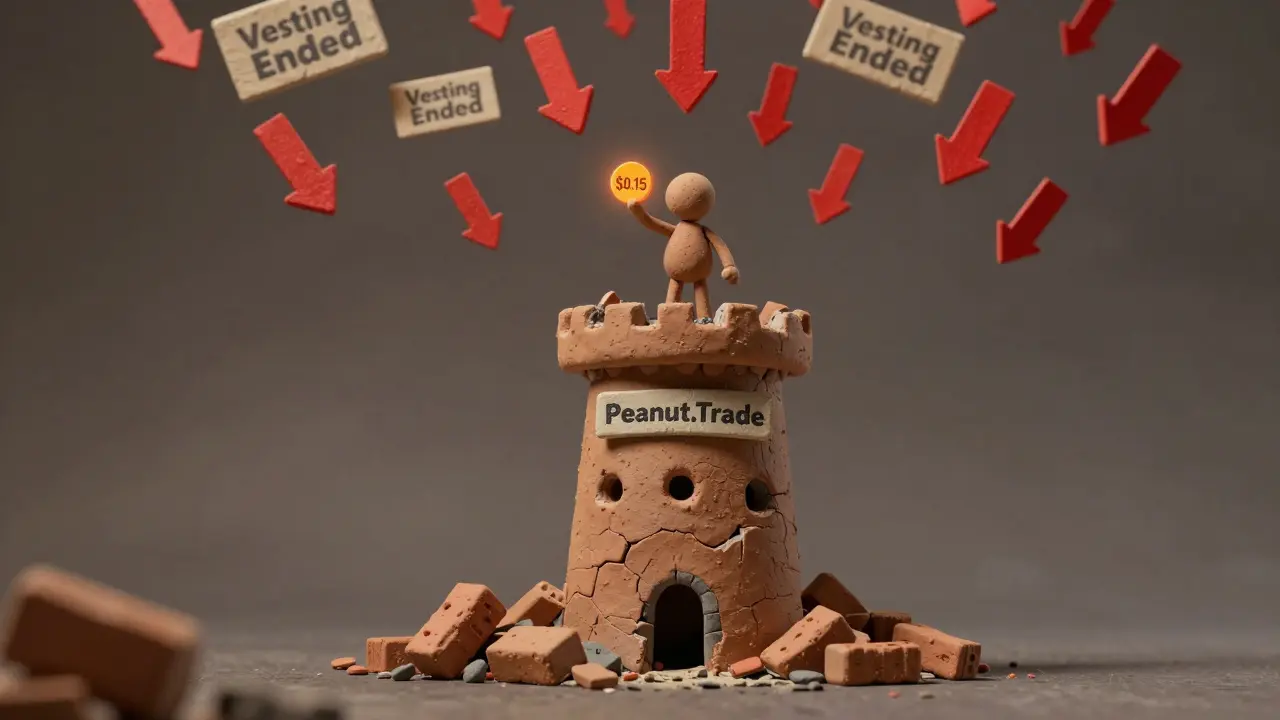
Why Did It Fail?
There are three big reasons:- No real demand - The price balancing tech was clever, but it didn’t solve a problem big enough to drive adoption. Traders didn’t switch from Uniswap to Peanut because the savings were too small.
- Too many similar projects - In 2021, there were hundreds of DeFi tokens promising to fix slippage, reduce fees, or eliminate bots. Most failed. Peanut was one of them.
- Weak tokenomics - 96.5% of the supply was locked in a 700-day vesting schedule. That meant almost no tokens were circulating early on. When the vesting ended, the market got flooded. No buying pressure. Just selling.
Could NUX Recover?
Some price prediction sites still throw out wild numbers. CoinLore says NUX could hit $28.52 by 2041. CoinCodex says it’ll stay under $0.01 through 2025. The truth? No one knows. The token has no active development team. No roadmap updates. No new features. The website still loads, but the blog hasn’t been touched since 2022. In crypto, silence means death. If a project isn’t building, talking, or growing - it’s dead. The only chance NUX has is a massive crypto bull run. Even then, it’d need a revival - new team, new tech, new marketing. That’s not happening.
What Can You Learn From This?
The Peanut.Trade airdrop is a textbook case of how not to judge a crypto project by its giveaways. Free tokens aren’t free money. They’re a marketing tool. If you joined the airdrop hoping to get rich, you were misled. The real value wasn’t in the tokens - it was in the early access. But even that didn’t matter because the product didn’t hold up. Here’s what you should do next time:- Check if the project has a working product - not just a whitepaper.
- Look at the team. Are they anonymous? Do they have past experience?
- See if the token is actually being used. Check blockchain analytics for active wallets.
- Don’t assume an airdrop means the project is strong. Many failed projects ran bigger airdrops than successful ones.
Where Is NUX Traded Today?
If you still hold NUX, you can trade it on a few exchanges:- Gate.io - The most active pair: NUX/USDT, with $83,000 in 24-hour volume
- LATOKEN - Limited liquidity, but still trading
- Uniswap V2 - On Ethereum, but with very low volume and high slippage
What’s the Bottom Line?
The Peanut.Trade airdrop gave away 71,000 NUX tokens to 2,000 people. At the time, it felt like luck. Today, it feels like a mistake. The token’s value collapsed. The project vanished. The community moved on. This isn’t about the airdrop being fake. It’s about how easy it is to get fooled by hype. Free tokens don’t create value. Real products do. If you’re looking for a crypto opportunity, skip the airdrops. Find projects with active development, real users, and transparent teams. That’s the only way to avoid ending up with a wallet full of ghost tokens.Did the Peanut.Trade airdrop actually give out tokens?
Yes. The airdrop was real. CoinMarketCap confirmed that 71,000 NUX tokens were distributed to 2,000 winners in late August 2021. Each winner received up to 35.50 NUX tokens. The tokens were sent directly to the wallet addresses participants provided during registration.
Is the Peanut.Trade project still active?
No. As of late 2025, there is no active development, no team updates, and no new features. The official website still exists but hasn’t been updated since 2022. The Telegram group and Twitter account are inactive. The project is considered abandoned.
What was the price of NUX during the airdrop?
At the time of the airdrop in August 2021, NUX was trading at approximately $0.31 per token. This was based on the $22,000 total value of the 71,000 tokens distributed. That price was already down 90% from its all-time high of $31.69, which occurred earlier in 2021.
Can I still claim Peanut.Trade airdrop tokens?
No. The airdrop ended in August 2021. The distribution window closed after a few days. There is no way to claim tokens now. Any website or social media post claiming to offer “late airdrop claims” is a scam.
Is NUX worth buying now?
No. With a market cap under $250,000, no active development, and zero community growth, NUX has no fundamental value. Price predictions claiming future gains are speculative and not backed by any real activity. Buying NUX now is gambling, not investing.
Why did the NUX token crash so hard?
The crash happened because the project failed to gain real adoption. The price-balancing tech didn’t attract enough users. The tokenomics led to a flood of supply once vesting ended. And the broader crypto market collapsed after 2021’s bull run. Without demand, the price collapsed - and it never recovered.
How many NUX tokens are in circulation?
As of October 2025, the circulating supply of NUX is 50,000,000 tokens. The total supply is higher, but most tokens remain locked in vesting or are held by early investors who haven’t sold. However, with trading volume so low, the effective liquidity is minimal.