Permanence of NFT Data Storage: Why Your NFT Might Vanish Overnight
 Dec, 14 2025
NFT Storage Permanence Calculator
Storage Method Selection
Select your NFT's storage method to assess permanence risk
80% of early NFTs used this method - highest risk of disappearing
Requires active pinning - risk depends on maintenance
Permanent storage for a single payment
Market-driven storage with ongoing costs
Risk: High (NFTs disappear in 3-6 months)
Risk: Medium (Service failure = data loss)
Risk: Low (More redundancy)
Permanence Assessment
Select a storage method to see risk assessment
IPFS Verification
Check if your IPFS file is still accessible
Most people think buying an NFT means owning a digital asset forever. That’s not true. Your NFT might look like a rare digital artwork, a profile picture, or a virtual sneaker - but if the data behind it isn’t stored properly, it could disappear tomorrow. No warning. No refund. Just a broken link. And it’s happening more than you think.
What Actually Gets Stored on the Blockchain?
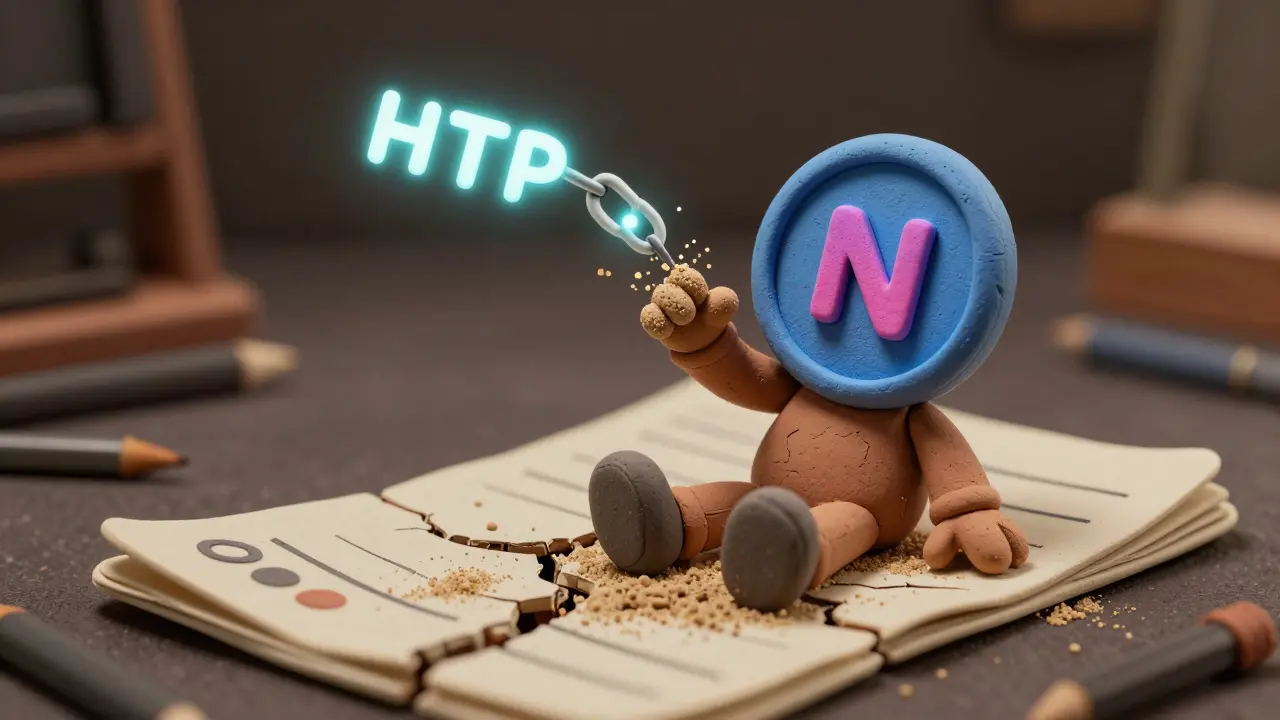
When you buy an NFT, you’re not buying the image or video itself. You’re buying a token on the blockchain - a digital certificate that says, "This is yours." The actual file? It’s stored somewhere else. Usually, it’s a link to a website, a cloud server, or a decentralized network. If that link breaks, your NFT becomes a ghost. It still exists on the blockchain. But the thing it’s supposed to represent? Gone.
Back in 2021, over 80% of NFT projects used regular HTTP links to store their metadata and media files. That means they were hosted on servers owned by companies like Amazon, Google, or small startups. If the company shuts down, runs out of money, or gets hacked? Your NFT turns into a 404 error. A 2023 study by LeewayHertz found that nearly 9 out of 10 NFTs from early projects had already lost access to their files. And most buyers didn’t even know.
The IPFS Solution - And Why It’s Not Perfect
Enter IPFS - the InterPlanetary File System. Developed by Protocol Labs in 2015, IPFS was built to fix this exact problem. Instead of storing files on a single server, IPFS breaks them into pieces and distributes them across thousands of computers worldwide. Each file gets a unique fingerprint called a CID - a long string of letters and numbers generated from the file’s content. If you change even one pixel, the CID changes. That means the link can’t be tampered with. It’s immutable.
By 2021, 67% of new NFT projects on Ethereum switched to IPFS. OpenSea, LooksRare, and other major marketplaces started using it. It seemed like the perfect fix. But here’s the catch: IPFS doesn’t store files forever by itself. It’s like a library where books are shared among patrons. If no one keeps a copy of your book, it eventually vanishes.
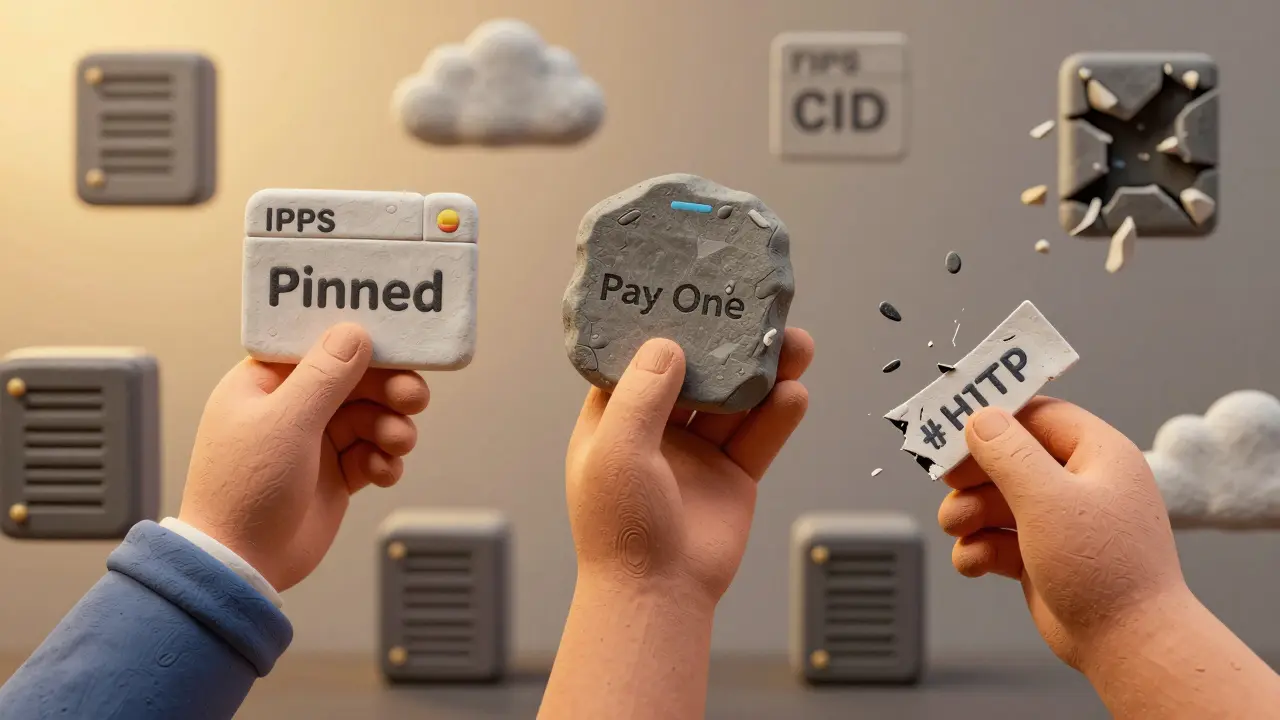
To keep your NFT alive, you need to "pin" it. That means paying a service - like Pinata, Filebase, or Fleek - to keep a copy of your file on their servers. If you stop paying? Your file gets deleted after a few months. The NIST IR 8472 report from March 2024 makes this crystal clear: IPFS provides addressability, not permanence. Without active pinning, your NFT’s data is just as fragile as an HTTP link.
Arweave: Pay Once, Store Forever?
Then there’s Arweave. It promises something different: permanent storage for a one-time fee. Instead of relying on ongoing payments, Arweave uses a token economy called the Blockweave. You pay once - about $0.01 per MB - and the network is designed to keep your data alive for 200+ years. Miners are paid from a pooled fund, incentivized to store data long-term because they earn more by holding onto it.
It sounds too good to be true. And in some ways, it is. Arweave is slower than IPFS. Retrieving a file can take 2 to 3 seconds, compared to under half a second on IPFS. It’s also more expensive upfront. But for collectors who want true permanence - artists, historians, institutions - it’s the only option that doesn’t require ongoing maintenance.
MIT and the University of North Texas are already using Arweave to store academic records as NFTs. Nike’s .SWOOSH platform stores virtual sneakers on Arweave too. These aren’t speculative projects. They’re institutional bets on long-term data survival.
Filecoin: The Incentivized Alternative
Filecoin is another player. It’s built on top of IPFS but adds a marketplace. Instead of relying on goodwill, Filecoin lets users pay miners in FIL tokens to store their data. Miners prove they’re keeping the files using cryptographic proofs. If they fail, they lose money. It’s a market-driven approach to permanence.
As of early 2024, storage costs were around $0.000004 per GB per day. That sounds tiny. But for a 10MB file, that’s $0.04 per year. Multiply that by 10,000 NFTs? It adds up. Filecoin works best for projects that can afford recurring costs and want verifiable, auditable storage.
The Real Problem: Perception vs. Reality
A 2023 Stanford survey of 1,200 NFT buyers found that 92% believed their NFTs were permanently stored on the blockchain. That’s a dangerous misunderstanding. The blockchain only stores the token. The art? That’s off-chain. And off-chain storage is where everything falls apart.
On Reddit, threads like "My NFTs from 2021 are now broken links - what now?" have over 1,200 comments. People are losing their digital art because the project owner stopped paying for hosting. Meanwhile, artists like Fewocious who used community pinning and multiple IPFS services still have 100% of their files intact.
The difference isn’t luck. It’s strategy.

How to Actually Protect Your NFTs
If you’re an artist or collector, here’s what you need to do:
- Use IPFS, not HTTP. Check your NFT’s metadata. If it starts with
https://, it’s at risk. Look foripfs://instead. - Pin to multiple services. Don’t rely on just Pinata. Use Fleek, Filebase, and NFT.Storage together. The more copies, the less likely your file disappears.
- Consider Arweave for high-value pieces. If your NFT is worth $10,000 or more, pay the one-time fee. It’s cheaper than losing it forever.
- Don’t trust NFT.Storage forever. Protocol Labs’ free service stores over 128 million NFTs - but their terms say they can delete data after 6 months if you don’t pin it yourself.
- Test your links. Go to ipfs.io and paste your CID. If the image loads, you’re good. If it says "not found," your file is already gone.
According to Hacken’s 2023 study, 34% of NFT collections had broken metadata within 18 months - all because creators didn’t follow these steps.
What’s Next for NFT Storage?
The industry is starting to wake up. IPFS Cluster 0.16.0, released in March 2024, now lets users automatically replicate pinned data across multiple providers. Crust Network claims 89% uptime for NFTs over two years. These are real improvements.
But the biggest challenge isn’t technical. It’s economic. Can these systems survive a crypto winter? In 2022, several pinning services shut down during the market crash. Chainalysis reported that 17% of Ethereum NFTs lost access to their data temporarily. That’s not a glitch. It’s a systemic risk.
Dr. Alex de Vries, a blockchain researcher, warned in his May 2024 IEEE paper that current models rely on speculative token economics. If the price of FIL or AR drops, miners stop storing data. Permanence isn’t guaranteed - it’s rented.
True permanence doesn’t exist unless there’s a long-term economic incentive. That’s why Arweave’s one-time payment model is the closest thing we have to real permanence today.
Final Reality Check
NFT data storage permanence isn’t automatic. It’s not built into the technology. It’s a choice you make - or don’t make.
Buying an NFT isn’t like buying a physical painting. You can’t hang it on your wall and forget about it. You have to manage its digital life. If you don’t, it will vanish. And no one will be responsible for it.
Permanence isn’t magic. It’s maintenance. And if you don’t do the work, your NFT is just a fancy link to a file that’s already gone.
Eunice Chook
December 16, 2025 AT 02:55NFTs are digital ghosts. You paid for a link. Not art. Not ownership. Just a pointer to a server that might shut down next Tuesday. Wake up.
Everyone thinks blockchain = eternal. It’s not. It’s a ledger. The file? Off-chain. And off-chain is trash unless you pay forever.
Ian Norton
December 16, 2025 AT 04:24You think Arweave is the answer? Please. It’s a Ponzi scheme dressed up as decentralization. Miners are paid in AR tokens. What happens when AR crashes? The whole system collapses. Permanence is a marketing lie. You’re renting storage from a volatile economy.
And don’t get me started on IPFS pinning services. They’re all one step away from bankruptcy. You’re trusting startups with your digital legacy. That’s not smart. That’s suicidal.
Nicholas Ethan
December 17, 2025 AT 20:33The fundamental flaw in contemporary NFT discourse is the conflation of cryptographic immutability with ontological permanence. The blockchain records the token identifier. The media object resides in an extralegal, economically contingent infrastructure. Absent sustained economic incentives for data retention, the artifact is functionally extinct regardless of its metadata integrity.
Arweave’s economic model remains the only viable approximation of durational integrity. All other systems are temporally bound by the volatility of tokenized labor.
Stanley Machuki
December 18, 2025 AT 03:48Yo. Don’t panic. You can fix this. Right now. Go check your NFTs on ipfs.io. If it loads? You’re good. If not? Pin it to three services today. Filebase, Fleek, NFT.Storage. Do it. It takes 5 minutes.
Arweave for the big ones. IPFS for the rest. Done. You just saved your digital art from becoming a meme about dumb people who thought NFTs were forever.
Stop overthinking. Start pinning. Your future self will thank you.
Kelly Burn
December 19, 2025 AT 12:22permanence is just a vibe 🌌
ipfs is like a library where everyone forgets to return books unless someone pays the librarian 💸
arweave? that’s the guy who paid $0.01 for a book and said ‘keep this forever’ and somehow… it works 🤯
if your nft’s art is worth more than your rent, spend the $10 now. not later. not ‘when the market recovers’.
you’re not buying art. you’re buying a digital heirloom. treat it like your grandma’s wedding ring. not a crypto trading card 📜💍