Philippines Blocks 20 Unlicensed Crypto Exchanges: What It Means for Users
 Jul, 7 2026
Imagine logging into your favorite cryptocurrency exchange only to find a blank screen or an error message stating the site is unreachable. For thousands of Filipino investors, this wasn't just a glitch; it was the result of a massive regulatory crackdown. In August 2025, the Philippine Securities and Exchange Commission (SEC) moved swiftly to block access to major international crypto platforms operating without local licenses. This action marked a turning point in how Southeast Asia handles digital assets, signaling that the era of unregulated offshore trading is over.
The headline figure often cited is "20," but the core enforcement action specifically targeted ten prominent exchanges: OKX, Bybit, MEXC, KuCoin, Bitget, Phemex, CoinEx, BitMart, Poloniex, and Kraken. These platforms were flagged for violating strict new rules designed to protect local investors from fraud and financial instability. The move wasn't just a warning shot; it involved technical blocks enforced by internet service providers, effectively cutting off access for millions of users on major networks like PLDT and Smart Communications.
Why Did the Philippines Crack Down on Crypto Exchanges?
To understand why these popular global platforms were blocked, you need to look at the legal framework established earlier in 2025. The Philippine government didn't pull this trigger randomly. They implemented two critical regulations: SEC Memorandum Circular (MC) No. 4 and SEC Memorandum Circular (MC) No. 5. These circulars took effect on July 5, 2025, creating a comprehensive set of rules for any entity dealing with digital assets in the country.
The primary issue was simple: non-compliance. Under these new laws, any platform acting as a Crypto Asset Service Provider (CASP) must be registered with the SEC. Operating without this license is illegal. The regulations were born out of necessity. Following the collapse of several high-profile international exchanges globally, Filipino regulators realized that allowing foreign platforms to operate without oversight left local investors vulnerable to total loss. If a foreign exchange goes bankrupt, Filipino users have little to no recourse to recover their funds. By requiring local registration, the government ensures there is a legal entity within the Philippines accountable for those assets.
Furthermore, the crackdown addressed broader economic concerns. The government wanted to bring crypto transactions under the taxation regime. Before 2025, crypto income was largely untaxed. Now, capital gains from selling crypto for fiat currency are taxed at 15 percent. Income from mining or staking falls under standard income tax, and selling goods for crypto attracts a 12 percent Value Added Tax (VAT). Platforms that refused to integrate with these tax reporting requirements were seen as facilitating tax evasion, further justifying the SEC's aggressive stance.
The Technical Block: How Access Was Cut Off
A regulatory order is only as good as its enforcement. In this case, the Philippine government leveraged its telecommunications infrastructure to ensure compliance. After the SEC issued its advisory, the National Telecommunications Commission (NTC) directed all internet service providers (ISPs) to block access to the websites and apps of the unlicensed exchanges.
PLDT Inc., one of the country's largest telecom providers, confirmed on August 12, 2025, that they had restricted access to all identified domains. Their wireless unit, Smart Communications, Inc., did the same. This meant that if you were connected to their network, you simply could not reach the servers of OKX, Bybit, or the others. PLDT’s Cyber Security Operations Group reported blocking billions of attempts to access malicious or unauthorized domains, highlighting the scale of their filtering capabilities.
This technical blockade created immediate friction for users. Many found themselves locked out of their accounts, unable to trade or withdraw funds easily. While tech-savvy users might turn to Virtual Private Networks (VPNs) to bypass these blocks, using a VPN to access an unlicensed financial platform carries its own risks. The SEC warned that individuals accessing these banned platforms do so at their own peril, with no consumer protection if things go wrong.

Key Requirements for Legal Crypto Operations in the Philippines
If you are a crypto company looking to operate in the Philippines, or an investor wondering why some platforms are safe while others are blocked, understanding the specific requirements is crucial. The barrier to entry is intentionally high to ensure stability and accountability.
| Requirement | Details | Purpose |
|---|---|---|
| SEC Registration | Mandatory license from the SEC | Legal accountability and oversight |
| Minimum Capital | PHP 100 million (~$1.76 million USD) | Ensures financial stability and ability to cover losses |
| Physical Presence | Must incorporate physically within the Philippines | Allows local authorities to audit and enforce laws |
| Fund Segregation | Customer funds must be separate from company assets | Protects user money if the exchange goes bankrupt |
| AML Reporting | Regular reports to the Anti-Money Laundering Council | Prevents illicit finance and terrorist funding |
The PHP 100 million capital requirement alone filters out many smaller, less stable exchanges. It ensures that only well-capitalized entities can handle public funds. The physical incorporation rule prevents companies from hiding behind offshore shell corporations. Perhaps most importantly, the fund segregation rule addresses the root cause of many exchange collapses. When customer funds are mixed with company operational funds, the exchange can accidentally (or intentionally) spend user money. By mandating separation, the SEC ensures that even if the exchange fails, the customers' crypto remains intact and retrievable.
Impact on Investors and the Market
For the average Filipino crypto user, this shift has been disruptive. Many were accustomed to using global giants like Binance (which faced similar restrictions in 2024) or OKX because of their deep liquidity and wide range of tokens. Suddenly, these options vanished from their browsers.
The market reaction was visible. On August 12, 2025, shares of PLDT fell by PHP 16 (1.22%) on the Philippine Stock Exchange, reflecting investor concern about the regulatory environment and potential impacts on telecom revenue or user churn. However, the long-term goal is market maturation. By forcing users toward licensed platforms, the government hopes to reduce the prevalence of scams and fraudulent investment schemes that thrive in unregulated spaces.
Investors now face a choice: migrate to locally licensed exchanges that comply with MC No. 4 and 5, or risk using banned platforms via workarounds. Licensed exchanges offer peace of mind and legal recourse. Banned platforms offer variety but come with zero protection. The SEC has made it clear: if you lose money on an unlicensed platform, the government will not help you recover it.
Regional Context: A Southeast Asian Trend
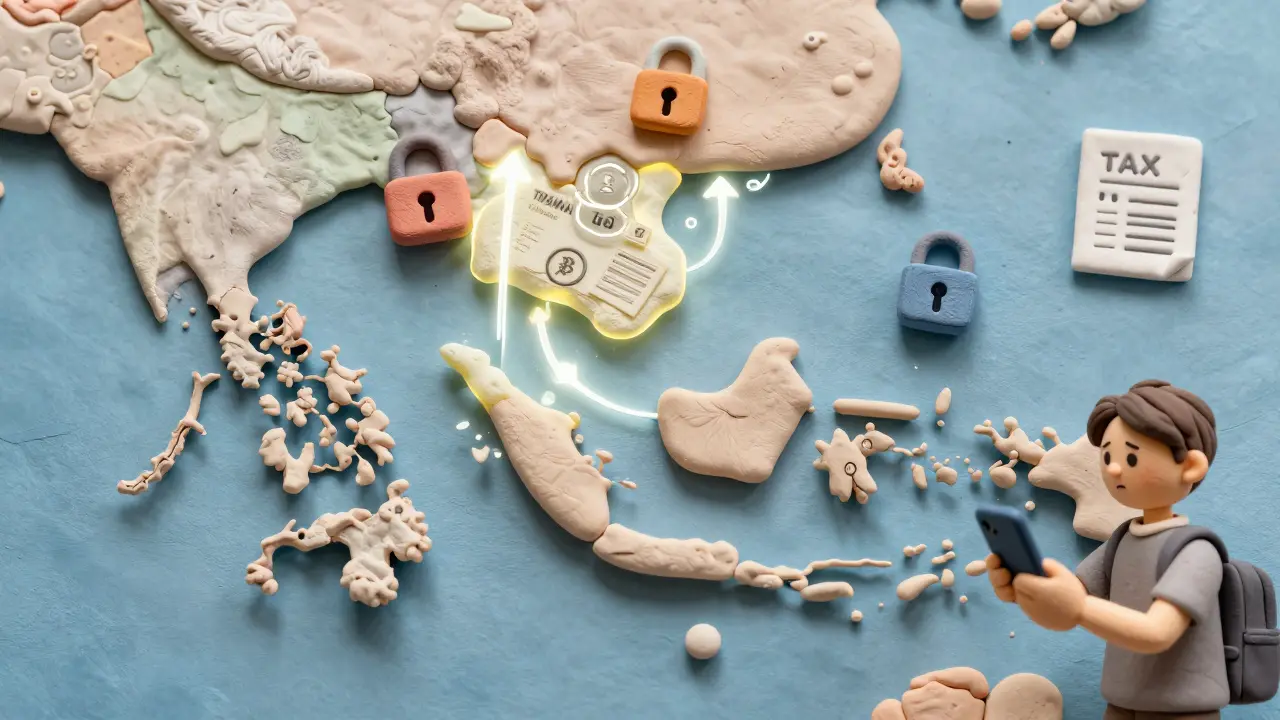
The Philippines is not acting in isolation. This crackdown is part of a broader trend across Southeast Asia where governments are tightening their grip on digital assets. Neighboring countries are adopting similar strategies to protect their economies and citizens.
In May 2025, Thailand's SEC ordered the blocking of five crypto exchanges, including Bybit and OKX, citing illegal operations and money laundering risks. Indonesia also tightened its policies in 2025, significantly increasing taxes on offshore crypto trades. Trades on domestic exchanges saw a modest tax increase, but trades on offshore platforms faced a fivefold tax hike, effectively discouraging users from using unregulated foreign services.
This regional alignment suggests that cross-border arbitrage-using one country's lax laws to serve another's users-is becoming increasingly difficult. Global exchanges can no longer assume they can serve Asian markets without adhering to local laws. The message from Manila, Bangkok, and Jakarta is consistent: comply with local regulations or leave the market.
What Should You Do Now?
If you are a crypto holder in the Philippines, the situation requires immediate attention. First, check if your current exchange is on the list of blocked platforms. If it is, you should consider withdrawing your assets to a self-custody wallet or transferring them to a licensed local exchange. Waiting too long could result in being locked out entirely if the platform decides to cease operations in the region due to the increased compliance costs.
Second, educate yourself on the tax implications. With the new 15% capital gains tax and 12% VAT, keeping accurate records of your transactions is no longer optional. Failure to report crypto income can lead to significant penalties from the Bureau of Internal Revenue.
Finally, be wary of influencers promoting specific platforms. The new regulations also target marketing. Content creators who promote unlicensed exchanges without proper disclosure or licensing can face legal action. Stick to information from verified, licensed sources.
Which crypto exchanges were blocked in the Philippines?
The SEC specifically named OKX, Bybit, MEXC, KuCoin, Bitget, Phemex, CoinEx, BitMart, Poloniex, and Kraken as unlicensed platforms. Access to these sites was blocked by major ISPs like PLDT and Smart Communications in August 2025.
Can I still use these blocked exchanges via VPN?
Technically, yes, many users use VPNs to bypass blocks. However, doing so means you are operating outside the law. The SEC warns that users of unlicensed platforms have no consumer protection. If the exchange hacks or shuts down, you cannot seek legal recourse in the Philippines.
What are MC No. 4 and MC No. 5?
These are Memorandum Circulars issued by the Philippine SEC that took effect in July 2025. They establish the legal framework for Crypto Asset Service Providers (CASPs), requiring licensing, minimum capital of PHP 100 million, physical presence in the country, and strict fund segregation.
How does the new crypto tax law affect me?
Selling crypto for fiat currency or exchanging it for goods incurs a 15% capital gains tax. Selling physical goods for crypto attracts a 12% VAT. Income from mining or staking is taxed under the regular income tax regime. You must report these transactions to avoid penalties.
Are there any licensed crypto exchanges in the Philippines?
Yes, several local exchanges have secured SEC licenses and comply with the new regulations. These platforms allow you to trade legally with full consumer protection. It is advisable to check the SEC's official list of registered CASPs before depositing funds.