Practical Byzantine Fault Tolerance (PBFT) Explained: How It Works and Why It Matters
 Jun, 22 2026
Imagine you are trying to agree on a dinner plan with five friends. Two of them are lying about their preferences, one is drunk and sending mixed signals, and the internet connection keeps dropping. How do you decide where to go without ending up at three different restaurants? This messy scenario is essentially what computer scientists call the Byzantine Generals' Problem, a concept first defined in 1982 by Leslie Lamport and his colleagues. In the digital world, this problem represents the nightmare of distributed systems: how do honest computers agree on a single truth when some participants might be malicious, broken, or just slow?
For decades, this was mostly a theoretical headache. That changed in 1999 when Miguel Castro and Barbara Liskov published a paper that turned theory into practice. They introduced Practical Byzantine Fault Tolerance (PBFT), a consensus algorithm designed to maintain system functionality even when some nodes behave arbitrarily or maliciously. PBFT didn't just solve the math; it proved you could build a secure, fault-tolerant system that actually ran fast enough for real-world use. Today, if you look under the hood of many enterprise blockchains and private ledgers, you will likely find PBFT or one of its many descendants keeping the lights on.
How PBFT Actually Works
To understand PBFT, you have to forget the idea of "mining" or "staking" that dominates public cryptocurrencies like Bitcoin or Ethereum. PBFT doesn't rely on economic incentives to keep people honest. Instead, it relies on strict mathematical rules and message passing. It assumes a fixed group of known validators-like a board of directors rather than an open crowd.
The core magic of PBFT lies in its ability to tolerate faults. The rule is simple but rigid: the system can handle f faulty or malicious nodes only if there are at least 3f + 1 total nodes. If you want your system to survive two traitors (f=2), you need at least seven validators (3*2 + 1 = 7). If you have fewer nodes than this threshold, the honest ones cannot distinguish between a lie and a network glitch, and consensus breaks down.
When a client sends a request (like a transaction), the process unfolds in three distinct phases:
- Pre-prepare: A designated leader node receives the request, timestamps it, and broadcasts it to all other validators. This step ensures everyone knows the order of requests.
- Prepare: Validators check the request's validity. If it looks good, they broadcast a "prepare" message to everyone else. Once a validator collects enough prepare messages (2f of them), it knows the majority agrees on the sequence.
- Commit: Validators then broadcast a "commit" message. When a validator sees 2f+1 commit messages, it executes the request and replies to the client. At this point, the decision is final.
This multi-phase approach ensures that even if the leader is corrupt or goes offline, the remaining honest nodes can still reach agreement. It provides what experts call "instant finality." Unlike Bitcoin, where you wait for six blocks to feel safe, PBFT transactions are irreversible the moment the commit phase completes.
Where PBFT Shines (and Where It Fails)
PBFT is not a one-size-fits-all solution. Its strengths are incredibly specific, which makes it perfect for certain jobs and terrible for others. You need to know these boundaries before choosing it for your project.
| Feature | PBFT | Proof of Work (Bitcoin) | Raft/Paxos |
|---|---|---|---|
| Fault Type | Byzantine (Malicious) | Economic Security | Crash (Honest Failures) |
| Node Requirement | 3f + 1 | High Hashrate | 2f + 1 |
| Finality | Instant | Probabilistic (Minutes) | Instant |
| Scalability | Low (O(n²) complexity) | Medium | High |
| Best Use Case | Permissioned Enterprise Ledgers | Public Currency | Internal Database Replication |
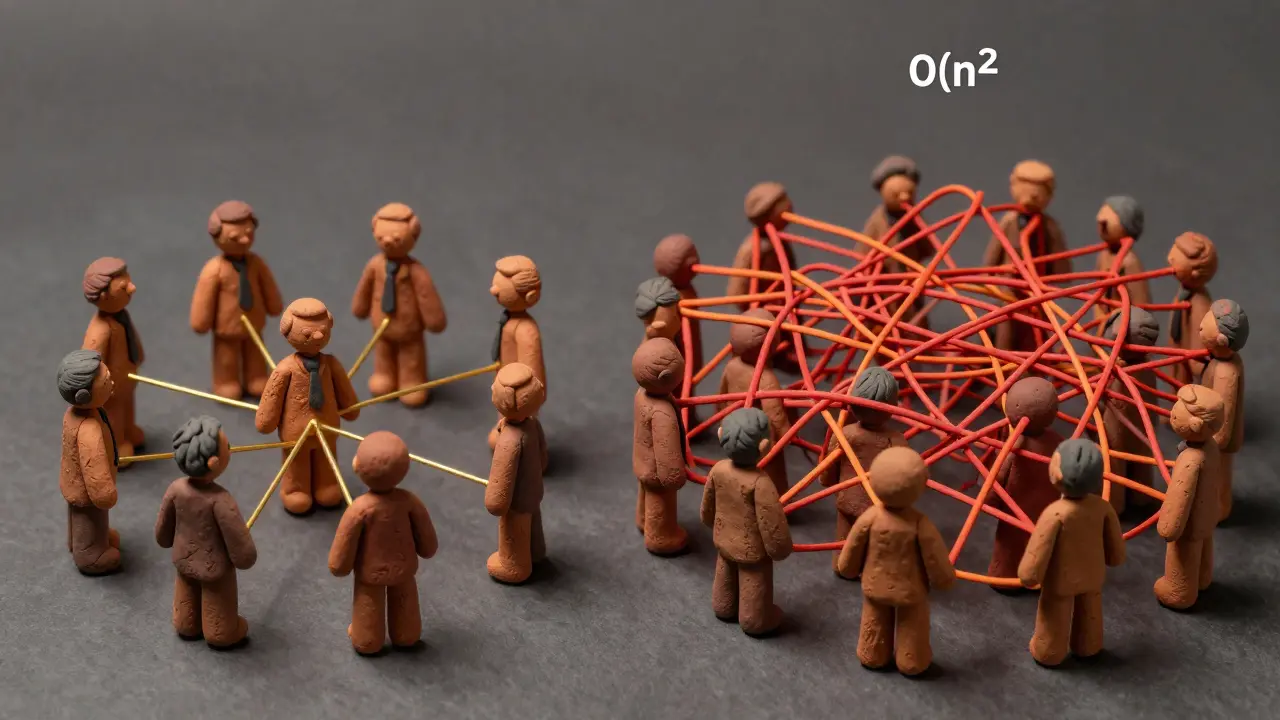
Notice the row for Raft and Paxos. These are popular consensus algorithms, but they assume nodes are "honest but fallible." They handle crashes well but fail if a node actively tries to deceive others. PBFT handles deception. However, this security comes at a cost. PBFT requires quadratic communication complexity, denoted as O(n²). This means if you double the number of nodes, the amount of data flying across the network quadruples. For a small group of ten trusted banks, this is fine. For a public blockchain with thousands of anonymous users, it creates a traffic jam that brings the system to a halt.
This is why PBFT is rarely seen in public coins. Instead, it powers permissioned networks like Hyperledger Fabric, an enterprise-grade framework for building blockchain applications. In these environments, participants are known entities. You don't have to worry about Sybil attacks (where one person creates fake identities) because identity is managed centrally. This allows PBFT to deliver high throughput-often thousands of transactions per second-with sub-second latency.

The Real-World Performance Trade-Offs
In their original 1999 paper, Castro and Liskov demonstrated that a BFT-NFS (Byzantine Fault Tolerant Network File System) performed only 3% slower than a standard non-replicated NFS. That efficiency was revolutionary. But modern implementations face different challenges. Network conditions today are less predictable than the controlled lab environments of the late 90s.
One major pain point is network partitioning. PBFT assumes a synchronous network where messages eventually arrive within a bounded time. If the internet splits into two isolated groups, PBFT can stall. Developers often report issues where consensus hangs during intermittent outages, even if the node count meets the 3f+1 requirement. To fix this, many teams implement fallback mechanisms that switch to simpler crash-fault tolerant protocols when Byzantine behavior isn't detected, as suggested in IBM’s Hyperledger best practices.
Another constraint is validator management. Since PBFT requires a fixed set of validators, adding or removing nodes is complex. You can't just let anyone join. A 2022 survey by ConsenSys found that 58% of developers cited "validator management overhead" as a significant hurdle. If you run a supply chain platform using PBFT with seven validators, and you want to add two more partners, you have to reconfigure the entire consensus layer carefully to avoid breaking safety guarantees.
Evolution: From PBFT to Modern Variants
PBFT hasn't stayed static. Over the last decade, researchers have tweaked it to address its weaknesses, particularly scalability and synchrony assumptions. These variants are now common in the blockchain ecosystem.
- Tendermint/CometBFT: Used by the Cosmos network, this variant modifies PBFT to include a proposer selection mechanism that reduces complexity and improves liveness. It maintains the 3f+1 rule but optimizes the message flow for blockchain-specific needs.
- HoneyBadgerBFT: This protocol removes the synchrony assumption entirely. It can operate in fully asynchronous networks, making it robust against severe network delays, though at the cost of higher computational overhead.
- Zyzzyva: An optimization that assumes most operations are correct. It uses optimistic replication to speed up processing, only falling back to full PBFT views when conflicts arise.
These adaptations show that while pure PBFT has limits, its core logic remains the gold standard for strong consistency. Even Apache Kafka, the popular event-streaming platform, released updates in 2023 inspired by PBFT principles to ensure mission-critical data feeds achieve 99.999% uptime with sub-100ms finality.
Should You Use PBFT for Your Project?
Deciding whether to adopt PBFT depends entirely on your threat model and scale requirements. Ask yourself these questions:
Do you need instant finality? If you are building a financial settlement system where reversals are unacceptable, PBFT is ideal. If you can tolerate probabilistic finality (like waiting for confirmations in crypto), Proof of Stake might be cheaper and easier to scale.
Is your participant list fixed? If you are coordinating a consortium of five banks or a government agency with known servers, PBFT works beautifully. If you are building a public app where anyone can download a wallet and join, PBFT will fail due to Sybil attacks and scaling limits.
Can you handle operational complexity? PBFT requires careful configuration of timeouts, cryptographic keys, and validator sets. It is not plug-and-play. Teams without experience in distributed systems often struggle with the initial setup and ongoing maintenance.
If your answer to the first two is yes, and you have the technical resources for the third, PBFT offers unmatched reliability. It is the engine behind billions of dollars in daily enterprise transaction volume, proving that despite its age, practical Byzantine fault tolerance remains a cornerstone of secure distributed computing.
What is the difference between PBFT and Proof of Work?
Proof of Work (PoW) relies on computational power and economic incentives to secure a network, offering probabilistic finality that takes time to confirm. PBFT relies on message passing among a known set of validators to achieve instant finality. PoW is better for open, permissionless networks, while PBFT is optimized for smaller, permissioned groups requiring immediate certainty.
Why does PBFT require 3f + 1 nodes?
The 3f + 1 formula ensures that honest nodes can always outvote malicious ones. If you have f faulty nodes, you need enough honest nodes to detect lies and still form a majority. Mathematically, this threshold prevents a coalition of faulty nodes from creating conflicting truths that honest nodes cannot resolve.
Can PBFT be used in public blockchains?
Generally, no. Pure PBFT struggles with public blockchains because it requires a fixed set of validators and suffers from O(n²) communication complexity. As the number of nodes grows into the thousands, the network becomes too slow. Public chains usually prefer Proof of Stake or hybrid models that offer better scalability.
What is the main weakness of PBFT?
Its primary weakness is scalability. Because every node must communicate with every other node multiple times during consensus, the network traffic increases quadratically. Additionally, it assumes a synchronous network, meaning it can stall if message delays exceed expected bounds.
Which industries use PBFT the most?
Financial services, government agencies, and healthcare sectors lead PBFT adoption. These industries prioritize data integrity, instant finality, and privacy over open accessibility. Enterprise platforms like Hyperledger Fabric, which use PBFT derivatives, are common in supply chain tracking and interbank settlements.
John Doe
June 23, 2026 AT 14:12Man, this post is literally the missing link in my understanding of why enterprise blockchains feel so different from crypto. The dinner analogy? Chef's kiss! 🍝 I always thought PBFT was just some dusty academic theory until I saw it actually powering Hyperledger Fabric in a project last year. It’s wild how the O(n²) complexity kills scalability for public nets but is totally fine for a consortium of banks who already know each other. You don’t need thousands of nodes when you have five trusted partners signing off on transactions. The instant finality part is what really sold me though-no more waiting six blocks to feel safe. Just commit and go. It’s like having a referee that doesn’t sleep or take bribes. Honestly, if more people understood the trade-off between decentralization and performance, we wouldn’t see so many failed projects trying to force PoW where it doesn’t belong. This explanation saved me from making a huge architectural mistake yesterday.
Skm Shubham
June 24, 2026 AT 20:27The author clearly has no clue about real-world distributed systems engineering. 😒 Calling PBFT 'practical' is laughable when you consider the massive overhead of validator management. Who has time to reconfigure consensus layers every time a partner joins? It’s not just 'complex,' it’s a nightmare for DevOps teams. And let’s be real, the 3f+1 rule is a luxury most startups can’t afford. They want speed, they want cheap, and they definitely don’t want to pay for seven redundant nodes just to handle two potential failures. This article reads like marketing fluff for Hyperledger rather than an honest technical assessment. If you’re building something new in 2024, look at modern DAG-based solutions instead of clinging to 1999-era algorithms. Don’t waste your life cycle on legacy tech.
Rob Aronson
June 26, 2026 AT 04:26I respectfully disagree with the notion that PBFT is obsolete. 🤔 While the O(n²) communication complexity is indeed a bottleneck for permissionless networks, it remains the gold standard for *permissioned* environments where identity is verified. In financial settlements, the cost of a single reversal outweighs the operational overhead of managing validators by orders of magnitude. The key insight here isn't just the algorithm itself, but the threat model: are you defending against Sybil attacks or malicious insiders? For the latter, PBFT provides deterministic finality that probabilistic models simply cannot match. Plus, variants like Tendermint have significantly optimized the view-change process. It’s not about choosing the 'newest' tech, but the right tool for the specific consistency requirements. 🚀
Fede Faith
June 27, 2026 AT 19:45Great breakdown! 👏 I’ve been working with CometBFT recently and seeing these principles in action is fascinating. One thing I’d add is how crucial the leader rotation mechanism is in modern implementations. Pure PBFT can get stuck if the leader is malicious or offline, but newer variants handle this much more gracefully. Also, don’t sleep on HoneyBadgerBFT for asynchronous networks-it’s heavy on compute but saves your bacon when network partitions happen. If you’re diving into this space, start small with a testnet of 4-7 nodes to get a feel for the latency spikes during view changes. Trust me, the learning curve is steep but worth it for the reliability gains. 💪
Josh Dodson
June 28, 2026 AT 00:39totally agree with the point about instant finality!! its a game changer for things like supply chain tracking where you cant afford delays. i tried setting up a small cluster last week and wow, the config files were intense lol. took me forever to get the timeouts right so it didnt crash during high load. but once it was running, the speed was insane compared to my old raft setup. just wish there was a simpler gui for managing validators instead of doing it all via cli commands. maybe someone should build that? 😅
Danna Charris
June 28, 2026 AT 21:38Fascinating read. The distinction between crash-fault tolerance and Byzantine fault tolerance is often glossed over in introductory materials. Most engineers default to Raft because it’s easier to implement, failing to recognize that their threat model requires protection against active adversaries. PBFT is not merely an alternative; it is a necessity for high-stakes environments. Do not confuse simplicity with security.