Public Blockchain Examples: Bitcoin, Ethereum, and More
 Jul, 25 2025
Blockchain Comparison Calculator
Choose Your Priority
Enter Your Transaction Volume
Recommended Blockchains
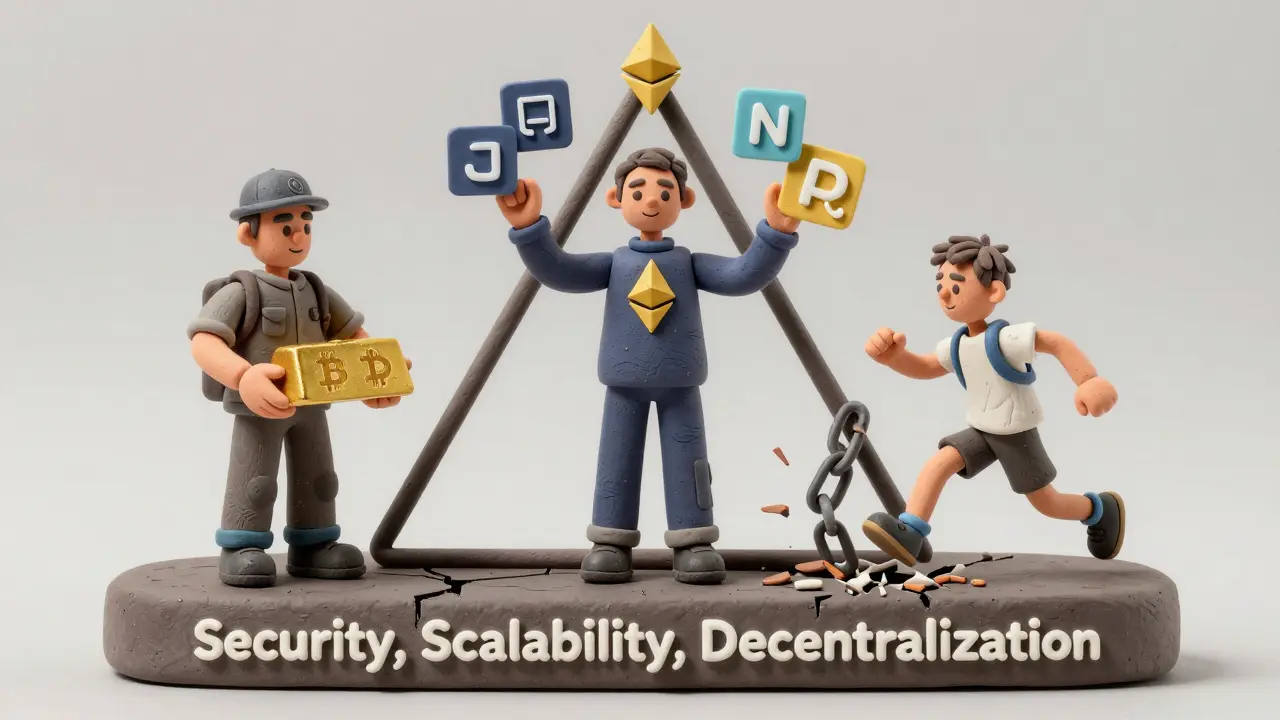
Blockchain Trilemma: You can't maximize all three simultaneously. Bitcoin prioritizes security, Ethereum prioritizes functionality, Solana prioritizes speed.
When people talk about blockchain, they usually mean one of two things: Bitcoin or Ethereum. But those two aren’t the whole story. Public blockchains are open networks where anyone can join, send transactions, or run code - no permission needed. They’re not owned by companies, governments, or banks. They run on thousands of computers around the world, all agreeing on what’s true. That’s the magic. And while Bitcoin started it all, Ethereum changed the game completely.
Bitcoin: The Original Digital Cash
Bitcoin isn’t just the first blockchain. It’s still the most secure. Launched on January 3, 2009, it was built to be digital money you could send directly to someone without a middleman. No bank. No fee collector. Just you, the network, and math.
It’s simple by design. Bitcoin’s job is to record who owns what. It doesn’t run apps. It doesn’t host websites. It just moves value. That’s why it’s called “digital gold.” People hold it because it’s hard to make more, hard to censor, and hard to destroy. Every 10 minutes, a new block gets added. Each block holds about 1MB of transactions. The network processes maybe 4 to 7 transactions per second. Slow? Yes. But that slowness is intentional. It makes attacks expensive.
As of 2023, Bitcoin’s network uses over 200 exahashes per second of computing power. That’s more than the entire top 500 supercomputers in the world combined. To take over Bitcoin, you’d need to control more than half that power - a cost estimated at $14.5 billion. That’s not just hard. It’s practically impossible.
There are over 15,000 full nodes running Bitcoin around the globe. That’s more than any other blockchain. Nodes are computers that store the full history of every Bitcoin ever sent. The more nodes, the harder it is to lie about what happened. Bitcoin’s code hasn’t changed much since 2009. That’s not because it’s outdated. It’s because it works. And it’s trusted.
Ethereum: The World Computer
Ethereum didn’t just copy Bitcoin. It rewrote the rules. In 2013, Vitalik Buterin proposed a blockchain that could run programs - not just payments. That’s what made Ethereum different. Instead of just tracking who owns coins, it could execute code. That code? Smart contracts. Self-running agreements that trigger when conditions are met.
Launched in July 2015, Ethereum quickly became the home of decentralized apps (dapps). Want to lend money without a bank? There’s a dapp for that. Want to trade unique digital art? That’s NFTs, mostly on Ethereum. Want to swap tokens automatically? DeFi protocols run on Ethereum. As of late 2023, over 4,000 dapps were live on Ethereum, with more than 50 million smart contracts deployed.
But Ethereum wasn’t perfect. It was slow. And expensive. During the 2021 crypto boom, a simple transaction could cost $180 in gas fees. That’s not user-friendly. So in September 2022, Ethereum did something no other major blockchain had done: it switched from mining to staking. Called “The Merge,” it cut energy use by 99.95%. Miners with giant rigs were replaced by validators who lock up 32 ETH (about $51,200 at the time) to help secure the network.
Now, blocks come every 12 seconds. Throughputs are 15-30 transactions per second. Gas fees average around $3.50 - still higher than Bitcoin’s $1.20, but far better than before. And Ethereum isn’t done. The upcoming “Dencun” upgrade in early 2024 will introduce proto-danksharding, which could slash Layer-2 transaction costs by 90%. That’s huge for scaling.

Other Public Blockchains You Should Know
Bitcoin and Ethereum aren’t alone. Other public blockchains are trying to solve different problems.
Cardano launched in 2017 with a focus on academic rigor. It uses a proof-of-stake system called Ouroboros and claims to be more energy-efficient than Bitcoin. It has over 2,000 nodes and a 10-second block time. But it’s still catching up in real-world usage.
Solana, launched in 2020, is all about speed. It claims to handle 65,000 transactions per second. That’s faster than Visa. But speed came at a cost. In 2022 alone, Solana had six major outages. When the network goes down, everything stops. That’s not ideal for financial apps.
Then there’s Polygon, which isn’t a standalone chain but a Layer-2 solution built on top of Ethereum. It’s used by big brands like Starbucks and Meta to run low-cost NFT projects. It’s not a public blockchain on its own - it relies on Ethereum’s security.
Each of these networks makes trade-offs. You can’t have maximum security, maximum speed, and maximum decentralization all at once. That’s the blockchain trilemma. Bitcoin picks security and decentralization. Ethereum picks functionality and is working on scalability. Solana picks speed but sacrifices uptime. Cardano picks research-backed design but lags in adoption.
Who Uses These Blockchains?
Bitcoin users are mostly holders. A 2023 Glassnode report showed that 62.3% of Bitcoin addresses haven’t moved coins in over a year. People buy it, hold it, and forget about it. Reddit’s r/Bitcoin community is full of posts like “Just bought my first 0.01 BTC as long-term savings - am I crazy?” with thousands of upvotes. The narrative is clear: Bitcoin is money, not a tool.
Ethereum users? They’re builders. Developers. Traders. People who interact with apps. Reddit’s r/ethereum is full of questions like “Best resources for learning Solidity in 2023?” and “Why is my transaction stuck?” There are 1.8 million daily active Ethereum wallets, compared to 850,000 for Bitcoin. Ethereum isn’t just a currency - it’s a platform.
On Trustpilot, Coinbase users praise Bitcoin for its simplicity and Ethereum for its power - but complain about high fees. That’s the split. Bitcoin is easy. Ethereum is powerful - but complicated.
Market and Regulation: Where Do They Stand?
As of late 2023, Bitcoin holds 52.3% of the entire $1.15 trillion crypto market. Ethereum is second at 18.7%. That’s not just popularity - it’s institutional trust. Fifteen U.S. public companies, including MicroStrategy and Tesla, hold over $12 billion in Bitcoin on their balance sheets. Not a single one holds Ethereum as a corporate asset.
Regulators see them differently too. The European Union’s MiCA law, effective in December 2024, treats Bitcoin as a “virtual asset” and Ethereum as a “utility token.” That means different rules for taxes, disclosures, and compliance. In the U.S., the SEC hasn’t ruled on Ethereum’s status. Gary Gensler has said many tokens beyond Bitcoin likely qualify as securities - a legal gray area that could affect how Ethereum is used in finance.
Meanwhile, Bitcoin’s Taproot upgrade in 2021 improved privacy and efficiency. The upcoming Taproot Assets protocol, launching in early 2024, will let users issue tokens on Bitcoin - without changing its core rules. That’s a big deal. It means Bitcoin could start supporting NFTs and tokenized assets - without becoming Ethereum.
What’s the Right Choice?
There’s no single “best” public blockchain. It depends on what you need.
If you want to store value, protect against inflation, or hold digital cash that can’t be frozen - Bitcoin is the most proven option. It’s battle-tested, decentralized, and simple.
If you want to use apps, trade tokens, lend money, buy NFTs, or build something on top of a blockchain - Ethereum is where the action is. It’s the most developed ecosystem, with the most tools, developers, and users.
For casual users? Start with Bitcoin. It’s easier to understand. For developers? Learn Ethereum. It’s where the future is being built.
Public blockchains aren’t going away. They’re evolving. Bitcoin stays focused. Ethereum keeps innovating. Others come and go. But the core idea remains: trust without a middleman. That’s powerful. And it’s here to stay.
What makes a blockchain "public"?
A public blockchain is open to anyone. You don’t need permission to join, send transactions, or run code. Everyone can see the ledger, and no single entity controls it. Bitcoin and Ethereum are public because anyone with an internet connection can participate - whether they’re a miner, validator, developer, or just sending crypto.
Is Bitcoin better than Ethereum?
Neither is better - they serve different purposes. Bitcoin is optimized for security and simplicity as digital money. Ethereum is optimized for programmability and running decentralized apps. Bitcoin is like a digital gold vault. Ethereum is like a global computer you can build software on. Choose based on what you need, not what’s trending.
Can I use Ethereum for simple payments like Bitcoin?
Yes, you can send ETH like you send BTC. But it’s not ideal. Ethereum’s gas fees are higher, and its network is designed for complex interactions, not just payments. For sending small amounts regularly, Bitcoin is cheaper and simpler. Ethereum is better for apps, DeFi, or NFTs - not for buying coffee.
Why do people say Ethereum is more scalable than Bitcoin?
Ethereum isn’t inherently more scalable - it’s just trying harder to become so. Bitcoin’s block size is capped, and changes are rare. Ethereum uses Layer-2 solutions like Arbitrum and Optimism to handle most transactions off-chain, then settles them on the main network. This lets it process far more transactions without changing its core protocol. Bitcoin is staying simple; Ethereum is building on top.
Are public blockchains safe from hackers?
The blockchains themselves are extremely secure. Bitcoin and Ethereum have never been hacked at the protocol level. What gets hacked are exchanges, wallets, or smart contracts with bugs. If you keep your private keys safe and use trusted wallets, your funds on a public blockchain are among the safest digital assets you can hold.
Stanley Wong
December 6, 2025 AT 22:48Bitcoin's just digital gold yeah but lets be real it's the only thing that's survived 15 years of every hype cycle and crash and still standing tall
Ethereum's cool and all with its smart contracts and dapps but you ever try sending 0.01 ETH during peak gas? You lose more in fees than you send
And don't even get me started on Solana's outages I lost a week's worth of NFT flips when it went down last year
Cardano's got the whitepapers but where are the users? I've seen more active wallets in my local coffee shop than on Cardano's explorer
The trilemma isn't a theory its a daily reality you pick two and sacrifice the third and most people pick security and decentralization even if it means slower transactions
Kenneth Ljungström
December 8, 2025 AT 09:12Man I just bought my first 0.02 BTC last week and honestly felt like I was joining a secret club 😊
Everyone on r/bitcoin is so chill no one's yelling about mooning or shilling
Ethereum's where the devs live but Bitcoin? That's where the quiet millionaires sleep 😴
Also just found out Taproot Assets is coming soon like imagine NFTs on Bitcoin without changing anything fundamental
That's next level simplicity right there 🤯
Brooke Schmalbach
December 8, 2025 AT 21:58Everyone keeps saying Bitcoin is secure but they ignore the fact that 95% of its hash rate is concentrated in three Chinese mining pools
And Ethereum's 'decentralized' validators? Most of them are institutional staking services like Coinbase and Lido
Cardano's Ouroboros is mathematically elegant but it's still slower than a dial-up connection when you try to swap tokens
Solana's 65k TPS? Sure if you ignore the six major outages and the fact that every node has to be a $10k server
And don't even get me started on Polygon being a Layer-2 and not even a real blockchain
Public blockchains are a myth wrapped in marketing jargon and investor FOMO
Nina Meretoile
December 10, 2025 AT 02:59There's something beautiful about how Bitcoin just sits there like a mountain unchanged for over a decade
It doesn't need to be everything to everyone it just needs to be reliable
Ethereum is like a bustling city full of innovation and noise and people building things that didn't exist before
And yeah the fees hurt but look at what's been built on top of it DAOs NFTs DeFi protocols that actually work
It's not just code it's a new kind of social contract
And the Merge? That was one of the most important tech milestones of the decade
Switching from energy-hungry mining to staking wasn't just technical it was ethical
Bitcoin holds value Ethereum enables possibility
And honestly we need both
Richard T
December 10, 2025 AT 14:27