Stablecoins: The Real Solution to Crypto Volatility?
 Oct, 28 2026
You buy Bitcoin on Monday, it’s up 10%. By Wednesday, you’re down 20%. Your portfolio looks like a rollercoaster that lost its safety harness. This is the classic crypto headache: massive potential wrapped in terrifying price swings. But what if you could keep your money on the blockchain-fast, global, and transparent-without watching your net worth crash every time Elon Musk tweets? Enter stablecoins. These are cryptocurrencies engineered to hold their value steady, usually pegged 1:1 to the U.S. dollar. They promise the best of both worlds: the tech benefits of crypto without the heart-attack-inducing volatility.
Why Regular Crypto Is Too Wild for Daily Use
Think about buying coffee with Bitcoin. If the price drops 5% while you’re waiting for the barista to make your latte, did you just pay double? That’s not practical. Traditional cryptocurrencies like Bitcoin or Ethereum are volatile because their supply is fixed or algorithmic, but demand fluctuates wildly based on speculation, news, and market sentiment. There’s no anchor keeping the price grounded. Stablecoins fix this by anchoring their price to something stable, typically fiat currency like the USD or commodities like gold. This makes them useful for things regular money does: paying bills, sending remittances, or storing value short-term. You get the speed of digital assets (transactions settle in seconds, not days) without the risk of waking up to find your savings halved overnight.
The Four Main Types of Stablecoins
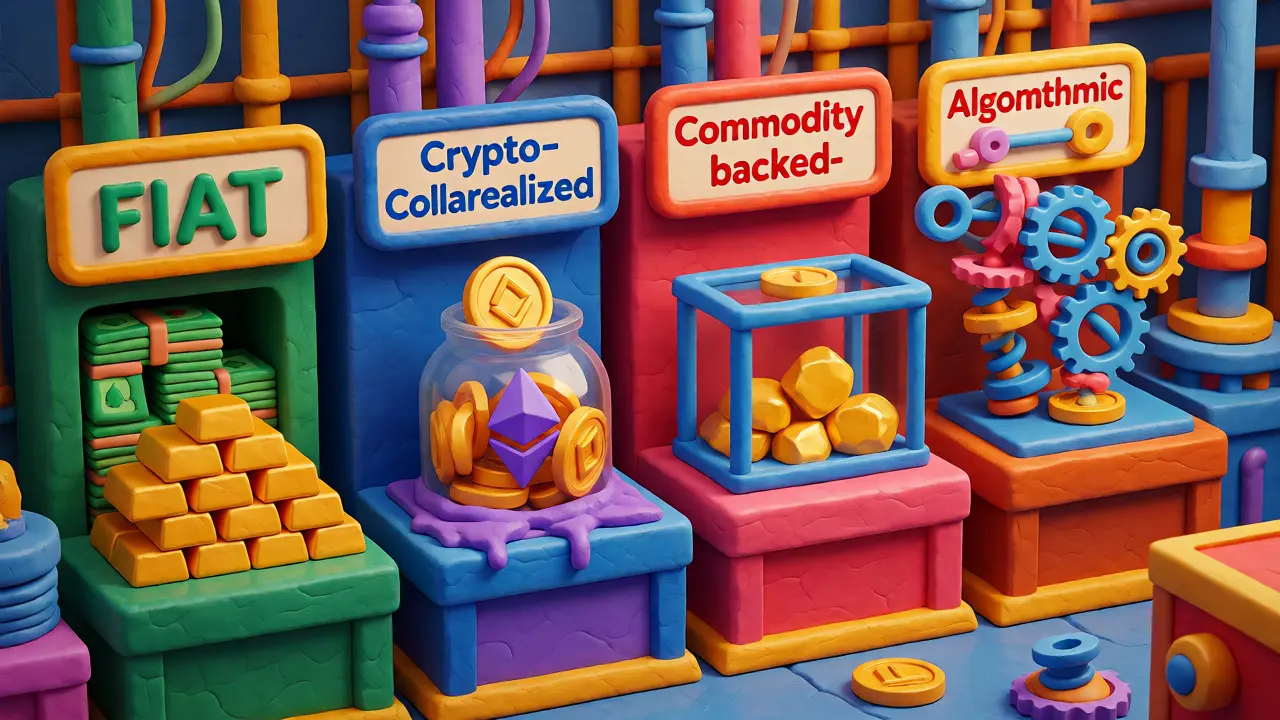
Not all stablecoins work the same way. How they maintain their peg determines their risk profile. Understanding these mechanisms is crucial before you park your cash in one.
| Type | Mechanism | Examples | Risk Level |
|---|---|---|---|
| Fiat-Collateralized | Backed 1:1 by actual cash or cash equivalents held in bank accounts. | USDC, USDT | Low (if audited) |
| Crypto-Collateralized | Overcollateralized with other cryptos; uses smart contracts to manage reserves. | DAI | Medium (market dependent) |
| Commodity-Backed | Pegged to physical assets like gold or silver stored in vaults. | PAXG, XAUT | Low (asset dependent) |
| Algorithmic | No collateral; uses code to adjust supply based on demand. | UST (collapsed), FRAX | High (fragile) |
Fiat-Collateralized: The Safe Bet
This is the most common type. Issuers like Circle (maker of USD Coin) claim that for every USDC token in circulation, there is one real U.S. dollar sitting in a bank account or invested in short-term Treasury bills. When you redeem your USDC, you should get your dollar back. The key here is trust and transparency. You need to know the issuer actually has the money. Audits and attestations are non-negotiable here. Without them, you’re taking a leap of faith.
Crypto-Collateralized: Overkill for Safety
Tokens like DAI, created by MakerDAO, don’t rely on banks. Instead, they use other cryptocurrencies as collateral. Because crypto prices swing, these systems require overcollateralization. To mint $1 worth of DAI, you might need to lock up $1.50 worth of Ethereum. If the price of ETH crashes, the system automatically liquidates some collateral to cover the debt. It’s decentralized and censorship-resistant, but it’s complex and can be expensive to use due to gas fees.
Algorithmic: The High-Wire Act
These coins have no backing at all. They rely on smart contracts and arbitrage incentives to keep the price near $1. If the price goes above $1, the protocol mints more tokens to increase supply. If it drops below, it burns tokens to reduce supply. Sounds elegant until it breaks. Remember TerraUSD (UST)? In May 2022, it collapsed entirely, wiping out billions. Algorithmic stablecoins are fascinating experiments, but they are prone to "death spirals" where panic leads to selling, which leads to lower prices, which leads to more panic.
How Stablecoins Actually Stabilize Value
It’s not magic; it’s mechanics. For fiat-backed coins, stability comes from redemption rights. If USDC trades at $0.98 on an exchange, traders will buy it cheap, redeem it for $1.00 with the issuer, and pocket the difference. This arbitrage pushes the price back to $1. For crypto-backed coins, stability comes from liquidation triggers. If your collateral value drops too low, bots sell your ETH to repay the DAI debt, ensuring the system never runs out of funds to honor redemptions.
However, stability isn't guaranteed. If people lose confidence in the issuer, they might rush to redeem their tokens all at once. This is called a "run." If the issuer doesn't have enough liquid cash ready (maybe their money is tied up in longer-term bonds), they can’t pay everyone immediately. The price drifts away from $1, and panic spreads. This happened briefly with USDC in March 2023 when Silicon Valley Bank failed, causing a temporary depeg because Circle had some reserves stuck there.
Real-World Uses Beyond Trading
So, why do people actually use these? It’s not just for trading pairs on exchanges.
- Cross-Border Payments: Sending money internationally via SWIFT takes days and costs high fees. Sending USDC on the Solana or Ethereum network takes seconds and costs cents. Migrant workers send remittances home instantly without losing 10% to wire fees.
- DeFi Yield Farming: You can lend your stablecoins on platforms like Aave or Compound to earn interest. Since the principal doesn’t fluctuate, your yield is pure profit (minus risks).
- Merchant Settlement: Some businesses accept stablecoins to avoid credit card processing fees. They receive payment instantly and can convert to fiat later if needed.
- Inflation Hedge: In countries with hyperinflation (like Argentina or Turkey), citizens use stablecoins to protect their savings from local currency collapse while still using digital rails.

The Risks You Can’t Ignore
Don’t let the name fool you. "Stable" doesn’t mean "risk-free." Here’s what can go wrong:
- Counterparty Risk: With fiat-backed coins, you trust the issuer. If they mismanage funds or commit fraud, you lose money. Tether (USDT) has faced scrutiny for years regarding its reserve composition.
- Regulatory Risk: Governments are still figuring out how to regulate these assets. New laws could restrict who can issue them or how they must hold reserves, potentially freezing funds or changing their legal status.
- Smart Contract Bugs: For DeFi-based stablecoins like DAI, a bug in the code could drain funds. While these protocols are battle-tested, hacks happen.
- Depegging Events: Even blue-chip coins can temporarily lose their peg during extreme market stress. You might end up selling at $0.97 instead of $1.00.
Choosing the Right Stablecoin
If you’re looking to move away from volatile assets, consider these factors:
- Audits: Does the issuer publish monthly attestations from reputable accounting firms? USDC does; check their website.
- Liquidity: Is it easy to buy and sell? USDT and USDC are everywhere. Smaller coins might have wider spreads.
- Network Support: Which blockchains support it? If you live on Ethereum, you want deep liquidity there. If you prefer cheap transactions, look for versions on Polygon, Arbitrum, or Solana.
- Transparency: Can you see exactly what backs the coin? On-chain data tools allow you to verify reserves for some coins, adding a layer of trust.
Stablecoins aren’t perfect, but they solve a critical problem: they make crypto usable. They bridge the gap between the chaotic world of speculative assets and the boring, reliable world of traditional finance. As regulations mature and issuers become more transparent, these digital dollars will likely become the backbone of the next generation of internet money.
Are stablecoins safe to hold?
They are safer than Bitcoin or Ethereum in terms of price volatility, but they carry different risks. Fiat-backed coins depend on the issuer's solvency and regulatory compliance. Crypto-backed coins depend on smart contract security and collateral health. Always diversify and choose well-audited options.
What happens if a stablecoin loses its peg?
If a stablecoin depegs, its price deviates from $1.00. In mild cases, it might trade at $0.98 or $1.02, offering arbitrage opportunities. In severe cases, like TerraUSD, it can drop to near zero, resulting in significant losses for holders who cannot exit quickly.
Can I earn interest on stablecoins?
Yes. Decentralized Finance (DeFi) platforms allow you to lend stablecoins to borrowers in exchange for interest payments. Rates vary based on demand and platform risk, often ranging from 2% to 10% annually, though higher yields usually come with higher smart contract risks.
Which stablecoin is the most popular?
Tether (USDT) typically has the highest market capitalization and trading volume globally, followed closely by USD Coin (USDC). USDC is often preferred in the United States due to its stronger regulatory alignment and frequent audits, while USDT dominates in Asian markets.
Do stablecoins replace traditional banking?
Not entirely. They offer faster settlements and better accessibility, especially for cross-border transfers. However, they lack deposit insurance (like FDIC in the US) and face regulatory uncertainty. They complement banking rather than fully replacing it, serving as efficient tools for specific financial tasks.