Staking vs Mining: Complete Comparison for Crypto Investors
 Oct, 24 2026
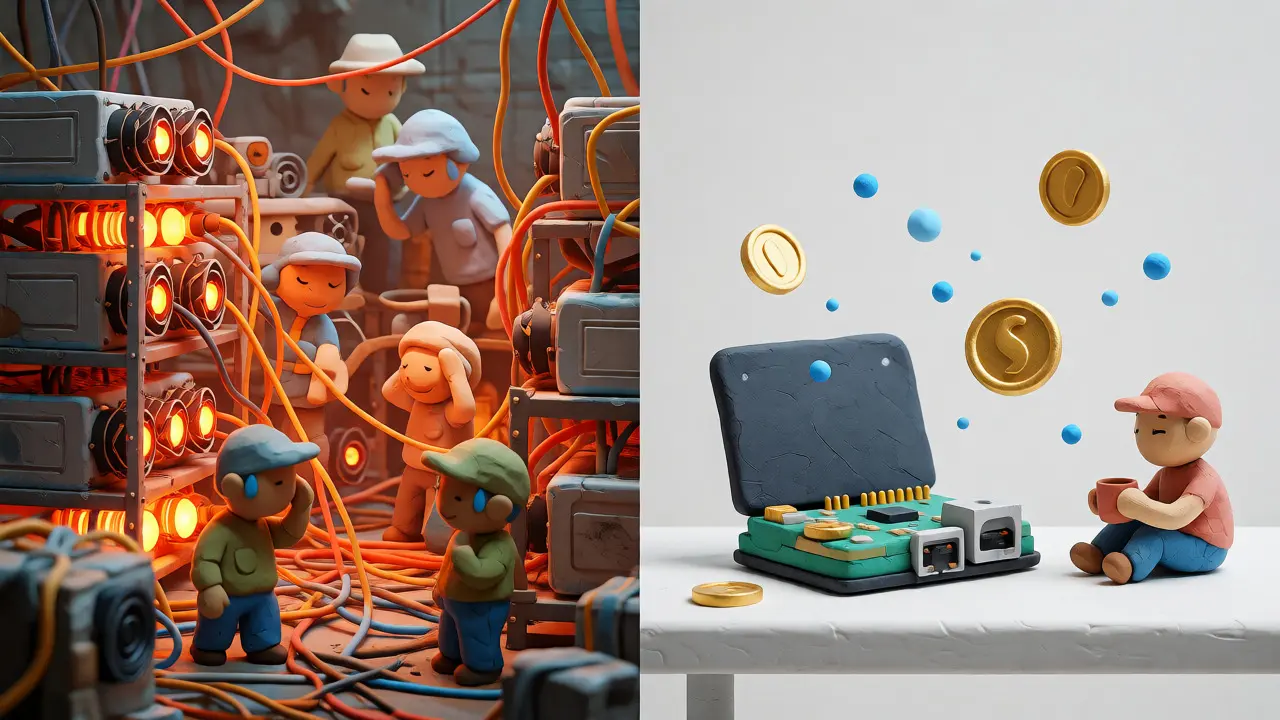
Imagine spending $9,200 on a rig, running it for eighteen months, and ending up with a net loss of $4,600 after paying your electric bill. That’s the reality for many home miners today. Now imagine locking up some coins in a digital wallet, doing almost nothing, and earning a steady 3-8% annual yield without buying expensive hardware or worrying about overheating fans. This isn't hypothetical; these are actual outcomes reported by community members on Reddit as recently as 2023.
If you've been looking at crypto investments, you've likely heard the debate between Proof of Work and Proof of Stake. One requires brute force computing power; the other requires financial commitment. But which one makes sense for you? Are you trying to secure a network, earn passive income, or just understand where the industry is heading? The answer depends entirely on your budget, technical skills, and risk tolerance.
The Core Difference: Computing Power vs. Financial Skin in the Game
At its heart, blockchain consensus is about agreement. How do thousands of strangers agree on who owns what without a bank? Two main methods exist: Mining and Staking.
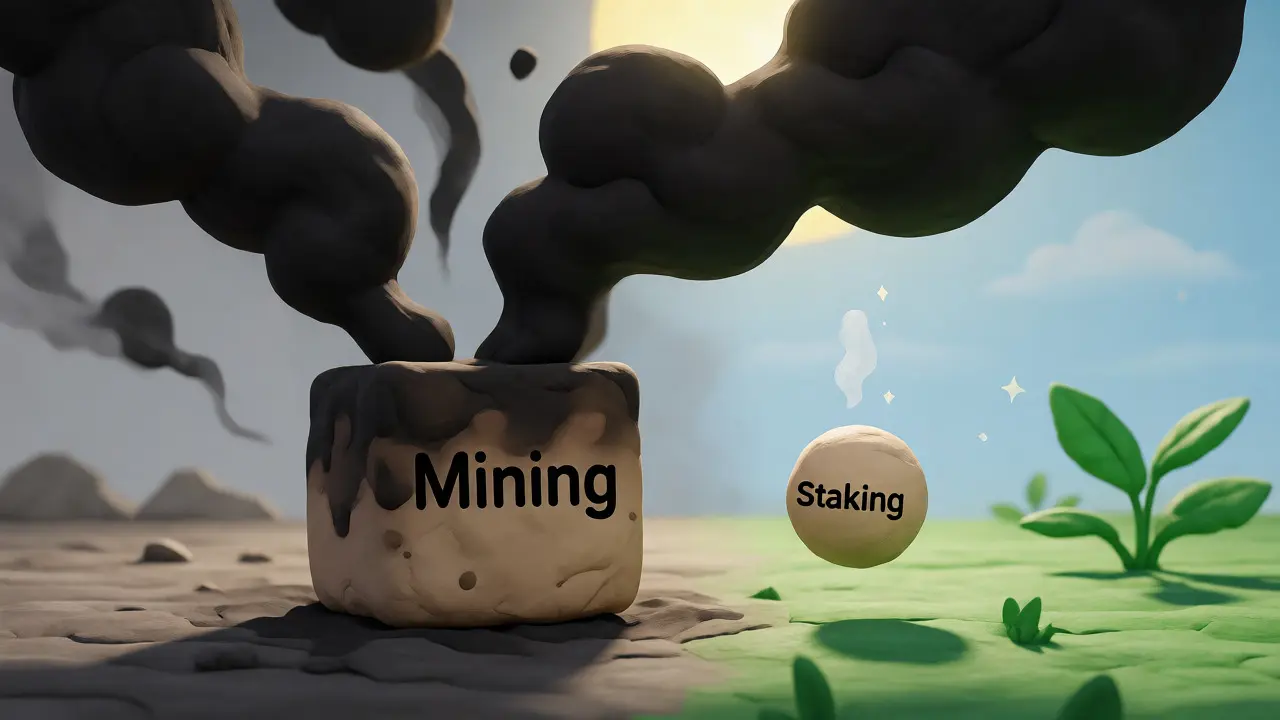
Mining, or Proof of Work (PoW), is the original method used by Bitcoin since 2009. Miners compete to solve complex mathematical puzzles using specialized computers. The first one to find the solution gets to add the next block of transactions to the chain and receives a reward. It’s a race based on raw computational horsepower. If you have more powerful machines, you win more often. This system is incredibly secure because attacking it would require an astronomical amount of electricity and hardware.
Staking, or Proof of Stake (PoS), works differently. Instead of burning energy to solve puzzles, validators lock up their own cryptocurrency as collateral. Think of it like posting a bond. If you try to cheat the system-say, by validating fake transactions-you lose your bond (this is called "slashing"). If you act honestly, you earn rewards from transaction fees and new coin issuance. Ethereum made this famous with "The Merge" in September 2022, cutting its energy use by 99.95%. Suddenly, securing the network wasn't about watts; it was about wealth.
Energy Consumption: A Massive Divide
This is the elephant in the room. Mining is energy-intensive. In 2023, Bitcoin miners globally consumed over 120 terawatt-hours annually. To put that in perspective, that’s more electricity than entire countries like Argentina or Norway use in a year. It’s not just about cost; it’s about environmental impact and public perception.
Staking changes the equation completely. When Ethereum switched from PoW to PoS, its energy consumption dropped from roughly 78.9 TWh/year to just 0.0026 TWh/year. That’s a reduction of 99.95%. You can run a staking validator on a standard computer or even a Raspberry Pi 4 costing under $200. The difference isn't marginal; it's categorical. If sustainability is a key factor in your investment thesis, staking networks have a clear advantage here.
Hardware Requirements and Entry Costs
Let’s talk money. What does it actually take to get started?
For Mining, you need specialized hardware. Bitcoin mining now relies on ASICs (Application-Specific Integrated Circuits). A top-tier machine like the Bitmain Antminer S19 XP Hyd costs around $4,500 and consumes 3,060 watts. And that’s just the start. You need cooling systems, sturdy shelving, and potentially dedicated electrical circuits. Plus, hardware depreciates fast. An ASIC might lose 50-70% of its value within twelve months as newer, faster models hit the market.
For Staking, the barrier is financial, not physical. To run a solo validator on Ethereum, you need 32 ETH. At recent prices, that’s tens of thousands of dollars tied up in capital. However, you don’t need fancy gear. A decent laptop or a small server is enough. If 32 ETH is too much, you can use liquid staking protocols like Lido or exchange-based staking on Coinbase, allowing you to participate with as little as $50. The trade-off? You’re exposing your capital to price volatility, whereas miners expose themselves to hardware obsolescence.
| Feature | Mining (PoW) | Staking (PoS) |
|---|---|---|
| Primary Resource | Computing Power & Electricity | Cryptocurrency Capital |
| Hardware Cost | $2,000 - $10,000+ (ASICs/GPUs) | $50 - $200 (Standard PC/RPi) |
| Energy Usage | Very High (e.g., 120+ TWh/yr for BTC) | Negligible (e.g., ~0.0026 TWh/yr for ETH post-merge) |
| Technical Skill | High (Rig setup, cooling, pool management) | Low to Medium (Wallet setup, node maintenance) |
| Risk Type | Hardware failure, rising electricity costs | Slashing penalties, lockup periods, price volatility |
| Accessibility | Low for retail (dominated by pools/farms) | High (exchange staking, liquid staking) |
Risk Profiles: Slashing vs. Obsolescence
Both methods carry risks, but they look very different.
In Mining, your biggest enemy is time. Technology moves fast. Today’s profitable miner might be worthless in two years if a new chip architecture comes out. Additionally, electricity prices fluctuate. If rates spike above $0.08/kWh, many home miners become unprofitable overnight. Regulatory risks also loom large; China banned mining in 2021, causing a temporary 50% drop in Bitcoin’s hash rate. Your asset (the machine) becomes obsolete, and you eat the depreciation.
In Staking, the risk is behavioral and structural. If your validator goes offline for too long or acts maliciously, you face "slashing." In Q1 2023 alone, Ethereum slashed 1,832 validators, totaling 1,737 ETH lost. Most of these weren't hackers; they were honest users whose servers went down during maintenance windows. There’s also liquidity risk. While liquid staking helps, traditional staking often involves lockup periods. During Ethereum’s transition, exit queues reached 16,000 validators with processing times stretching weeks. You can’t always access your funds instantly.
Profitability and Returns
What do you actually make?
Mining returns are highly variable and depend on the coin’s price, network difficulty, and your efficiency. For example, a user on Reddit documented a 6-GPU rig costing $9,200. Over 18 months, it earned $6,400 in Bitcoin but cost $1,800 in electricity. After accounting for hardware depreciation, the net result was a loss. Home mining has become increasingly difficult as professional farms with cheap power dominate the space. Retail miners often struggle to break even unless they have access to subsidized or renewable energy.
Staking offers more predictable yields. Ethereum’s base reward rate hovers around 3.0-4.2% APY. Solana offers higher yields, often 6-8%, due to its different economic model. Liquid staking protocols like Marinade on Solana have pushed this to 10-12%. These returns are paid in the native token, so your dollar-value return depends heavily on the asset’s price performance. If the token doubles, your yield effectively doubles in fiat terms. If it crashes, your yield might not cover the loss. But unlike mining, you aren’t fighting against increasing hardware costs every month.

Centralization Concerns
A common critique of both systems is centralization. In mining, about 65% of Bitcoin’s hash rate is controlled by just ten mining pools. This concentration means a few entities have significant influence over the network. For retail miners, this means you’re essentially renting hash power from these giants rather than competing independently.
Staking faces similar scrutiny. As of August 2023, three entities-Lido, Coinbase, and Kraken-controlled 31.2% of Ethereum’s staked supply. Critics argue this creates a "plutocracy" where the rich get richer and have more say in governance. Vitalik Buterin argues that PoS is more resistant to long-term centralization pressures because it doesn’t require massive industrial infrastructure, but the data shows concentration is still a real issue. The difference is that staking centralization is easier to monitor and theoretically easier to correct through protocol updates than the physical inertia of mining farms.
Which Should You Choose?
There is no single winner; it depends on your goals.
- Choose Mining if: You love tech projects, enjoy tinkering with hardware, have access to cheap electricity (<$0.08/kWh), and want to support a specific PoW chain like Bitcoin or Litecoin. Be prepared for high upfront costs and active management.
- Choose Staking if: You want passive income with minimal effort, believe in the long-term value of PoS chains like Ethereum or Solana, and prefer lower environmental impact. It’s accessible via exchanges if you don’t want to manage nodes.
The industry is shifting. Gartner predicts that by 2025, 80% of new enterprise blockchain implementations will use PoS variants due to ESG pressures. Mining remains dominant for Bitcoin, but staking is becoming the default for new projects. Understanding both gives you a clearer picture of where crypto is headed.
Can I mine and stake at the same time?
Yes, but typically on different networks. You might mine Bitcoin (PoW) while staking Ethereum (PoS). Some newer hybrid consensus mechanisms allow for combinations, but most major coins stick to one primary validation method.
Is staking safer than mining?
It depends on how you define safety. Mining has physical risks (fire, hardware failure) and economic risks (electricity costs). Staking has slashing risks (penalties for downtime) and smart contract risks if using liquid staking protocols. Generally, staking is less physically demanding but exposes you to greater price volatility of the underlying asset.
How much money do I need to start staking?
For solo staking on Ethereum, you need 32 ETH. However, using centralized exchanges like Coinbase or liquid staking protocols like Lido allows you to start with any amount, sometimes as low as $10-$50, though fees may apply.
Why did Ethereum switch from mining to staking?
Primarily to reduce energy consumption by 99.95% and improve scalability. Proof of Stake is also seen as more economically efficient and resistant to certain types of attacks compared to Proof of Work.
Do I pay taxes on staking rewards?
In most jurisdictions, including the US and EU, staking rewards are treated as taxable income upon receipt. The value is determined at the time you receive the reward. Always consult a tax professional for your specific situation.