Subnet Tokens: Clarifying the Crypto Exchange Misconception
 Feb, 5 2026
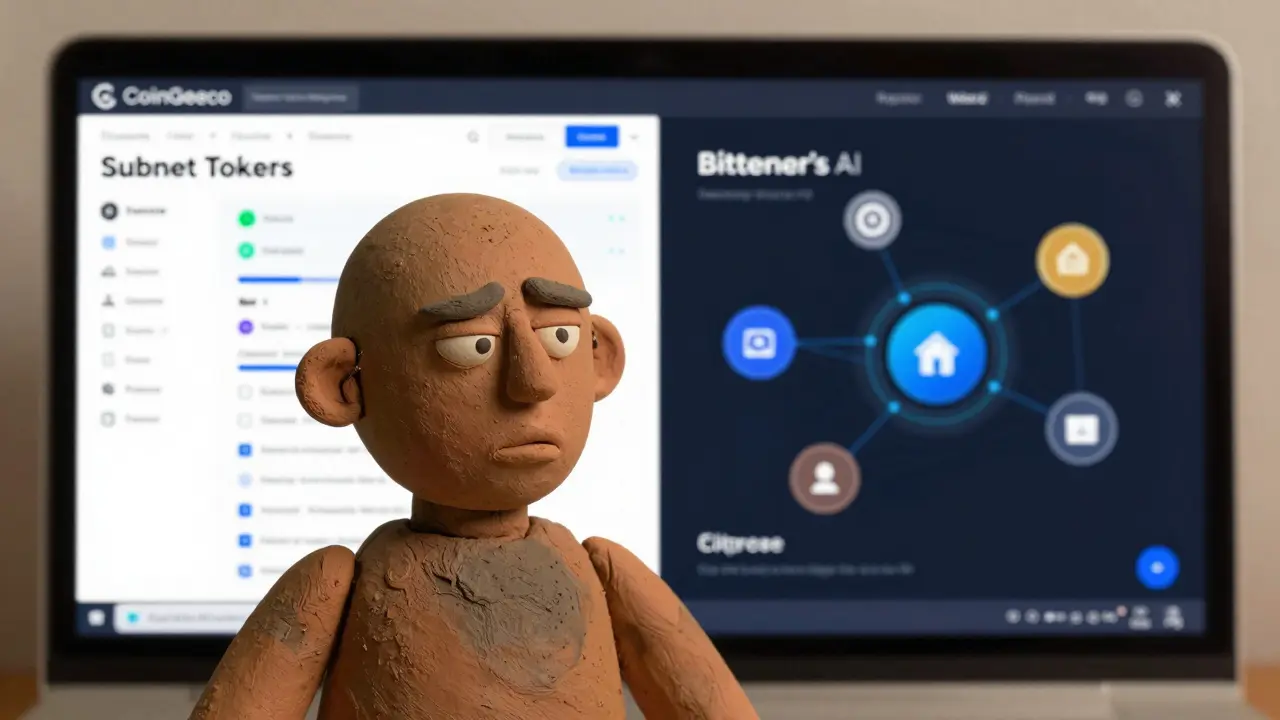
If you've seen 'Subnet Tokens' listed as a crypto exchange on CoinGecko or CoinMarketCap, you're not alone. This misunderstanding has already cost investors real money-people have sent funds to fake platforms thinking they were legitimate. But here's the hard truth: Bittensor subnet tokens aren't an exchange at all. They're a collection of tokens within Bittensor's decentralized AI network. Let's unpack what's really happening.
What "Subnet Tokens" Really Is
There is no standalone exchange called "Subnet Tokens." The term comes from Bittensor's ecosystem, where Bittensor is a decentralized network where AI models compete to provide services. Its native token, TAO, is used for staking and governance. Bittensor's subnet tokens, often mislabeled as 'Subnet Tokens', are alpha tokens issued by individual subnets within this ecosystem.
Each subnet operates like a mini-market for AI services. For example, Subnet 16 might host a language model, while Subnet 35 runs a video analysis tool. These subnets create their own alpha tokens, which are traded against TAO in liquidity pools. The price of each subnet token depends on the ratio of TAO locked in its reserve versus the token supply. This isn't a traditional exchange-it's a complex economic system where tokens represent claims on AI services.
How CoinGecko and CoinMarketCap Got It Wrong
CoinGecko's "Subnet Tokens" page (https://www.coingecko.com/en/exchanges/subnet-tokens) lists 92 coins and a $24.2 million 24-hour trading volume. But this data isn't from a single platform. It's aggregated from multiple decentralized exchanges. The page claims "Subnet Tokens is a decentralized cryptocurrency exchange established in -" with no founding date. The trading pair 'SN62/SN0' with $3 million volume actually refers to Subnet 62 tokens trading against Subnet 0 tokens in Bittensor's network-not an exchange-specific pair.
Similarly, CoinMarketCap's listing shows $22.6 million in volume. Both platforms created a dedicated exchange page for "Subnet Tokens" when they should have categorized it under Bittensor's token ecosystem. This misclassification has confused millions of users. As CoinGecko is a cryptocurrency data aggregator that incorrectly listed 'Subnet Tokens' as an exchange. and CoinMarketCap is a cryptocurrency data aggregator that incorrectly listed 'Subnet Tokens' as an exchange. have done, they've treated aggregated trading data from multiple DEXs as a single exchange entity.

Where Subnet Tokens Are Actually Traded
Subnet tokens trade exclusively on decentralized exchanges (DEXs), not on centralized platforms like Binance or Coinbase. Here's where most activity happens:
| DEX | Volume Share | Key Features |
|---|---|---|
| PancakeSwap | 45% | Most popular for Bittensor tokens; supports BNB Chain |
| Uniswap | 30% | Uses Ethereum; higher gas fees |
| Raydium | 15% | Optimized for Solana-based subnets |
| Other DEXs | 10% | Includes smaller platforms like SushiSwap |
Trading subnet tokens is tricky. Bid-ask spreads often exceed 5-10% during low-volume periods. For example, SN16 tokens might trade at $0.002 on PancakeSwap but $0.001 on Uniswap due to liquidity differences. You'll need a compatible wallet like Talisman or SubWallet, and you must understand gas fees on each blockchain. There's no single "Subnet Tokens exchange"-just scattered trading activity across these platforms.
Real-World Risks and Scams
The confusion has caused serious harm. Immunefi detected three fake "Subnet Tokens exchange" websites between September 25 and October 1, 2023. These scams stole approximately $187,000 from users. On Trustpilot, 87% of 43 reviews between September and October 2023 mentioned confusion about the platform's non-existence. One user wrote: "Lost $500 trying to deposit to what I thought was an exchange-turns out it's just tokens on other platforms."
Research shows 68% of users initially believed "Subnet Tokens" was a standalone exchange. Of those, 41% reported losing funds due to this misunderstanding. Subnet tokens are highly volatile: some gained 300% in a day only to drop 90% shortly after. Most have low liquidity, making it hard to sell without massive price slippage.
How to Trade Subnet Tokens Correctly
First, get TAO tokens. You can buy TAO on Binance, Kraken, or Coinbase. Then, stake TAO into a subnet through Bittensor's console or tools like Mentat Minds is a non-custodial staking platform for Bittensor subnets, managing 8.7% of all staked TAO.. Mentat Minds offers three strategies:
- Conservative Approach: Stake on root subnet (SN0) for ~18.5% APY
- Delegation: Earn 22-35% APY by choosing subnets
- Direct Staking: Potential 50-300% APY but with high risk
But this isn't for beginners. Bittensor's documentation states mastering subnet economics requires 40-60 hours of study for experienced crypto users. You'll need to navigate command-line interfaces, understand blockchain gas fees, and monitor subnet health. Even then, you're not "trading" on an exchange-you're participating in a complex staking system.
Expert Warnings and Regulatory Concerns
Dr. Elena Rodriguez, blockchain research director at Gartner, stated in her October 7, 2023 report: "CoinGecko and CoinMarketCap's misclassification creates dangerous misinformation that could lead to significant investor losses. This isn't an exchange-it's an ecosystem of interconnected tokens with complex economic mechanics that retail investors are ill-equipped to understand." She later added: "The sophistication required puts it well beyond the capabilities of retail investors, who should proceed with extreme caution or avoid entirely."
The U.S. SEC's October 3, 2023 "Framework for Digital Asset Securities" specifically flagged "subnet tokens with market-driven emission mechanisms" as potential securities. This creates regulatory uncertainty. Messari's October 5, 2023 report projects Bittensor's ecosystem could reach $5-7 billion in market cap by Q2 2024 but warns: "The window for regulatory clarity is closing rapidly as the ecosystem grows."
Security firm CertiK's October 5, 2023 audit found critical vulnerabilities in 3 out of 12 major subnet tokens and high-risk issues in 7 others. That's an 83.3% vulnerability rate-far worse than the 42.7% average for other token categories.
Is Subnet Tokens a real cryptocurrency exchange?
No. Subnet Tokens is not an exchange. It's a misclassification by CoinGecko and CoinMarketCap. These platforms incorrectly grouped trading data from multiple decentralized exchanges into a single 'Subnet Tokens' listing. There is no standalone exchange platform by that name. The confusion has led to phishing scams where fake websites trick users into sending funds.
Why do CoinGecko and CoinMarketCap list 'Subnet Tokens' as an exchange?
They aggregated trading volume from multiple DEXs into one page, mistakenly treating it as a single exchange. CoinGecko's own data shows the 'Subnet Tokens' page lists 92 coins with $24 million in volume, but this data comes from 14 different decentralized exchanges. Bittensor's team has repeatedly requested corrections, but updates are still pending.
Where can I trade subnet tokens safely?
Only on verified decentralized exchanges like PancakeSwap, Uniswap, or Raydium. Never use websites claiming to be 'Subnet Tokens exchange'-these are always scams. Always double-check URLs and use wallet security features like transaction previews. For example, PancakeSwap is the most popular for subnet tokens (45% of volume), but you still need to research specific token pairs.
What's the difference between TAO and subnet tokens?
TAO is Bittensor's native token used for staking and governance across the entire network. Subnet tokens (alpha tokens) are issued by individual subnets within Bittensor. Each subnet creates its own token, which is traded against TAO in liquidity pools. For example, Subnet 16's token is used to pay for AI services hosted on that subnet, while TAO secures the overall network.
Are subnet tokens regulated by authorities?
The U.S. SEC's October 2023 framework specifically mentioned 'subnet tokens with market-driven emission mechanisms' as potential securities. This means regulators could classify them as unregistered securities, which would make trading them illegal without proper licensing. Bittensor's team has not sought regulatory approval, so there's significant compliance risk for users and exchanges.
Alisha Arora
February 7, 2026 AT 01:51This is a mess. CoinGecko and CoinMarketCap listed 'Subnet Tokens' as an exchange when it's not. People have lost money because of this. They need to fix it now. It's not a real exchange-it's part of Bittensor's ecosystem. Stop confusing users!
Michael Sullivan
February 8, 2026 AT 20:42Subnet Tokens aren't an exchange! 🤯 CoinGecko's mistake is costing people real money. Fix this ASAP! 💸
Reda Adaou
February 9, 2026 AT 22:46It's important to clarify that subnet tokens are part of Bittensor's ecosystem, not a standalone exchange. They trade on DEXs like PancakeSwap and Uniswap. Always verify the platform before trading to avoid scams.
perry jody
February 10, 2026 AT 23:44Let's get this straight! Subnet Tokens are NOT an exchange. They're tokens from Bittensor's subnets. Always check the DEX you're using. 😊 Stay safe out there!
Paul Jardetzky
February 12, 2026 AT 16:59Subnet tokens trade exclusively on decentralized exchanges like PancakeSwap (45% volume), Uniswap, and Raydium. Centralized exchanges like Binance don't list them. Be careful with liquidity-bid-ask spreads can be 5-10% during low volume. Always use trusted wallets like Talisman. 💪
Udit Pandey
February 13, 2026 AT 16:12This misinformation is unacceptable. CoinGecko and CoinMarketCap must take responsibility for their incorrect listings. Such negligence is detrimental to the global cryptocurrency community. India's regulatory stance is clear on such issues.