Transitioning to Quantum-Resistant Algorithms: A Guide for Blockchain Security
 May, 14 2026
Imagine you lock your diary with a key that only you possess. You feel safe. But what if someone could steal the diary, keep it locked away, and wait ten years for a master key that doesn't exist yet? That is the reality of Quantum-Resistant Cryptography, also known as Post-Quantum Cryptography (PQC). It is not just a theoretical concern for physicists; it is an urgent operational challenge for blockchain developers and enterprise security teams.
We are standing on the edge of a cryptographic cliff. Current public-key systems like RSA and ECC rely on math problems that classical computers find nearly impossible to solve. However, quantum computers leverage principles of quantum mechanics to potentially crack these codes exponentially faster. The threat isn't just future decryption; it's the "harvest now, decrypt later" attack, where malicious actors intercept encrypted data today and store it until quantum hardware becomes powerful enough to break it.
Why the Transition Is Urgent Right Now
You might think we have decades before quantum computers become a real threat. Think again. Dr. Michele Mosca, a cryptography expert from the University of Waterloo, estimated there is a one-in-seven chance that fundamental public-key cryptography tools will be broken by 2026. By 2031, that probability rises to 50%. For blockchain networks, which often hold financial records or identity data with long-term value, this timeline is terrifyingly short.
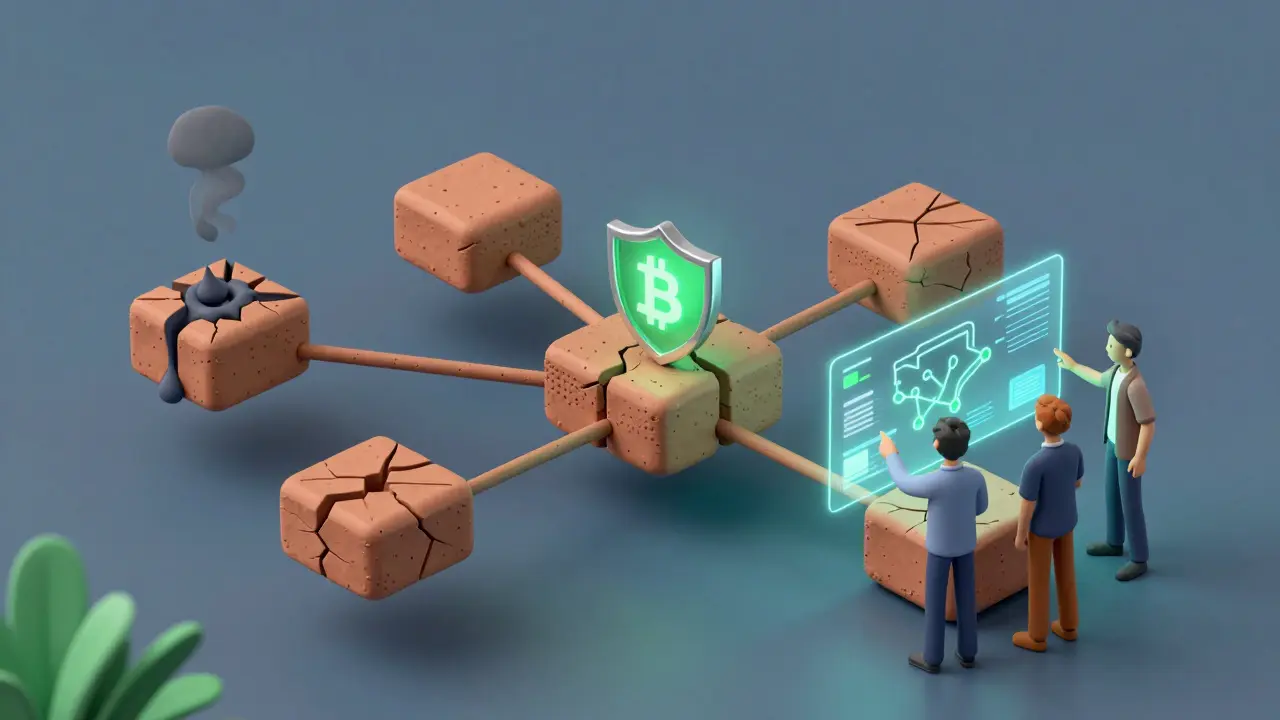
The urgency stems from the nature of distributed ledgers. Unlike a centralized database where you can patch software overnight, blockchain protocols require consensus. Upgrading a network to new cryptographic standards is complex, risky, and slow. If a quantum computer emerges sooner than expected, legacy blockchains could be vulnerable to double-spending attacks or private key theft before they even begin their migration.
NIST Standards: The New Foundation
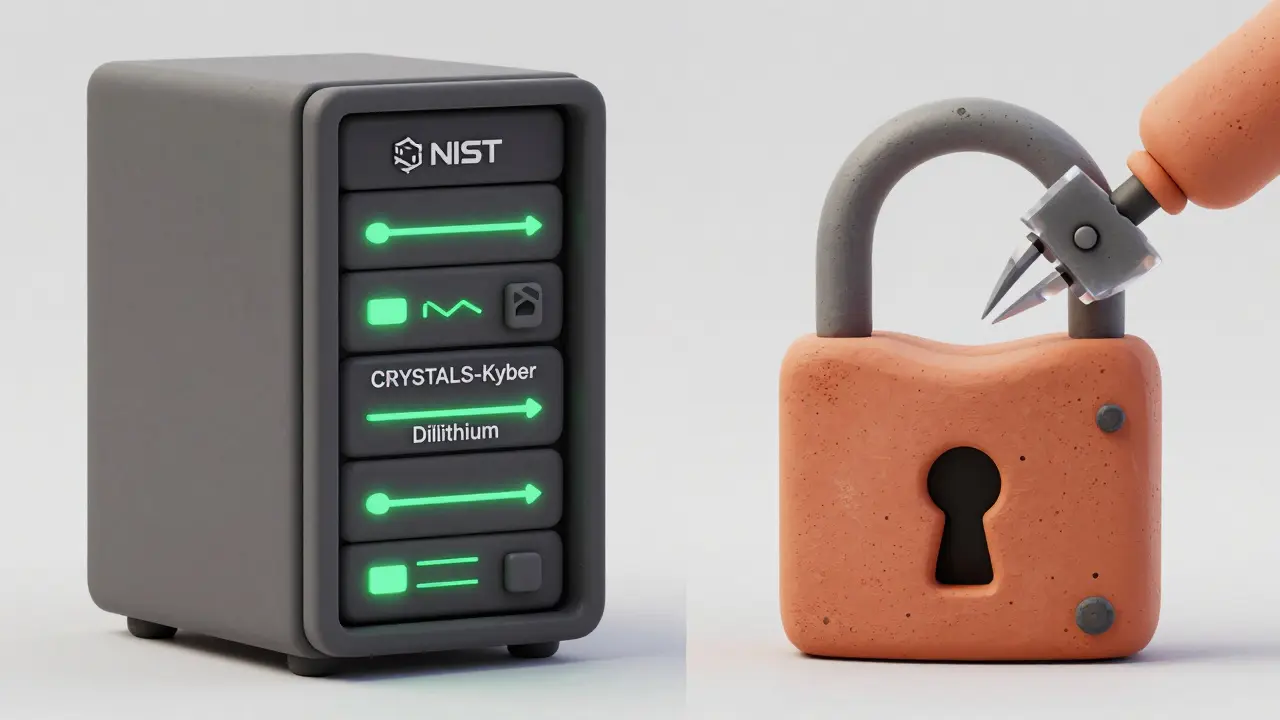
On July 5, 2022, the National Institute of Standards and Technology (NIST) announced its first four standardized quantum-resistant algorithms. This was a pivotal moment because it moved PQC from academic theory to industrial implementation. These algorithms are designed to run on existing classical hardware, meaning you don't need a quantum computer to use them-they are built to resist quantum attacks.
NIST divided these standards into two categories based on their function:
- General Encryption (Key Encapsulation): CRYSTALS-Kyber is the primary standard here. It is chosen for its speed and comparatively small encryption keys, making it ideal for secure communications like HTTPS connections.
- Digital Signatures: Three algorithms were selected:
- CRYSTALS-Dilithium: The primary recommendation for most applications due to high efficiency.
- FALCON: Recommended for applications requiring smaller signature sizes.
- SPHINCS+: A backup option based on a different mathematical approach (hash-based), providing diversity in case other lattice-based methods fail.
| Algorithm | Type | Best Use Case | Key Characteristic |
|---|---|---|---|
| CRYSTALS-Kyber | Encryption | Secure web access, key exchange | Small keys, fast operation |
| CRYSTALS-Dilithium | Signature | General digital signatures | High efficiency |
| FALCON | Signature | Bandwidth-constrained apps | Smaller signature size |
| SPHINCS+ | Signature | Backup/Critical infrastructure | Hash-based, distinct math |
PQC vs. Quantum Cryptography: Don't Confuse Them
A common misconception is confusing Post-Quantum Cryptography (PQC) with Quantum Cryptography. They are fundamentally different approaches. Quantum Key Distribution (QKD) uses quantum physics properties (like entanglement) to detect eavesdropping. It requires specialized hardware and infrastructure.
In contrast, PQC algorithms are classical code. They derive security through mathematical complexity rather than physical laws. As IBM clarifies, PQC can be implemented on existing platforms without new quantum infrastructure. For blockchain networks, which operate globally across diverse hardware, PQC is the practical path forward. QKD remains niche due to distance limitations and cost, whereas PQC updates are software patches.
Implementing Crypto-Agility in Blockchain
The transition isn't just about swapping one algorithm for another. It requires building Crypto-Agility, the ability to rapidly switch cryptographic primitives without redesigning the entire system. IBM recommends a three-step framework for this transition:
- Inventory: Identify all cryptographic assets. In blockchain, this includes transaction signatures, smart contract logic, and node-to-node communication channels.
- Assess: Determine which components are most vulnerable to quantum attacks. Public keys exposed on-chain are at immediate risk; private keys held offline are safer but still vulnerable if intercepted during transmission.
- Migrate: Implement hybrid schemes. During the transition period, use both classical and post-quantum algorithms together. This ensures security even if one method is broken unexpectedly.
For blockchain specifically, consider the impact on block size. Some PQC algorithms produce larger signatures than ECC. FALCON helps mitigate this, but SPHINCS+ can significantly increase storage requirements. Networks must adjust block limits or fee structures accordingly.
Challenges in the Migration Process
Switching to quantum-resistant algorithms is complex. Organizations must phase out existing systems while implementing new ones, a process prone to errors. The "harvester attack" scenario means you cannot wait for perfect solutions. You must start migrating sensitive data now.
Interoperability is another hurdle. Older nodes may not support new algorithms. Hard forks might be necessary, risking network fragmentation. Additionally, academic research continues to evolve. While NIST's selections are robust, ongoing analysis may reveal weaknesses. Building systems that allow easy updates-crypto-agility-is essential to handle future revelations.
Next Steps for Developers and Enterprises
If you manage a blockchain project or handle sensitive data, act now. Start with a free PQC ideation workshop or internal audit. Identify critical endpoints where public keys are exposed. Test CRYSTALS-Kyber for encryption needs and Dilithium for signatures in non-production environments. Measure performance impacts carefully. Remember, the goal is not just to survive the quantum era but to maintain trust in your data's integrity throughout the transition.
What is the difference between Quantum Cryptography and Post-Quantum Cryptography?
Quantum Cryptography (like QKD) uses quantum physics principles and requires specialized hardware. Post-Quantum Cryptography (PQC) uses classical algorithms designed to resist quantum attacks and runs on existing hardware.
Which NIST algorithm should I use for blockchain transactions?
For general digital signatures in blockchain, CRYSTALS-Dilithium is the primary recommendation due to its efficiency. If bandwidth is constrained, FALCON offers smaller signatures. SPHINCS+ is a good backup.
Is my current blockchain data already compromised?
Not necessarily, but it is at risk. Attackers may be harvesting encrypted data now to decrypt later when quantum computers are available. This is known as a "harvest now, decrypt later" attack.
Do I need a quantum computer to implement PQC?
No. PQC algorithms are designed to run on classical computers. They are software updates that provide security against quantum threats without requiring quantum hardware.
When will quantum computers break current encryption?
Experts estimate a 50% chance of breaking fundamental public-key cryptography by 2031. Given the long lifespan of blockchain data, preparation should begin immediately.