US Sanctions on Myanmar Crypto Entities: What the 2025 OFAC Rules Mean for You
 May, 31 2026
Imagine losing your entire life savings to an investment that looked perfect on paper. For over a decade, this nightmare has been played out by thousands of Americans who fell victim to sophisticated cryptocurrency scams orchestrated from hidden compounds in Southeast Asia. But something changed in late 2025. The United States government stopped just warning people and started hitting these criminal networks where it hurts most: their ability to move money.
On September 8, 2025, the U.S. Department of the Treasury’s Office of Foreign Assets Control (OFAC) dropped a major regulatory hammer. They sanctioned nine specific entities operating in Shwe Kokko, Myanmar, and ten others in Cambodia. These weren't random businesses; they were identified as key players in a massive cyber scam ecosystem that had cost American citizens more than $10 billion in 2024 alone. If you are involved in cryptocurrency trading, especially with any ties to Southeast Asian platforms or individuals, understanding these new restrictions is no longer optional-it is critical for your legal and financial safety.
The Target: Shwe Kokko and the Karen National Army
To understand why these sanctions matter, you first need to know who is behind the curtain. The primary target of this action was Shwe Kokko, a region in northern Myanmar located near the Thai border. This area is not controlled by the central Burmese military but rather by the Karen National Army (KNA), an ethnic armed organization.
For years, the KNA has allowed large-scale cyber scam centers to operate within its territory in exchange for protection and revenue. The U.S. Treasury explicitly designated the KNA as a transnational criminal organization. They also sanctioned its leader, Saw Chit Thu, and his two sons, Saw Htoo Eh Moo and Saw Chit Chit. By targeting the leadership and the location simultaneously, the U.S. government signaled that it views the entire infrastructure-from the physical buildings to the local militia protecting them-as part of the crime.
This is significant because Shwe Kokko became known as a notorious hub for virtual currency investment scams. These operations didn't just hack wallets; they used social engineering. Scammers would pose as friendly investors, romance partners, or job recruiters, luring victims into fake trading platforms. Once the money was deposited, often in Bitcoin or stablecoins like USDT, it was moved through complex chains of wallets to obscure its origin. The sanctions aim to cut off the exit ramps for these illicit funds.
How the Scams Work: Forced Labor and Crypto Fraud
There is a dark side to these crypto scams that goes beyond lost money. The people executing these frauds are often not willing criminals. They are victims themselves. The Treasury Department highlighted that these operations rely on "modern slavery." Thousands of people are lured to these compounds in Myanmar and Cambodia with promises of high-paying tech jobs. Instead, they are held against their will, subjected to violence, and forced to run the scam calls and chats.
This dual nature of the crime-financial fraud combined with human trafficking-is why the U.S. used multiple Executive Orders to justify the sanctions:
- E.O. 13851: Targets transnational criminal organizations.
- E.O. 13694: Addresses malicious cyber-enabled activities.
- E.O. 13818: Focuses on serious human rights abuses.
- E.O. 14014: Targets those threatening Burma's stability.
By invoking all four, the Treasury ensured there was no legal loophole for these entities to hide behind. It wasn't just about stopping a bank transfer; it was about dismantling a system built on coercion and theft.
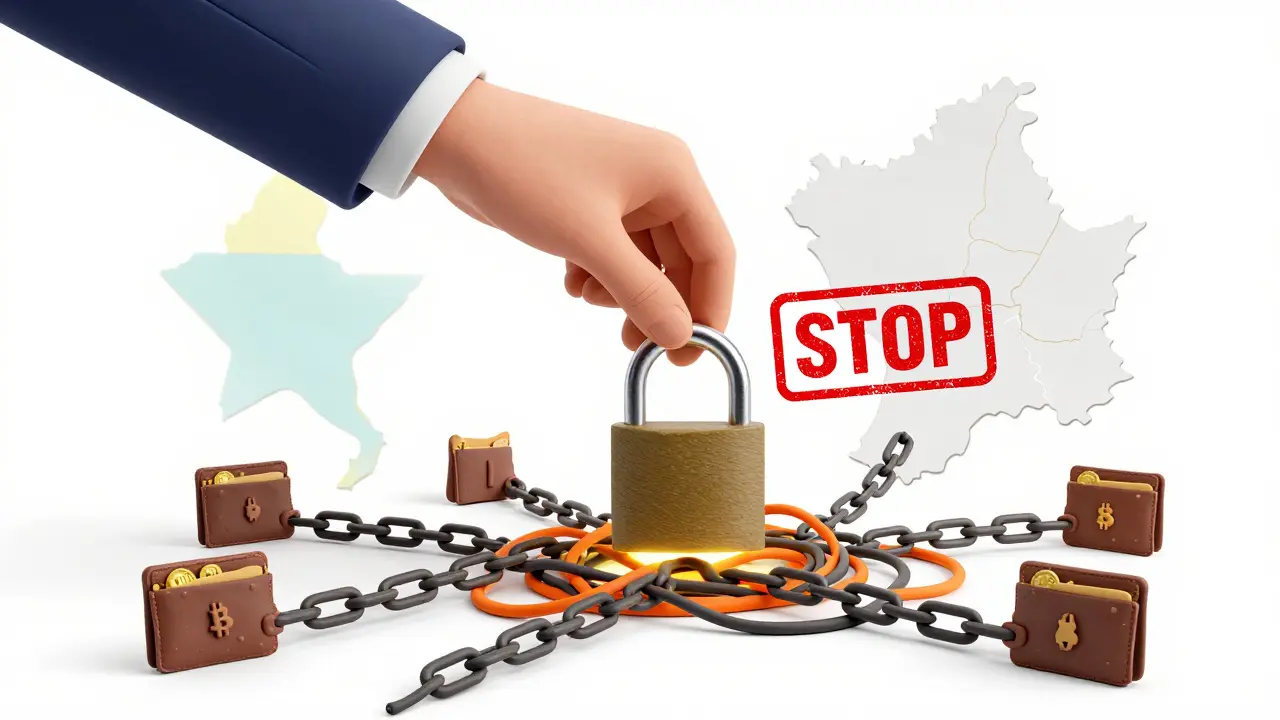
What These Sanctions Actually Do
When OFAC places an entity on its Specially Designated Nationals (SDN) list, the consequences are severe. Here is what happens in practice:
- Asset Freeze: Any assets belonging to the sanctioned entities that are within U.S. jurisdiction-or under the control of U.S. persons-are immediately frozen. You cannot touch them.
- Transaction Ban: U.S. citizens, companies, and anyone using the U.S. financial system (including dollars) are prohibited from engaging in transactions with these entities. This includes sending crypto to their wallets if you know or should know they belong to a sanctioned group.
- Secondary Sanctions Risk: While primarily aimed at U.S. persons, non-U.S. entities that facilitate significant transactions for these sanctioned groups risk being cut off from the U.S. financial system themselves.
For the average crypto user, this means you must be hyper-vigilant about where your funds go. If you interact with a platform based in Shwe Kokko or associated with the KNA, you could inadvertently violate U.S. law. Even if you are not in the U.S., many global exchanges comply with OFAC rules to maintain their own licenses. Your account could be frozen if you send funds to a blacklisted address.
| Aspect | Detail |
|---|---|
| Date of Action | September 8, 2025 |
| Issuing Agency | U.S. Treasury / OFAC |
| Primary Location | Shwe Kokko, Myanmar (Burma) |
| Entities Sanctioned | 9 in Myanmar, 10 in Cambodia |
| Estimated Victim Losses (2024) | Over $10 Billion (U.S. Citizens) |
| Legal Basis | E.O. 13851, 13694, 13818, 14014 |

Why Cryptocurrency Was the Weapon of Choice
You might wonder why these scammers chose crypto instead of traditional banking. The answer lies in speed and opacity. Traditional banks have robust anti-money laundering (AML) checks. If you try to wire $50,000 to a suspicious account in Myanmar, the bank will likely flag it. Crypto, however, allows for peer-to-peer transfers that can be executed in minutes across borders.
These scam centers used sophisticated methods to launder the stolen funds. They would receive payments in various cryptocurrencies, then use mixers, cross-chain bridges, and decentralized exchanges (DEXs) to break the audit trail. The goal was to convert the dirty crypto into clean fiat currency or stablecoins that could be used to buy real estate, luxury cars, or weapons.
The Treasury’s action specifically targets the "ownership structures and operators" of these networks. This suggests they are not just looking at the end-user wallets but also the intermediaries-the exchangers and liquidity providers-that help these syndicates cash out. If you run a business that interacts with unregulated offshore crypto firms, you need to review your counterparties immediately.
Red Flags: How to Spot a Myanmar-Based Scam
Not every crypto opportunity is a scam, but the ones originating from these regions share common traits. Here is how to protect yourself:
- Unsolicited Contact: Did a stranger message you on Telegram, WhatsApp, or Instagram offering guaranteed returns? Legitimate investors do not cold-message strangers with tips.
- Fake Platforms: Are you asked to deposit funds into a website that looks professional but has no regulatory license? Many scam sites mimic popular exchanges like Binance or Coinbase but are entirely fake.
- Pressure Tactics: Do they urge you to act quickly? "Limited time offer" or "market crashing soon" are classic psychological triggers used to bypass your rational thinking.
- Job Offers Requiring Relocation: If you are offered a remote tech job that suddenly requires you to travel to Southeast Asia, walk away. This is a hallmark of the forced labor pipeline.
If you suspect you have already sent money to one of these entities, stop trying to recover it through further payments. Scammers often claim you need to pay a "tax" or "fee" to withdraw your funds. This is a secondary scam. Report the incident to the FBI’s Internet Crime Complaint Center (IC3) and your local authorities immediately.
The Bigger Picture: A Warning to Other Regions
The sanctioning of Myanmar entities sends a clear message to other jurisdictions hosting similar operations. Cambodia was also targeted in this same announcement, with ten additional entities sanctioned. This indicates that the U.S. intelligence community has mapped out a broader network spanning Southeast Asia.
Under Secretary of the Treasury John K. Hurley stated that these actions build on previous efforts, suggesting this is just the beginning. With American losses skyrocketing to $10 billion in 2024, the political pressure to act is immense. We can expect future sanctions to expand to include more facilitators, such as payment processors, hosting providers, and even local officials who look the other way.
For the legitimate crypto industry, this is actually good news. It helps separate the innovators from the criminals. As regulatory clarity improves and bad actors are squeezed out, trust in digital assets can grow. However, it requires vigilance. You must ensure your own compliance practices are robust. Know your customer (KYC) and know your transaction (KYT) protocols are not just bureaucratic hurdles; they are your shield against accidental association with sanctioned entities.
Next Steps for Crypto Users and Businesses
If you are an individual trader, update your wallet security. Never share your seed phrase, and verify the reputation of any exchange you use. Stick to well-known, regulated platforms that publicly state their compliance with OFAC guidelines.
If you run a crypto business, conduct an immediate audit of your users and counterparties. Use blockchain analytics tools to screen addresses against the latest SDN list. Ensure your terms of service explicitly prohibit interactions with sanctioned regions and entities. Failure to do so could result in heavy fines or loss of banking relationships.
The era of unchecked anonymity in crypto is ending. The U.S. government has shown it has the will and the technical capability to trace illicit flows and punish those who enable them. Stay informed, stay cautious, and keep your hands clean.
Can I still send crypto to friends or family in Myanmar?
You can generally send personal remittances to individuals in Myanmar, provided they are not on the SDN list and the funds are not intended for sanctioned entities. However, you must exercise extreme caution. Avoid using platforms based in Shwe Kokko or associated with the Karen National Army. Use reputable, compliant exchanges that perform their own screening. If the recipient is linked to a sanctioned organization, the transaction is illegal.
Are all crypto transactions in Southeast Asia banned?
No. The sanctions target specific entities involved in cyber scams and forced labor, primarily in Shwe Kokko, Myanmar, and certain locations in Cambodia. Legitimate businesses in Singapore, Thailand, or Vietnam that comply with international laws are not automatically sanctioned. However, due diligence is required to ensure you are not indirectly supporting the blacklisted networks.
What happens if I accidentally send money to a sanctioned wallet?
If you realize you have sent funds to a sanctioned entity, you should freeze the transaction if possible (though this is rare in crypto). Immediately report the incident to OFAC and seek legal counsel. Ignoring the mistake can lead to severe penalties. OFAC may grant a license to block the funds, but proactive disclosure is crucial to mitigate liability.
How do these sanctions affect the price of Bitcoin?
Direct impact on Bitcoin's price is minimal. These sanctions target specific criminal enterprises, not the underlying technology. In fact, increased regulation often boosts long-term confidence in the market by reducing fraud. However, short-term volatility may occur if major exchanges delist tokens associated with sanctioned regions.
Who is Saw Chit Thu and why was he sanctioned?
Saw Chit Thu is the leader of the Karen National Army (KNA), an ethnic armed group in Myanmar. He was sanctioned because the KNA provides protection and infrastructure to cyber scam syndicates in Shwe Kokko. The U.S. government determined that the KNA benefits financially from these criminal operations, making it a transnational criminal organization under U.S. law.
Dana Rapoport
June 2, 2026 AT 00:48It is honestly terrifying to think about how many people are trapped in those compounds right now. We often look at crypto scams as just a financial loss, but the human cost here is absolutely staggering. The fact that they use forced labor makes this so much worse than just a standard fraud case. I really hope these sanctions actually dismantle the infrastructure rather than just pushing them underground again.
Christina Pearce
June 4, 2026 AT 00:35I’ve been following the news on Shwe Kokko for a while and it’s wild to see OFAC finally pull the trigger on the KNA leadership. Saw Chit Thu has been hiding behind that militia protection racket for years. It’s good to see the US government treating this as a transnational criminal organization issue instead of just a cybercrime thing. Hopefully this stops the flow of dirty money into their pockets.
Rosie Morris
June 5, 2026 AT 13:38my cousin lost like 5k to one of these fake platforms last year. she thought it was legit because the site looked so professional. its crazy how easy it is for them to trick ppl who just want to make some extra cash. i feel so bad for her still.
lorna erni
June 6, 2026 AT 22:40Don't be stupid if you fall for these scams. You should have known better than to trust a random guy on Telegram with guaranteed returns. It's not even hard to spot these things if you actually do your research before sending money. People just get greedy and then cry about it when they lose everything. The sanctions are great but maybe we need to sanction the victims' lack of common sense too lol.
stalin brian
June 8, 2026 AT 21:51hey lorna thats kinda harsh. most victims are just regular folks trying to navigate a confusing space. its not always greed sometimes its desperation or just naivety. the scammers are pros at psychological manipulation. its way more complex than just being dumb. we should focus on holding the criminals accountable not blaming the victims.
kamal ifrani
June 9, 2026 AT 13:28This entire situation exposes the absolute moral bankruptcy of the Western approach to Southeast Asia. While OFAC plays hero by sanctioning a few entities, they ignore the decades of geopolitical maneuvering that created these power vacuums in the first place. The Karen National Army isn't operating in a void; they are reacting to a region destabilized by external interests. Calling them 'criminals' without addressing the systemic corruption that allows these zones to exist is disingenuous at best. The real crime is the indifference to human rights abuses committed by regimes that the US quietly supports elsewhere. This is performative justice designed to soothe American anxieties while the actual machinery of exploitation continues unchecked under different flags.
saradee dee
June 11, 2026 AT 08:56oh my god this is so scary! i read somewhere that thousands of people are held against their will there. it feels like something out of a horror movie but its real life. i cant believe they force people to work in these scam centers. it makes me so angry and sad at the same time. please everyone stay safe and dont click on suspicious links!
Craig Swanson
June 13, 2026 AT 03:44You guys need to wake up and realize that compliance is no longer optional for anyone in this space. If you are running a business or even just trading seriously, you need to check your counterparties against the SDN list immediately. I see too many people ignoring KYC protocols thinking they are above the law. Get your blockchain analytics tools ready because the era of anonymity is dead. Protect yourself before someone else does it for you.