What is Celsius (CEL) Crypto? The Rise, Fall, and Current Status of the Defunct Token
 Jun, 29 2026
Imagine a platform promising you high interest rates on your Bitcoin, Ethereum, or other cryptocurrencies. You deposit your funds, watch your balance grow, and feel like you’ve found the holy grail of passive income. That was the promise of Celsius Network, a centralized crypto lending platform that operated from 2017 until its dramatic collapse in 2022. At the heart of this ecosystem was the Celsius (CEL) token, an ERC-20 utility token designed to reward users for holding it within their portfolios.
But here is the hard truth: Celsius no longer exists as an active business. It filed for Chapter 11 bankruptcy in July 2022, freezing billions of dollars in user assets. Today, CEL is largely considered a defunct token with minimal utility, serving more as a cautionary tale than a viable investment. If you are asking "What is Celsius CEL crypto coin?" in 2026, you are likely looking at historical data, checking on bankruptcy recovery updates, or trying to understand why such a popular platform failed so spectacularly.
The Origin Story: How Celsius and CEL Started
To understand what CEL is, we have to look back at when it actually meant something. Founded in 2017 by Dan Schatt and Alex Mashinsky, Celsius Network launched with a simple mission: make earning yield on cryptocurrency easy for everyone. They raised $50 million in an Initial Coin Offering (ICO) in March 2018, selling 325 million CEL tokens-roughly half of the total supply.
The platform went live in June 2018. Users could deposit over 30 different cryptocurrencies, including Bitcoin and Ethereum, to earn annual percentage yields (APYs) that were significantly higher than traditional bank savings accounts. For example, in May 2022, Celsius offered up to 6.2% APY on Bitcoin. But the real hook was the CEL token itself.
Celsius used CEL as a loyalty mechanism. The more CEL you held relative to your total portfolio, the better your rewards. This created a four-tier system:
- Bronze Tier: Less than 5% of your portfolio in CEL.
- Silver Tier: 5-10% in CEL.
- Gold Tier: 10-15% in CEL.
- Platinum Tier: 15% or more in CEL.
If you hit Platinum status, you could get bonus interest rates of up to 35% and loan discounts of up to 30%. It sounded too good to be true, but during the bull market of 2020 and early 2021, it worked. Millions of users flocked to the app, drawn by aggressive marketing featuring celebrities like Snoop Dogg and Cristiano Ronaldo.
How the CEL Token Actually Worked
CEL wasn’t just a badge of honor; it had specific functions within the Celsius ecosystem. As an ERC-20 token on the Ethereum blockchain, it facilitated several key features:
- Enhanced Yields: Holding CEL boosted the interest you earned on other deposited assets.
- Loan Discounts: Borrowers who held CEL paid lower interest rates on loans taken against their collateral.
- CelPay Cashback: Sending CEL via the CelPay feature gave users a 2% cashback bonus.
- Interest Payments: Users could choose to receive their interest earnings in CEL instead of the asset they deposited, often at a higher rate.
This structure incentivized users to buy and hold CEL, driving up demand and, theoretically, its price. In April 2021, CEL reached an all-time high of $8.63. At its peak, Celsius claimed to manage $12 billion in assets and had 1.7 million users across 100 countries. It positioned itself as a safer, more regulated alternative to decentralized finance (DeFi) protocols, though it remained fully centralized.
The Fatal Flaws: Why the Model Collapsed
So, how did a company with $12 billion in assets go bankrupt? The answer lies in the unsustainable nature of its business model and risky investment decisions.
First, the interest rates Celsius promised were simply too high to sustain through normal lending alone. Academic analysis from the University of California’s Blockchain Lab calculated that Celsius’s promised yields exceeded sustainable lending returns by 3-5%. To keep paying users, Celsius needed constant new deposits-a characteristic often associated with Ponzi schemes.
Second, Celsius engaged in dangerous trading practices. Instead of keeping user funds safe in cold storage or lending them out conservatively, Celsius invested heavily in illiquid and volatile assets. Most notably, they put $115 million into the TerraUSD (UST) stablecoin ecosystem. When UST collapsed in May 2022, wiping out roughly $536 million of Celsius’s assets, the damage was catastrophic.
Third, there was the issue of transparency. Investigations revealed that Celsius had lent user funds to affiliated entities, including the hedge fund Alameda Research, violating its own terms of service. Furthermore, to prop up the price of CEL and meet interest obligations, Celsius spent $350 million buying its own tokens on open markets since 2019. This artificial support masked the underlying insolvency.
The Crash: June 2022 Bankruptcy
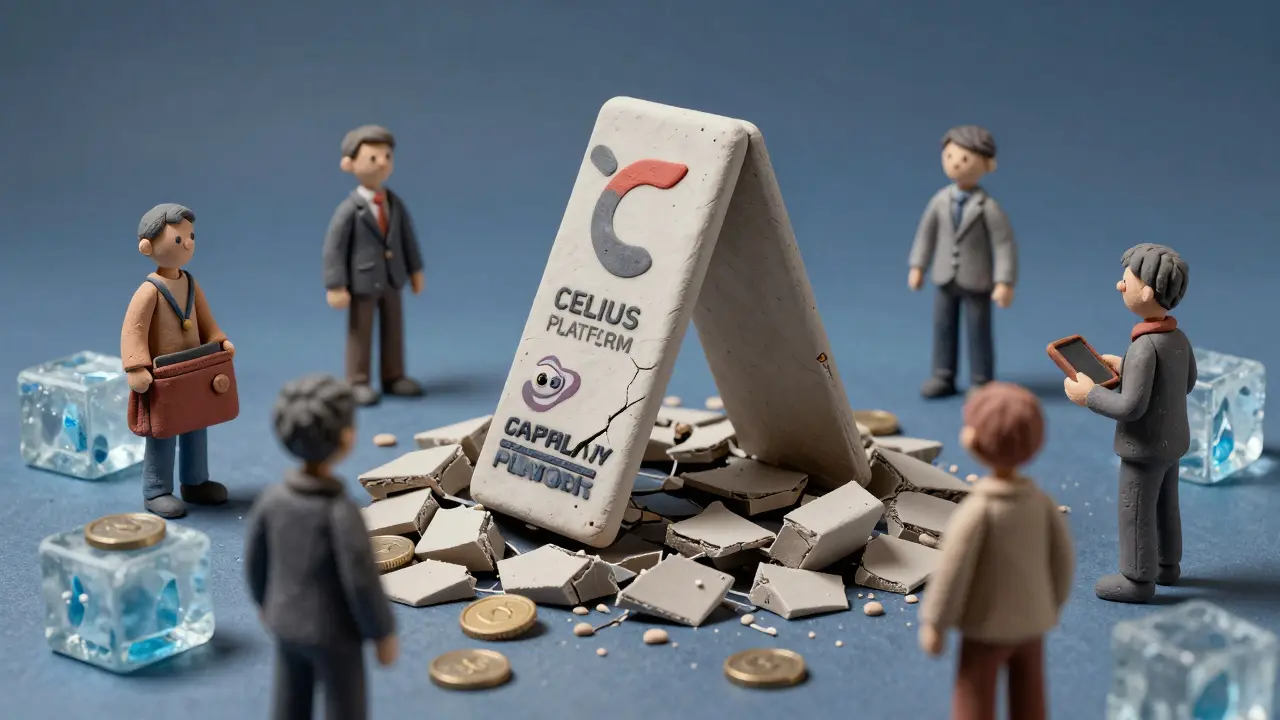
The house of cards fell in June 2022. Amidst extreme market volatility following the Terra/Luna crash, Celsius announced on June 12, 2022, that it was pausing all withdrawals, staking, and transfers. They cited "unprecedented market conditions," but users quickly realized their money was gone.
The impact on CEL holders was devastating. Within days, the price of CEL plummeted from $1.15 to $0.12-a 90% drop in a single day. By January 2026, the token was trading at a mere $0.025461 with negligible volume. For Platinum tier users who had allocated 15% or more of their portfolios to CEL, the losses were compound: their main holdings were frozen, and their CEL tokens became nearly worthless.
On July 13, 2022, Celsius Network LLC filed for Chapter 11 bankruptcy in the Southern District of New York. The filing revealed a grim reality: Celsius had only $4.3 billion in liquid assets against $7.2 billion in user liabilities, leaving a 40% shortfall. The U.S. Securities and Exchange Commission (SEC) also charged Celsius with selling unregistered securities, arguing that the interest-bearing accounts functioned as investment contracts.
Current Status of CEL in 2026
As of mid-2026, CEL is effectively a dead token. With the platform shut down, there is no utility left for the token. You cannot use it to earn interest, get loan discounts, or pay fees because the Celsius app no longer operates. Exchanges continue to list it, but trading volume is minimal, indicating near-total market abandonment.
However, the story isn’t entirely over for former users. The bankruptcy proceedings, overseen by Judge Shelley Chapman, have moved toward a recovery plan. In December 2023, a settlement was approved where secured creditors would receive 100% of their claims. General unsecured creditors-which includes most retail users-are expected to recover approximately 33-40% of their holdings based on the liquidation value of remaining assets.
Industry analysts predicted early on that CEL would become completely worthless, and that prediction has largely held true. The token serves now primarily as a historical artifact of the 2022 crypto winter.
| Feature | Peak Era (2021-2022) | Current Status (2026) |
|---|---|---|
| Token Utility | Loyalty rewards, loan discounts, cashback | No utility; platform defunct |
| Price Range | $0.01 - $8.63 (ATH) | ~$0.025 (negligible volume) |
| User Base | 1.7 million+ users globally | Frozen assets; recovery process ongoing |
| Regulatory Status | Operated without full SEC registration | Bankrupt; subject to SEC enforcement |
| Investment Viability | High risk/high reward speculation | Not recommended; essentially worthless |
Lessons Learned: Centralization vs. Decentralization
The fall of Celsius highlights a critical distinction in crypto: centralized finance (CeFi) versus decentralized finance (DeFi). With Celsius, users did not control their private keys. They relied entirely on the company’s solvency and honesty. When Celsius failed, users had no direct access to their funds-they became creditors in a legal battle.
In contrast, DeFi protocols allow users to retain custody of their assets through smart contracts. While DeFi carries its own risks (such as smart contract bugs), it eliminates counterparty risk-the risk that the platform itself will run away with your money or mismanage it.
The Celsius case directly influenced regulatory changes. The 2024 passage of the Digital Commodities Consumer Protection Act now requires crypto lending platforms to maintain 100% reserves against customer deposits, a rule Celsius blatantly violated. This has led to stricter oversight of competitors like Nexo and BlockFi, which also faced scrutiny during the same period.
Should You Buy CEL Today?
Short answer: No. There is no fundamental reason to invest in CEL in 2026. The platform is gone, the utility is gone, and the community is fractured. Any price movement is purely speculative and driven by rumors rather than actual product usage.
If you are looking for yield in crypto today, consider established DeFi protocols with transparent audits and non-custodial structures, or regulated custodial solutions that provide proof of reserves. Always remember: if an offer sounds too good to be true, it probably is.
Recovery Process for Former Users
If you were a Celsius user before the freeze, your path to recovery depends on your creditor classification. The court-approved plan prioritizes secured creditors. Unsecured creditors must file claims through the official bankruptcy portal. Recovery distributions are expected to occur in tranches over time, with estimates suggesting a 33-40% return based on current asset valuations. Keep an eye on official communications from the Celsius Trustee, as timelines can shift based on asset liquidation speeds.
Is Celsius Network still operating in 2026?
No, Celsius Network ceased operations in June 2022 and filed for Chapter 11 bankruptcy in July 2022. The platform is currently under court-supervised liquidation and does not accept new deposits or allow withdrawals.
What happened to my CEL tokens after the bankruptcy?
Your CEL tokens are still in your wallet if you withdrew them before the freeze. If they were held inside the Celsius app, they are part of your frozen claim. The token itself has lost almost all value due to the lack of utility and market confidence.
Can I still earn interest with CEL?
No. The loyalty program, interest bonuses, and loan discounts tied to CEL were discontinued when Celsius halted operations. There is no functional ecosystem left to utilize these features.
Why did Celsius fail compared to competitors like Nexo?
Celsius failed due to risky investments in illiquid assets like TerraUSD, opaque lending practices to affiliated entities, and unsustainable interest rates that required constant new capital. Competitors like Nexo maintained more conservative reserve ratios and avoided heavy exposure to volatile algorithmic stablecoins.
How much will Celsius users recover from the bankruptcy?
According to the December 2023 court-approved plan, general unsecured creditors are expected to recover approximately 33-40% of their claims. Secured creditors may receive 100%. Actual amounts depend on the final valuation and liquidation of Celsius’s remaining assets.