What is Cofinex (CNX) Crypto Coin? Full Breakdown of the Exchange Token
 Jan, 16 2026
Cofinex (CNX) is the native utility token of Cofinex Exchange, a cryptocurrency trading platform that claims to operate under regulation by the Czech National Bank. Unlike major exchange tokens like BNB or OKB, CNX has minimal market presence, limited liquidity, and serious transparency issues that make it a high-risk asset for most investors.
What CNX Actually Does
CNX isn’t a standalone blockchain or a decentralized currency. It’s a utility token built to work inside the Cofinex Exchange ecosystem. That means its only real purpose is to give users discounts on trading fees, access to staking rewards, or perks like early access to new coin listings. Beyond that, there’s no clear documentation on how else you can use it.
The exchange says it offers spot trading, futures, margin trading, and even a crypto debit card called the Cofinex Card. It also promotes a Web3 wallet and integrates TradingView for charting - features you’ll find on bigger platforms. But here’s the catch: none of these services are independently verified. There are no third-party audits, no public security reports, and no detailed breakdown of how the token actually powers these tools.
Supply, Market Cap, and Price Chaos
CNX has a fixed maximum supply of 500 million tokens. As of late 2025, about 65 million are in circulation - just 13% of the total. That sounds small, but the real problem is the wild inconsistency in how its value is reported.
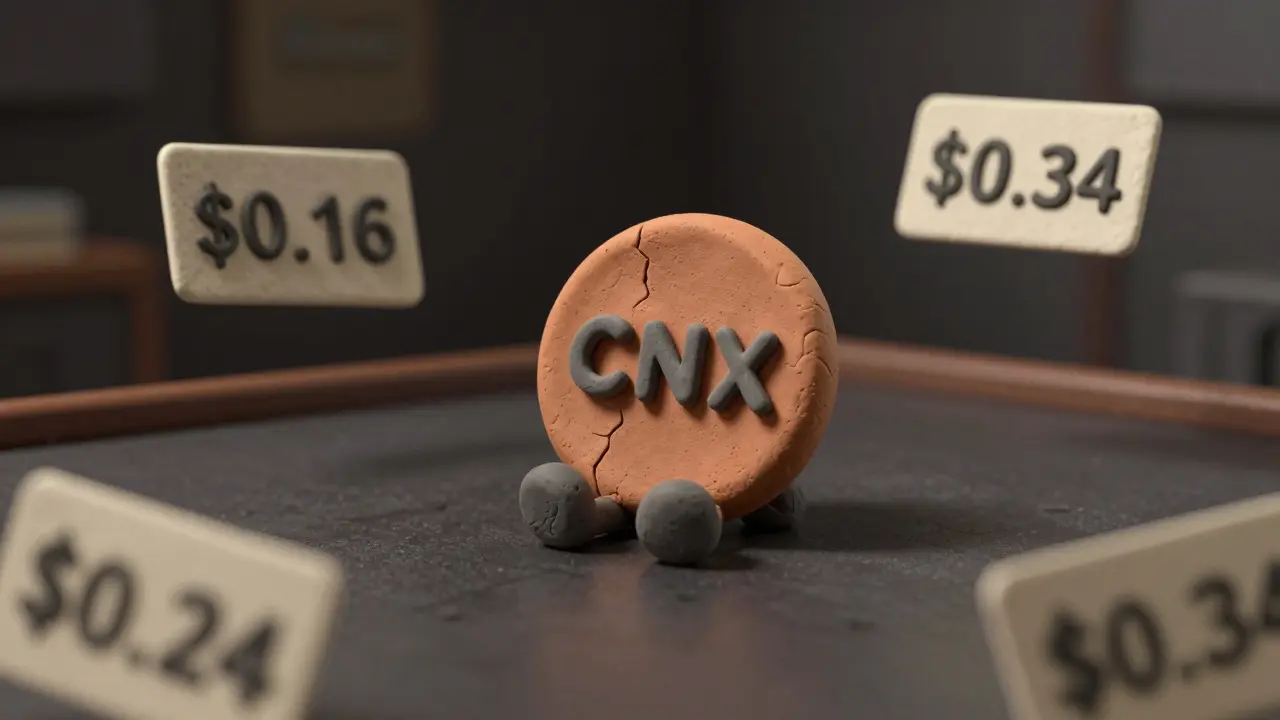
One source says CNX trades at $0.34. Another says $0.16. Another says $0.21. That’s not normal volatility - that’s a red flag. When different data aggregators can’t agree on the price, it usually means one of three things: the token is being manipulated, the data is outdated, or the exchange listing is too thin to support reliable pricing.
The market cap numbers are even more confusing. Holder.io claims a $22.1 million market cap. RootData says it’s under $10.4 million. The fully diluted valuation (FDV) - which assumes all 500 million tokens are in circulation - ranges from $80 million to $170 million. That’s a huge gap for a token with barely any trading volume.
Where You Can Trade CNX (And Why That Matters)
CNX trades on only one exchange: Coinstore. That’s it. No Binance. No KuCoin. No Coinbase. No Huobi. Just Coinstore.
This is a massive red flag. Major exchange tokens like BNB or XRP trade on dozens of platforms. That gives them liquidity, price stability, and trust. CNX being stuck on a single, lesser-known exchange means:
- You can’t easily buy it with USD or EUR - you need to first buy another crypto and swap it.
- If Coinstore goes down or gets hacked, your CNX is locked up.
- There’s no competition to keep the price fair - a single trader could swing the price by $0.10 in minutes.
Trading volume confirms this. On December 3, 2023, 24-hour volume was $9,800. That’s less than what a single whale might spend on BNB in a day. RootData and CoinCodex reported even lower volumes - around $4,100. That’s not a market. That’s a sandbox.

Transparency Score: 11% - What That Really Means
RootData, a platform that rates crypto projects on transparency, gave Cofinex a score of just 11%. On a scale of 0 to 100, that’s near the bottom. For comparison, Binance scores above 85, and even smaller exchanges like Bitrue score above 50.
What does a 11% score mean? It means:
- No public team members with verifiable LinkedIn profiles.
- No clear legal structure or audit reports.
- No GitHub activity - no code updates, no open-source development.
- No user reviews on Trustpilot, Reddit, or other community forums.
- No press coverage from reputable crypto news outlets like CoinDesk or The Block.
The project claims to be regulated by the Czech National Bank. But there’s no public record of Cofinex being listed on the CNB’s official register of licensed entities. Regulatory claims without proof are meaningless in crypto.
Who’s Using It? (Spoiler: Almost No One)
Cofinex says it has over 115,000 users. But where are they? There are no active Reddit threads about CNX. No Telegram groups with more than a few hundred members. No YouTube tutorials. No Twitter conversations with real traders sharing experiences.
RootData shows zero user ratings. Zero. That’s not because it’s new - it’s because nobody trusts it enough to even try.
Compare that to BNB. Binance has millions of users, hundreds of thousands of Reddit posts, and dozens of YouTube channels dedicated to trading with it. CNX doesn’t even have a Wikipedia page.
How CNX Compares to Other Exchange Tokens
Here’s how CNX stacks up against the big players:
| Token | Exchange | Market Cap (approx.) | Trading Pairs | Transparency Score |
|---|---|---|---|---|
| CNX | Cofinex | $10M-$22M | 1 (Coinstore) | 11% |
| BNB | Binance | $90B+ | 50+ | 87% |
| OKB | OKX | $5B+ | 30+ | 79% |
| KCS | KuCoin | $1.2B | 20+ | 72% |
| FTT (defunct) | FTX | $0 (collapsed) | 0 | N/A |
Notice the pattern? The tokens with real value are backed by massive exchanges with transparent teams, public audits, and global user bases. CNX has none of that. It’s more like FTT before the crash - a token with hype but no foundation.

Why the Price Keeps Jumping and Crashing
RootData shows CNX hit an all-time high of $0.50 in October 2025 - but that date is in the future as of January 2026. That’s not a typo. It’s a sign the data is either fabricated or pulled from a bot-generated source.
Price swings of 300% in 24 hours? That’s not market activity - that’s pump-and-dump behavior. When a token’s price moves wildly on tiny volume, it’s almost always being manipulated by insiders or bots.
The fact that CNX trades on only one exchange makes this even easier. A single wallet can buy up all available CNX, push the price up, then sell it back slowly to unsuspecting buyers. No one’s watching. No one’s auditing. No one’s stopping it.
Should You Buy CNX?
If you’re looking for a long-term investment, the answer is no. CNX lacks the fundamentals, transparency, and liquidity to be a safe asset. Even if you believe in the exchange’s claims, there’s no way to verify them.
If you’re thinking of trading it for a quick profit? You’re playing Russian roulette. The volume is too low. The data is unreliable. The team is anonymous. And the only exchange listing is a single, unproven platform.
There’s a reason no major crypto analyst covers CNX. No one from Messari, Delphi Digital, or CoinGecko has written about it. That’s not an accident. It’s a warning.
Final Thoughts
Cofinex (CNX) is not a cryptocurrency you should hold. It’s not even a cryptocurrency you should trade unless you’re prepared to lose everything you put in. The token has no real utility beyond vague promises of fee discounts. It’s not listed on any major exchange. Its price is inconsistent. Its team is hidden. Its regulatory claims are unverified. And its user base appears to be nonexistent.
If you’re drawn to CNX because it’s cheap - don’t be fooled. A low price doesn’t mean value. It just means risk. And in crypto, the riskiest assets are the ones nobody’s talking about - except the people trying to sell them.
Stick to tokens with real track records. If you want to trade on a new exchange, use one with public audits, verified teams, and multiple listings. CNX doesn’t meet any of those standards.
Is Cofinex (CNX) a scam?
Cofinex isn’t officially labeled a scam, but it has nearly every red flag of one: hidden team, unverified regulation, zero transparency score, single-exchange listing, and wildly inconsistent price data. While it may not be a deliberate fraud, it’s a high-risk project with no accountability - which is functionally the same as a scam for most investors.
Can I buy CNX with USD?
No. CNX only trades against USDT on Coinstore. To buy it, you first need to purchase USDT or another major crypto on a platform like Binance or Kraken, then transfer it to Coinstore and swap for CNX. This adds steps, fees, and risk.
Is Cofinex regulated by the Czech National Bank?
Cofinex claims to be regulated by the Czech National Bank, but there is no public record of this on the CNB’s official website. Regulatory claims without verifiable proof are meaningless in crypto. Always check government databases before trusting such claims.
Why does CNX have so many different prices?
Because it trades on only one exchange with very low volume, price data is unreliable. Different aggregators pull from different timestamps or use manipulated data. This kind of inconsistency is a sign of low liquidity and possible price manipulation.
What’s the safest way to trade CNX?
There isn’t one. CNX is too risky for safe trading. If you still choose to trade it, never invest more than you can afford to lose. Use a small amount, set strict stop-losses, and never hold it long-term. Treat it like gambling, not investing.
Jason Zhang
January 17, 2026 AT 10:53CNX? Nah. I saw this pop up on Coinstore last week and thought, 'cool, maybe a hidden gem.' Turned out the 'price' was just a bot spinning its wheels. Zero volume, zero transparency, zero reason to touch it. I’ve seen pump-and-dumps in my sleep - this one doesn’t even have the energy to be entertaining.
Just delete the tab. Your wallet will thank you.
Katherine Melgarejo
January 17, 2026 AT 23:12so like… if i bought CNX, would i be the dumbest person on the internet? or just the dumbest person on coinstore?
also, is the ‘czech national bank regulation’ just a screenshot they photoshop onto their homepage? because i’ve seen that exact font before - it’s the same one used in my cousin’s fake ‘i graduated from harvard’ diploma.
Patricia Chakeres
January 19, 2026 AT 03:53Let me guess - this is part of a coordinated devaluation campaign by the ‘crypto establishment’ to bury small players. Binance doesn’t want competition. They control the narrative. Look at how they scrubbed any mention of CNX from CoinGecko’s archives - that’s not coincidence, that’s censorship.
And don’t tell me about ‘low volume’ - that’s exactly what they want you to think. The real trading happens in dark pools. The ‘11% transparency score’? That’s a fake metric cooked up by RootData, which is owned by a former Binance exec. They’re terrified of CNX because it’s decentralized *enough* to threaten their oligopoly.
They’ll call it a scam until the day it hits $10. Then they’ll claim they ‘always saw the potential.’
Buy the dip. The real investors are already in.
And yes, I’ve bought 10,000 CNX. You’re welcome.
Telleen Anderson-Lozano
January 20, 2026 AT 17:50I get why people are skeptical - and honestly? The skepticism is justified. The price inconsistencies? Yeah, that’s a red flag. The single-exchange listing? Huge issue. The lack of team info? Major concern. But… maybe - just maybe - it’s not all bad?
I’ve seen projects start with zero transparency and slowly, painfully, build credibility over time. Maybe Cofinex is just… really, really bad at PR? Maybe their dev team is small, working quietly, and just hasn’t had time to update their docs? I mean, look at early Ethereum - no one knew who was behind it either, and look where that went.
It’s still a gamble, obviously. But I’m not saying buy it - I’m saying don’t dismiss it outright. Do the deep dive. Check the domain registration. Look at the IP addresses behind the site. Maybe there’s a clue nobody’s noticed yet.
Also, I’m weirdly curious about that ‘Cofinex Card’ - if it’s real, and if it actually works, maybe that’s the hidden utility? Not the token itself, but the infrastructure around it?
Just… don’t put your rent money in it. But maybe a few bucks for the experiment?
Haley Hebert
January 21, 2026 AT 09:34Hey, I know it’s easy to hate on CNX - and honestly, the data makes it look sketchy as hell - but I just want to say, if you’re reading this and you’re thinking about trying it, just go slow. Maybe start with $5. Just to see how it feels. No pressure. No expectations.
If you lose it? Okay. You learned something. If you make a little? Cool. You got lucky. Either way, you didn’t risk your whole life on it.
And hey - if you do try it, drop a comment and let us know how it went. We’re all just trying to figure this out, one weird coin at a time. 💙
Also, I love that you included the Czech National Bank thing - that’s such a common trap. Always verify. Always. Even if it’s ‘obvious.’