What is GrapeCoin (GRAPE)? A Warning on Conflicting Data and High Risk
 Jun, 18 2026
You’ve probably seen the ticker GrapeCoin pop up in a chat group or a price alert. The promise is usually simple: massive returns, cutting-edge technology, and a chance to get in early. But if you look closer at what is GrapeCoin (GRAPE), you’ll find something much messier than a clean investment opportunity. You will find conflicting data, anonymous teams, and technical claims that defy basic computer science.
As of mid-2026, GrapeCoin sits in a dangerous gray area of the crypto market. It isn’t just a risky asset; it’s a case study in how information asymmetry can trap investors. Whether it’s a failed Layer-1 blockchain project or a forgotten Solana-based meme token, the evidence points to extreme caution. This article breaks down exactly what GRAPE is supposed to be, why the data doesn’t add up, and how you can protect your capital from similar traps.
The Identity Crisis: Two Projects, One Ticker?
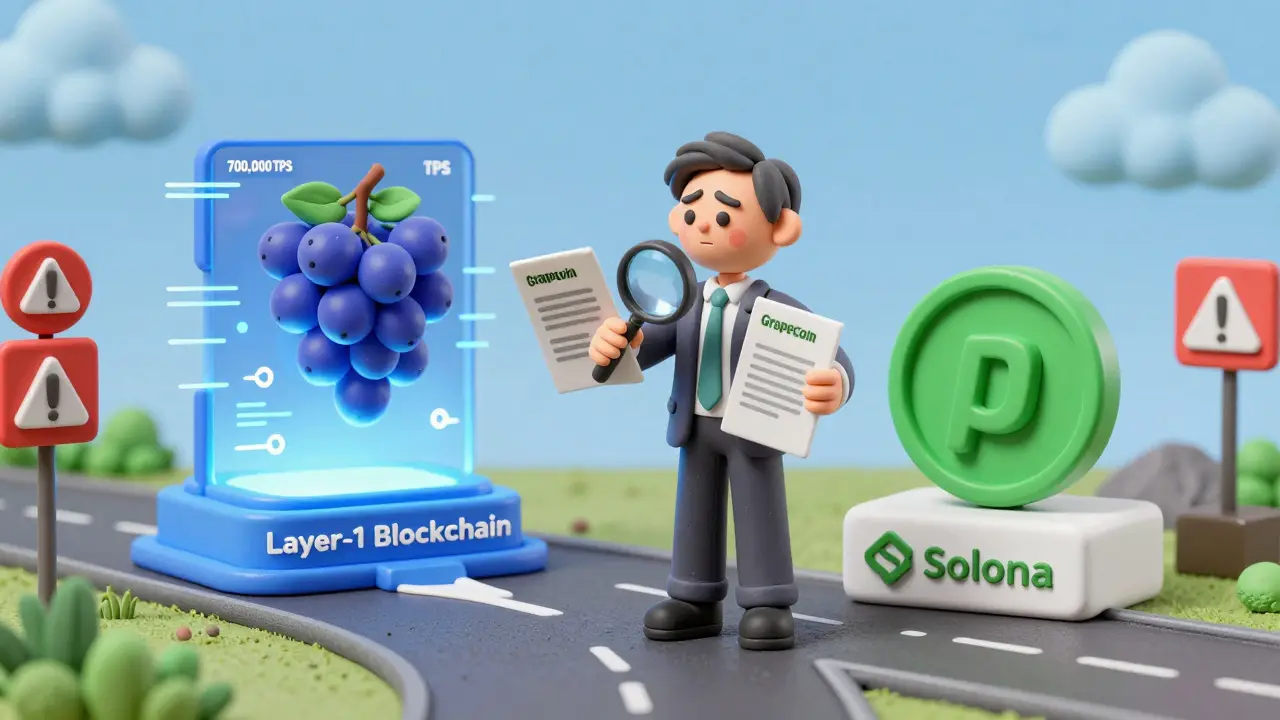
The first red flag with GrapeCoin is that nobody seems to agree on what it actually is. In the world of cryptocurrency, identity matters. If you don’t know what you’re buying, you’re gambling blind. With GRAPE, we have two completely different narratives fighting for dominance, and neither checks out cleanly.
On one side, you have the "Grape" ecosystem described on sites like grap3.com. Here, GRAPE is presented as the native utility token of a new Layer-1 Blockchain. This version of the project claims to use proprietary technologies called VINE and ANNE. It promises to be built specifically for gaming and the metaverse. The technical specs are jaw-droppingly high: they claim 700,000 transactions per second (TPS). For context, Visa handles about 65,000 TPS during peak times. Ethereum handles roughly 15-30 TPS without layer-2 solutions. A claim of 700,000 TPS is not just ambitious; it’s statistically improbable for a public blockchain in its current state.
On the other side, platforms like Coinswitch.co list GRAPE as a token built on the Solana blockchain. Solana is a well-known, high-performance network, but it uses Proof-of-History consensus, not the Direct Acyclic Graph (DAG) technology claimed by the grap3.com team. These two descriptions are mutually exclusive. A token cannot simultaneously be a native Layer-1 chain with its own DAG protocol AND a simple token running on Solana’s infrastructure. This contradiction suggests either severe misinformation, a rebranding gone wrong, or worse-a deliberate attempt to confuse investors.
Technical Claims That Defy Logic
Let’s dig into the technology behind the "Layer-1" version of GrapeCoin, because this is where the physics of distributed systems break down. The project promotes a concept called the "branch-chain" and a protocol named VINE, which utilizes Direct Acyclic Graph (DAG) technology. DAGs are real tech-used by projects like Nano and IOTA-but they have known limitations.
The grape3.com website makes a specific claim: "Adding an advanced node to the network will increase the TPS by 1000." In distributed computing, this violates fundamental principles. When you add nodes to a decentralized network, you typically introduce latency and consensus overhead. While some sharding techniques can improve scalability, linear scaling where every single node adds a fixed 1,000 TPS is unheard of. Even Fantom’s Lachesis DAG, which is highly optimized, maxes out around 10,000 TPS under optimal conditions. Claiming 700,000 TPS suggests the marketing team has confused theoretical maximums with production reality, or they are simply fabricating metrics.
Furthermore, there is no public GitHub repository for this supposed mainnet. There are no smart contract audits from reputable firms like CertiK or OpenZeppelin. Without code transparency, these technical claims are just words on a website. In crypto, if it’s not open-source, it’s not trustworthy.
Market Data: The $0 Volume Paradox
If the technology were real and the community active, the market data would reflect it. Instead, the numbers tell a story of abandonment or fraud. Let’s look at the hard facts from major aggregators like CoinMarketCap and CoinGecko.
| Metric | Official/Marketing Claims | Verified Aggregator Data (2026) |
|---|---|---|
| Trading Volume (24h) | "Exceeding 7,500 ETH" / High Activity | $0 USD |
| Market Cap | Implied Multi-Million Dollar Project | $0.00 |
| Circulating Supply | Active Distribution | 0 GRAPE (or unverified) |
| Ranking | Top Gaming Token | #7243+ (Bottom 5%) |
| Price Prediction | $12.93 by 2050 | No reliable model exists |
Notice the discrepancy? Marketing materials might mention a "$10 million pre-sale" or "7,500 ETH in volume," but on-chain data shows zero liquidity. If you try to buy GRAPE on major exchanges like Binance, Coinbase, or Kraken, you won’t find it. It may appear on obscure, low-tier exchanges like LBank, but even there, the order books are often thin or non-existent. A project with $0 trading volume is effectively illiquid. You might be able to buy in, but you likely couldn’t sell out without crashing the price to zero.
The Danger of Astronomical Price Predictions
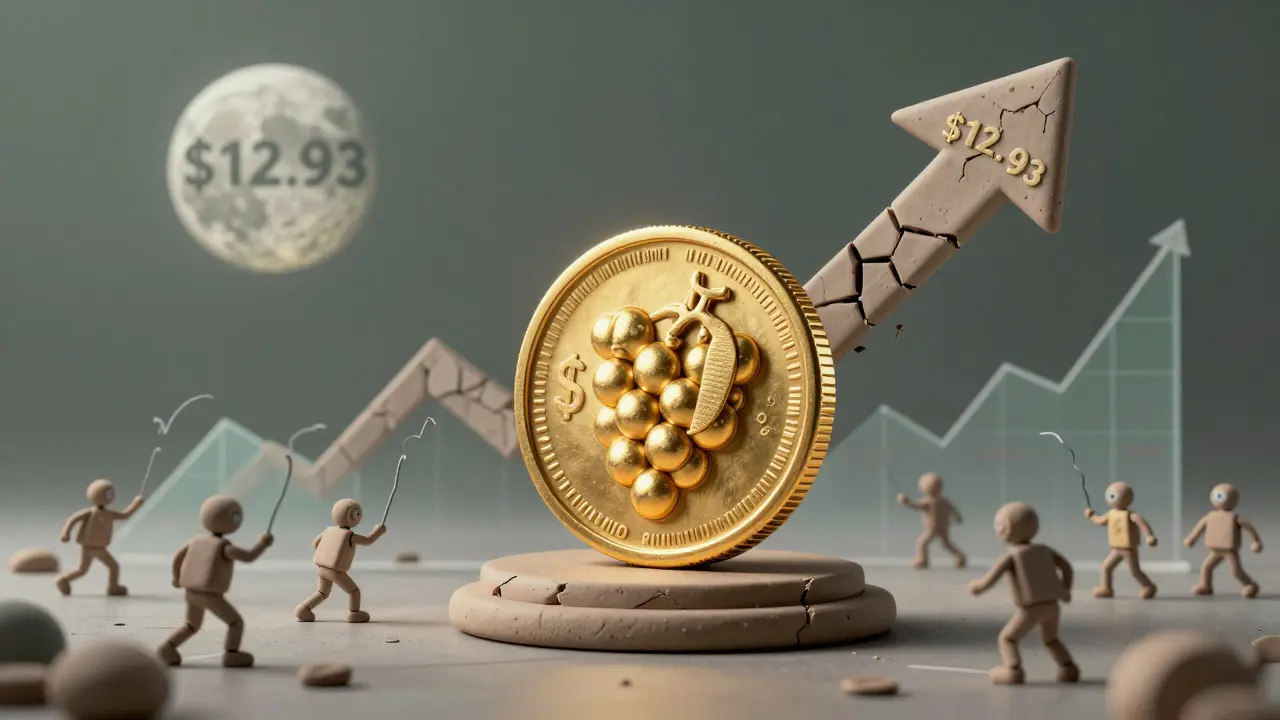
One of the most common hooks used by low-cap coins is the "moonshot" prediction. For GrapeCoin, some third-party sites like Changelly have published predictions suggesting GRAPE could reach $0.0927 by 2030 and $12.93 by 2050. Let’s put that in perspective.
To go from a fraction of a cent to $12.93 requires a growth rate that exceeds Bitcoin’s entire history combined. Bitcoin grew roughly 100,000x from its early days to its all-time highs. A 129,000x growth over 26 years implies an annual compounded growth rate that defies economic logic. Even Ethereum, the second-largest cryptocurrency, hasn’t achieved this kind of sustained exponential growth relative to its initial launch value.
These predictions are not based on fundamentals. They are algorithmic guesses generated by bots scraping social media hype. Relying on them is like betting on a lottery ticket because a stranger said the odds were good. In reality, 99% of micro-cap tokens fail within their first year. GRAPE fits the profile of a "zombie coin"-a project that still has a website and a listing on aggregators but has no active development, no users, and no hope of recovery.
Red Flags: Anonymity and Lack of Regulation
In the post-2023 regulatory landscape, anonymity is a major risk factor. Reputable projects disclose their team members, legal entities, and compliance strategies. GrapeCoin offers none of this.
- Anonymous Team: No LinkedIn profiles, no verified identities. The "industry experts" mentioned in press releases are never named.
- No Regulatory Compliance: There are no SEC filings, no MiCA (Markets in Crypto-Assets) registration in Europe, and no clear legal jurisdiction. This means if the project disappears, you have no legal recourse.
- Stalled Development: Wayback Machine archives show that the project’s roadmap hasn’t been updated since late 2023. Promises of a mainnet launch and CEX listings have passed without delivery.
- No Community Engagement: Reddit threads are sparse or filled with potential shill posts. Trustpilot has zero reviews. A healthy crypto project thrives on community feedback; GRAPE operates in silence.
This pattern mirrors past scams like Squid Game Token (SQUID), which promised high yields and rapid growth before executing a "rug pull"-withdrawing all liquidity and leaving investors with worthless tokens. The absence of security audits and the presence of contradictory technical narratives make GRAPE a textbook example of high-risk speculation.
How to Verify Crypto Projects Yourself
You don’t need to be a blockchain developer to spot a bad project. Use this checklist before putting money into any low-cap coin like GrapeCoin.
- Check the Contract Address: Is it verified on Etherscan or Solscan? Does the code match the whitepaper?
- Verify Liquidity: Look at the 24-hour volume on CoinMarketCap. If it’s near zero, walk away.
- Assess the Team: Are they doxxed (publicly identified)? Do they have a track record in tech?
- Scrutinize Tech Claims: If a coin claims 10x the speed of Ethereum with no peer-reviewed paper, it’s likely lying.
- Look for Audits: Has a firm like CertiK, Hacken, or OpenZeppelin audited the smart contracts?
GrapeCoin fails almost all of these tests. It lacks verifiable liquidity, has an anonymous team, makes impossible technical claims, and has no security audits. The combination of these factors places it in the highest risk category.
Conclusion: Is GrapeCoin Worth Your Attention?
The short answer is no. GrapeCoin (GRAPE) appears to be either a dead project or a misleading scheme designed to capture attention through exaggerated claims. The conflict between its Layer-1 DAG narrative and its Solana token existence creates too much uncertainty. The lack of trading volume means you cannot easily exit your position. The astronomical price predictions are mathematical fantasies.
In the crypto market, opportunity cost is real. Every dollar tied up in a zombie coin like GRAPE is a dollar not invested in established assets with real utility, transparent teams, and proven technology. Stick to projects with open-source code, active communities, and verifiable on-chain activity. Don’t let the allure of a "1000x ROI" blind you to the basic red flags.
Is GrapeCoin (GRAPE) a scam?
While we cannot legally label it a "scam" without a court ruling, GrapeCoin exhibits multiple characteristics of fraudulent or abandoned projects. These include anonymous developers, contradictory technical narratives, zero trading volume despite high claims, and lack of security audits. Treat it as extremely high-risk.
What blockchain is GrapeCoin built on?
There is conflicting information. Some sources claim it is a standalone Layer-1 blockchain using DAG technology (VINE protocol). Others list it as a token on the Solana blockchain. This inconsistency is a major red flag indicating poor project management or intentional deception.
Can I buy GrapeCoin on Binance or Coinbase?
No. As of 2026, GrapeCoin is not listed on major regulated exchanges like Binance, Coinbase, or Kraken. It may appear on smaller, less secure exchanges, but liquidity is virtually non-existent, making purchases risky and sales difficult.
Are the price predictions for GRAPE accurate?
No. Predictions suggesting GRAPE will reach $12.93 by 2050 are mathematically implausible and not based on fundamental analysis. They are likely generated by automated algorithms ignoring the project's lack of utility, volume, and development progress.
Why does GrapeCoin claim 700,000 TPS?
This claim contradicts known limitations of DAG technology and distributed systems. Established DAG-based networks like Nano handle significantly fewer transactions. Such exaggerated metrics are often used in marketing to attract inexperienced investors who equate higher numbers with better technology.