What is KIKICat (KIKI) Crypto Coin? Guide to the AI Meme Token
 Aug, 25 2026
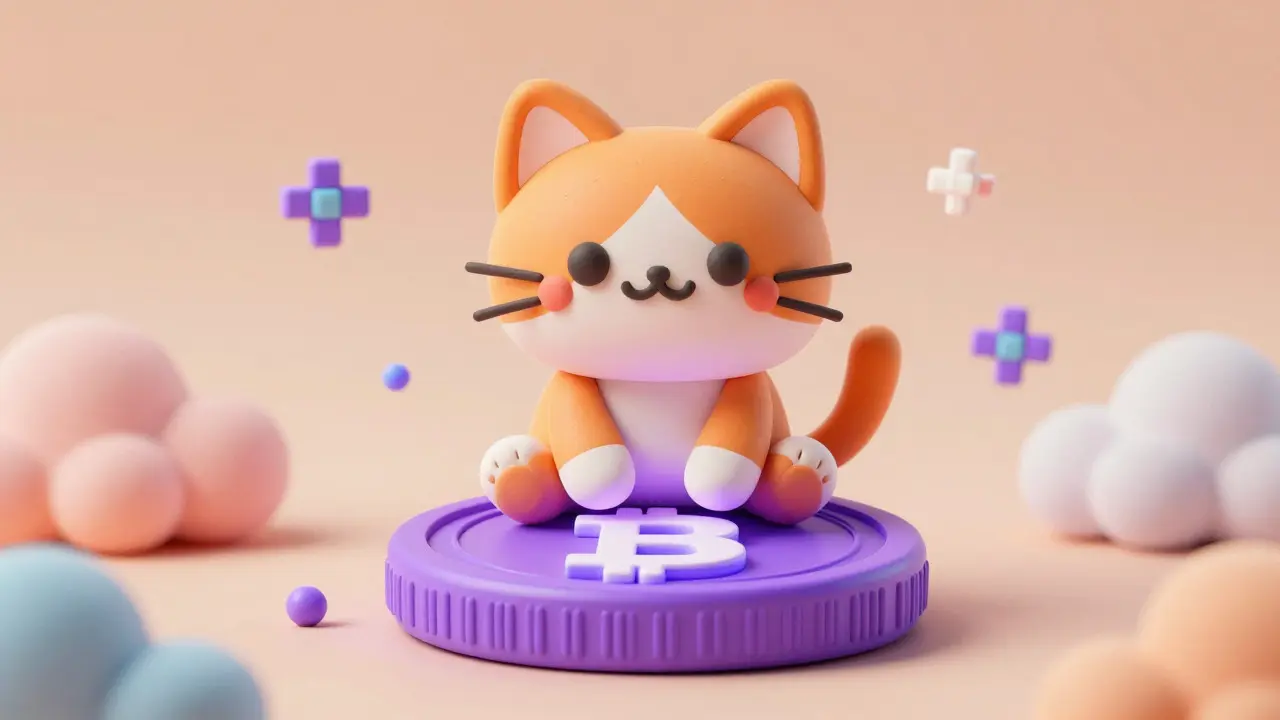
Have you seen that specific cat GIF on Giphy with over 11 billion views? That character is now a cryptocurrency. KIKICat (ticker: KIKI) is a Solana-based meme cryptocurrency that merges digital intellectual property with artificial intelligence branding. Launched in late December 2024, it aims to be more than just a funny image; it positions itself as an "AI-driven" asset built for speed and low fees on the Solana blockchain.
If you are looking at charts and wondering if this is a legitimate investment or just another passing trend, you are in the right place. This guide breaks down what KIKI actually is, how its supply works, where you can buy it, and why the data across different tracking sites looks so confusing. We will cut through the noise to give you a clear picture of this micro-cap token as of mid-2026.
The Core Concept: Digital IP Meets AI
Most meme coins rely on celebrity endorsements or random internet moments. KIKICat takes a different angle by tokenizing an existing digital asset. The foundation is the "KIKI" cat character, which has amassed massive organic popularity on Giphy. By putting this IP on-chain, the project argues that it holds inherent cultural value before even considering speculative trading.
The twist is the "AI-driven" label. In the current market cycle, adding AI to the narrative helps projects stand out. For KIKI, this means using AI tools for community engagement and branding rather than complex on-chain computation. While some tokens embed actual algorithms into their smart contracts, KIKI’s AI aspect is primarily a marketing and utility framework. It uses the efficiency of the Solana network to support fast transactions while leveraging the recognizable face of the KIKI cat to attract attention from both meme enthusiasts and tech-curious investors.
Tokenomics: Supply and Circulation
Understanding the supply structure is critical for any crypto asset. KIKICat operates with a fixed maximum supply of 1,000,000,000 tokens. There is no inflationary mechanism; once all tokens are issued, no new ones are created. As of August 2026, nearly 100% of these tokens are in circulation. Data from major aggregators shows circulating supplies hovering between 999,979,621 and 1,000,000,000 KIKI. This means there are no upcoming vesting schedules or large unlocks that could flood the market with sell pressure in the near future.
Since KIKI is a standard SPL token on Solana, it is not mineable. You cannot run hardware to earn it. Acquisition happens exclusively through primary distribution events (like initial listings or airdrops) or secondary market trading. Because the supply is fully unlocked, the Fully Diluted Valuation (FDV) is almost identical to the live Market Capitalization. This simplifies valuation analysis but also means that price movements are driven purely by demand relative to the existing float.
| Attribute | Value / Detail |
|---|---|
| Ticker Symbol | KIKI |
| Blockchain | Solana |
| Maximum Supply | 1,000,000,000 |
| Circulating Supply | ~999,980,000 (99.99%) |
| Launch Date | December 22, 2024 |
| Mineable | No |
| Primary Narrative | Digital IP + AI Branding |

Navigating Price Volatility and Data Discrepancies
Here is where things get tricky for new investors. If you check three different websites today, you might see three completely different prices for KIKI. This isn't necessarily a scam; it's a common issue with low-liquidity, micro-cap tokens. Let's look at the data spread as of mid-2026:
- CoinGecko: Reports a price around $0.000059 USD with a very low 24-hour volume of roughly $3.93. This suggests thin liquidity on specific pairs tracked by this platform.
- CoinMarketCap: Lists the price near $0.000046 USD, ranking it outside the top 3,000 cryptocurrencies.
- CoinStats: Shows a higher price point of approximately $0.000838 USD with a significantly higher trading volume of over $140,000 in 24 hours.
- Stockscan: Records an All-Time High (ATH) of $0.08403, meaning the token has dropped by over 99% from its peak.
Why the difference? Each aggregator pulls data from different exchanges and pairs. Some track only the most active markets, while others include smaller, less liquid venues. When a token trades thinly, a single large buy order can spike the price on one exchange without affecting others immediately. Always check the 24-hour volume alongside the price. A high price with zero volume is a red flag for illiquidity, making it hard to exit your position quickly.
Where to Trade KIKICat
Liquidity for KIKI is concentrated on a few specific platforms. For centralized exchanges (CEX), MEXC is widely cited as the primary venue. The KIKI/USDT pair on MEXC often records the highest reliable trading volumes among major CEXs. If you are holding USDT, this is likely your best entry point for tighter spreads.
For those preferring decentralized finance (DeFi), KIKI trades on Solana-based DEXs. Since it lives on the Solana network, you can use wallets like Phantom or Solflare to swap directly. However, you must be careful about slippage. On low-volume days, swapping a significant amount of KIKI might move the price against you due to shallow order books. Always check the liquidity pool depth before executing a trade.
Note that while Coinbase and Crypto.com provide price tracking for KIKI, they do not always host active spot markets for it. Their data serves as a reference, but execution usually happens on MEXC or Solana DEXs.

Risk Assessment: What You Need to Know
KIKICat fits the profile of a high-risk, speculative asset. Here are the key risk factors to weigh before buying:
- Extreme Volatility: With an ATH of $0.084 and current prices in the fractions of a cent, the potential for gains is high, but so is the risk of total loss. Meme coins often follow herd behavior rather than fundamental value.
- Data Fragmentation: As mentioned, market cap estimates vary wildly between trackers (from ~$60k to ~$7M). This makes it difficult to assess true project size. Rely on on-chain data or multiple sources to cross-reference.
- Lack of Institutional Coverage: There are no major analyst reports or academic studies backing KIKI. It remains a retail-driven play. The absence of detailed public roadmaps or audited smart contract reports adds to the uncertainty.
- Regulatory Ambiguity: Like all meme coins, KIKI exists in a gray area regarding regulation. While Solana itself faces regulatory scrutiny, individual tokens like KIKI are rarely targeted specifically unless involved in fraud. Still, keep an eye on broader crypto legislation.
The "AI" and "IP" narratives are strong marketing tools, but they do not guarantee utility. Unlike DeFi protocols that generate revenue from fees, KIKI’s value proposition is currently tied to community sentiment and brand recognition. If the hype fades, the lack of intrinsic cash flow could lead to sustained price declines.
Frequently Asked Questions
Is KIKICat a good investment in 2026?
Whether KIKICat is a good investment depends entirely on your risk tolerance. It is a micro-cap meme coin with high volatility and thin liquidity. It offers high speculative upside if the community grows, but lacks the fundamental revenue streams of established DeFi projects. Only invest what you are willing to lose, and treat it as a speculative bet rather than a long-term hold.
How do I buy KIKI coin?
The easiest way to buy KIKI is through a centralized exchange like MEXC, where you can trade USDT for KIKI. Alternatively, you can use a Solana-compatible wallet (like Phantom) to swap SOL for KIKI on a decentralized exchange (DEX) such as Raydium or Jupiter. Ensure you have enough SOL for gas fees if trading on-chain.
What is the maximum supply of KIKI?
The maximum supply of KIKICat is 1,000,000,000 tokens. As of mid-2026, virtually all of these tokens are already in circulation, meaning there are no significant future unlocks scheduled that could impact supply dynamics.
Why do different websites show different prices for KIKI?
Price discrepancies occur because each data aggregator tracks different exchanges and trading pairs. Low-liquidity tokens can have varying prices across venues. Some sites may update data faster than others, or include/exclude certain small exchanges. Always check the 24-hour volume to gauge which price reflects the most active market.
Does KIKICat have real-world utility?
Currently, KIKICat's utility is primarily social and speculative. It leverages the popularity of the KIKI cat IP and AI branding to drive community engagement. It does not yet generate native protocol revenue like many DeFi tokens. Its value is derived from market sentiment and the success of its marketing narrative.
Dave Worth
August 26, 2026 AT 03:40They are watching you through the cat GIFs 📡. That 11 billion views stat is not organic, it is a bot farm signal designed to trigger FOMO in your lizard brain 🧠. The "AI" part is just a smokescreen for a pump and dump scheme that has been cooking since December 2024 🍳. Why would anyone trust a token where the price data is so fragmented it looks like a glitch in the simulation? Because the elites want you to think it is innovation while they drain your liquidity 💸. Check the contract holders if you dare, but I bet you will find the top ten wallets hold more than half the supply 🕵️♂️. It is all about control, people. The Solana network is just the delivery mechanism for this digital opium 🏃♂️💨. Do not let them fool you with cute branding. The real story is who benefits when the music stops 🎺.
Kelechi Precious Nwachukwu
August 27, 2026 AT 23:05My god this article is so confusin because every site show diffrent price 😱
I check CoinGecko and see $0.000059 but then CoinStats say $0.000838 which is like 14 times more!! How can that be possible??
The cat is cute sure but is it worth my money? I am from Nigeria and we know how scams work here so I am very careful.
If the volume is only $3.93 on one site then how do you sell if you want out?
It feels like a trap for young people who think AI means smart investment.
Please someone tell me the truth before I buy and lose everything 🙏
Valentine Okpala
August 28, 2026 AT 16:43It’s fascinating how we’ve turned a simple internet meme into a complex financial instrument with the weight of 'digital IP' attached to it 🤔
There’s something almost philosophical about the fact that its value is derived entirely from collective belief rather than utility.
We are essentially trading air, but air that smells like potential and fear.
The discrepancy in prices isn't just a technical error; it's a reflection of the market's fractured reality.
In a way, it mirrors our own fragmented attention spans in the digital age.
Do we invest in the cat, or in the story we tell ourselves about the cat?
Probably both, and neither, really.
Just a chill observation from the sidelines, no need to rush in.
The silence of the low volume speaks louder than the hype ever could 🍵
Sean Dalton
August 30, 2026 AT 01:34Typical American garbage coin 🇮🇪
Why are we even talking about this? It’s another sign of the US economy rotting from the inside out.
Solana is fine, I suppose, but these little meme tokens are pure speculation driven by uneducated retail investors.
Back in Ireland, we preferred solid assets, not some cat with an AI label slapped on it for marketing purposes.
The fact that the price varies so wildly between trackers shows how immature this market is.
No institutional coverage? Of course not. Who wants to put their name on a gamble like this?
It’s all hype and noise, much like the rest of the American crypto scene.
Keep your money in bonds or gold, not in digital cats.
Pathetic really, that we have to waste time analyzing this nonsense.
Just another example of why the global financial system needs stricter regulation, preferably led by sensible Europeans.
Rajni Mathur
August 30, 2026 AT 22:15One must observe the sheer audacity of labeling a meme coin as 'AI-driven' without any substantive algorithmic integration on-chain 📉
The narrative is a classic case of vaporware, leveraging buzzwords to obscure the lack of fundamental revenue generation.
Furthermore, the fragmentation in price data across aggregators suggests a severe liquidity crisis, rendering exit strategies nearly impossible for significant positions.
To treat this asset as anything other than a high-risk speculative vehicle is to ignore basic principles of valuation and market depth.
The reliance on Giphy views as a proxy for cultural value is tenuous at best, given the ephemeral nature of internet trends.
Investors should be wary of the 'fully diluted valuation' being identical to market cap, as it offers no buffer against future dilution or unlock events, though none are currently scheduled.
Ultimately, the absence of institutional interest confirms its status as a retail-only play, devoid of long-term viability.
One should proceed with extreme caution, if at all, when considering such instruments.
The risk-reward ratio is heavily skewed towards capital erosion.
A sober analysis reveals little more than a cleverly packaged commodity with no intrinsic cash flow.
Bill Patterson
September 1, 2026 AT 10:34overhyped trash
just another scam
stay away
lol