What Is MinoTari (XTM)? Complete Guide to Tari L1 Blockchain & Tokenomics
 Mar, 30 2026
When you hear about MinoTari, you're looking at more than just another speculative asset. It is the native token of the Tari Network, a project attempting to solve one of the biggest headaches in crypto: the scalability trilemma. As of March 30, 2026, MinoTari operates as the lifeblood of the Tari L1 base layer. If you are considering adding XTM to your portfolio or trying to understand why miners are merging with Monero networks, here is the real breakdown of what makes this protocol different.
The Core Architecture: Why Two Layers?
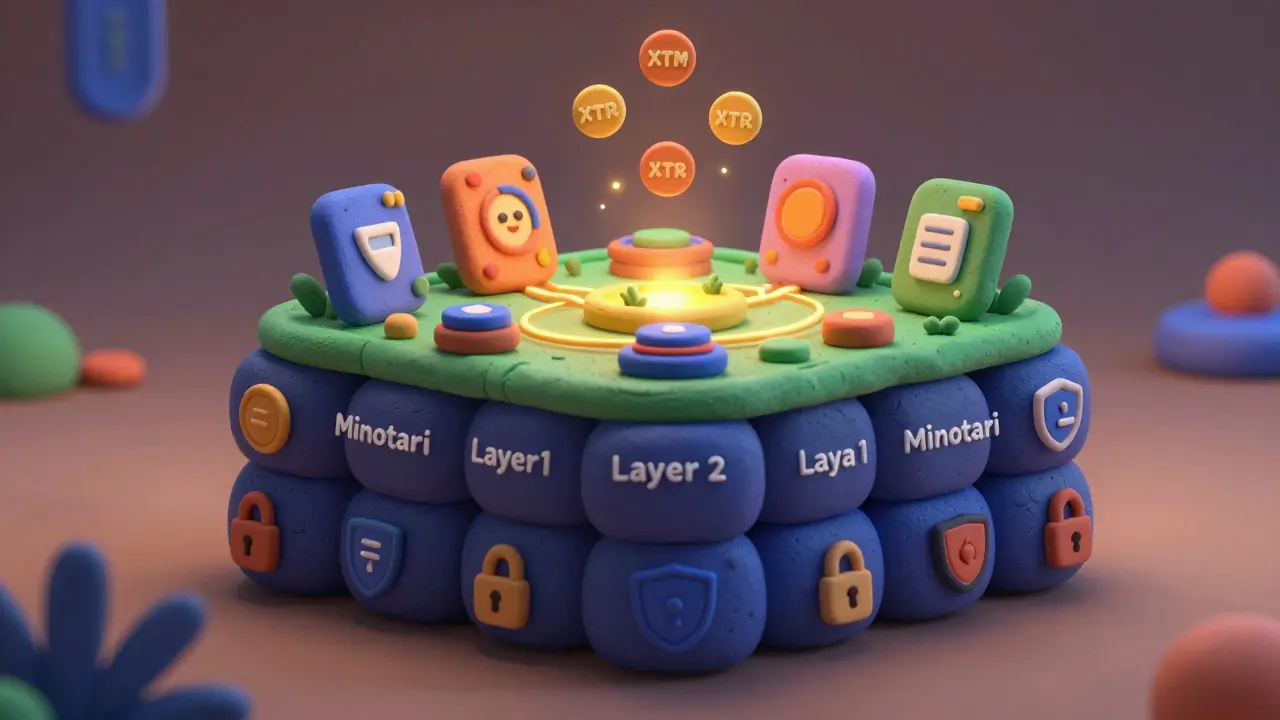
Most blockchains struggle to balance speed with security. Tari takes a radical approach by splitting these jobs entirely. The base layer, known as Minotari (Layer 1), acts as the global settlement ledger. It handles security and state management using Proof-of-Work. On top of that sits the Digital Assets Network (DAN), which is the scalable Layer 2 solution designed for high-speed smart contracts and applications. This separation means users don't have to choose between a secure, decentralized network and the ability to run complex dApps without paying massive gas fees.
This dual-layer setup addresses the "blockchain trilemma" differently than competitors like Bitcoin or Ethereum do. While Bitcoin focuses heavily on security and store of value, and Ethereum offers robust smart contracts but often struggles with throughput, Tari aims to bridge the gap. Layer 1 ensures the network isn't compromised, while Layer 2 handles the heavy lifting of digital asset operations. For developers, this means you get the distribution benefits of a decentralized app store feel, accessible directly through the miner interface.
Understanding XTM Token Utility
You can't talk about MinoTari without discussing the XTM token, the native cryptocurrency used to secure the network. Unlike many tokens that exist solely to raise funds during an ICO, XTM has specific mechanical uses within the ecosystem. First, it is required to pay transaction fees on the Layer 1 blockchain. Second, and perhaps more interestingly, XTM serves as the fuel to enter Layer 2.
Here is how the mechanics work: You hold XTM on Layer 1. To create assets or interact with the high-speed Layer 2 environment, XTM tokens are burned in a process governed by the Turbine Model, an economic framework creating a relationship between Layer 1 and Layer 2. Specifically, burning XTM creates XTR (the Layer 2 token) at a 1:1 conversion ratio. This design theoretically maintains equilibrium between the two layers, preventing infinite inflation on the faster chain while maintaining demand for the base asset.
| Feature | Layer 1 (Minotari) | Layer 2 (Digital Assets Network) |
|---|---|---|
| Primary Function | Security & Global State | Smart Contracts & Scalability |
| Native Asset | XTM | XTR |
| Consensus | Proof-of-Work | High-Speed Finality |
| Fees | Low, Stable | Near-Zero |
Mining and Network Security
One of Tari's most unique features is its hybrid mining model. Traditional proof-of-work blockchains rely on specific hardware (ASICs or GPUs) that centralizes power. Tari implements a hybrid consensus that combines SHA3x standalone mining and RandomX merge-mining with Monero. Roughly 50% of the block rewards go to dedicated SHA3x miners, and the other 50% come from merge-miners who support both Monero and Tari simultaneously.
Why does this matter? Merge-mining leverages the massive hash rate already established by the Monero community. Instead of starting from zero, Tari instantly inherits security. Miners running the Monero daemon can enable Tari in their settings and mine both currencies without extra cost. This creates a robust barrier against 51% attacks right from day one because an attacker would essentially need to compromise Monero's security to hurt Tari. The block rewards are distributed 100% to miners and transaction fee earners, ensuring the network incentivizes those protecting the ledger.

Technical Foundation: Built on Rust and Mimblewimble
Software engineering choices matter when building critical financial infrastructure. Tari is written in Rust, a systems programming language known for memory safety. This choice reduces the risk of common vulnerabilities found in C++ or Solidity-based chains, such as buffer overflows. Furthermore, the protocol utilizes an enhanced version of the Mimblewimble protocol, a privacy-focused blockchain technology.
Standard Mimblewimble protocols prioritize privacy and small block sizes but historically lacked advanced scripting capabilities. Tari improves on this by introducing "TariScript," allowing for smart contract functionality without compromising privacy too much. They also added one-sided payments and stealth addresses. These innovations mean you get the privacy guarantees of Mimblewimble-like hiding transaction amounts and sender/receiver identities-while still having enough flexibility to build DeFi or NFT applications on Layer 2.
Market Status and Tokenomics as of March 2026
If you are looking to trade XTM today, the landscape shows a mix of volatility and structural opportunity. According to data available on March 30, 2026, MinoTari trades at approximately $0.0008 USD. While the ranking on aggregators hovers around #4472, the fundamental metrics show a total supply cap of 21 billion XTM. Of this total, 70% is reserved for mining rewards, ensuring the bulk of supply goes to participants securing the network rather than venture capital VCs dumping coins.
Note on Liquidity: Data providers differ significantly on volume. CoinMarketCap reported roughly $24k in 24-hour volume, while CoinGecko showed over $111k. This discrepancy suggests trading happens across fragmented venues, so always check order depth before large entries.
The pre-mine of 30% was allocated to fund development and ecosystem growth, though the majority of value accrues to miners. Over the last 90 days leading up to this date, the token saw a decline of roughly 52%. However, this aligns with broader bearish trends in lower-cap Layer 1 projects. The long-term incentive structure remains sound due to the burn mechanism; as Layer 2 adoption grows, more XTM must be burned to create XTR, potentially creating deflationary pressure if adoption outpaces issuance.
Risks and Adoption Challenges
No protocol is without friction. The dependency on Monero for merge-mining is a double-edged sword. While it provides immediate security, it ties part of Tari's fate to Monero's regulatory standing. If governments crack down on Monero specifically due to its privacy features, Tari could face collateral heat, even though Tari itself adds significant transparency features via TariScript.
Furthermore, developer adoption is in early stages. The "app store" built into the miner is ambitious, promising a way to distribute applications to every node automatically. But until there is a killer app-a wallet game, a decentralized social media tool, or a major payment integration-that feature remains theoretical. Current trading patterns show underperformance compared to the broader crypto index, suggesting investors are waiting for clear signals of mass user adoption before betting heavily on the technology.
Next Steps for Investors and Users
For those diving in, the first step is securing your own node. Because the architecture encourages everyone to participate, setting up a miner allows you to validate transactions and earn XTM directly. If you are purely investing, ensure you buy on exchanges supporting the pair, noting that liquidity varies. Understanding the burn mechanic is vital: holding XTM isn't just about price appreciation; it's about your ability to convert it into the Layer 2 currency needed for future dApps.
Frequently Asked Questions
What is the primary purpose of XTM?
XTM secures the Tari Layer 1 network through Proof-of-Work mining, pays transaction fees on Layer 1, and is burned to create XTR tokens on Layer 2.
How does Tari mining work?
Tari uses a hybrid approach where 50% of rewards go to SHA3x miners and 50% go to RandomX miners who merge mine with the Monero network.
What is the difference between Layer 1 and Layer 2 in Tari?
Layer 1 (Minotari) handles security and settlement using Proof-of-Work, while Layer 2 (Digital Assets Network) focuses on high-speed smart contracts and application scalability.
Is MinoTari private like Monero?
Yes, it is built on the Mimblewimble protocol which hides transaction amounts and sender/receiver details, though it adds smart contract capabilities.
What is the total supply of XTM?
The total supply is capped at 21 billion XTM, with 70% allocated to mining rewards and 30% initially reserved as a pre-mine.
Zackary Hogeboom
March 31, 2026 AT 18:04The dual architecture approach here is actually pretty fascinating when you dig into the documentation. Most chains try to do everything at once and fail miserably at scaling while keeping security intact. Tari splitting L1 for settlement and L2 for speed feels like the right move for this market cycle. I've been reading about how the burn mechanism works for XTM to XTR conversion and it creates genuine demand. It reminds me a bit of how Ethereum handles gas but with a focus on privacy that is much stronger.
I think the merge mining with Monero is the real secret sauce though. Getting that instant hash rate security inheritance without needing custom ASIC farms is brilliant engineering honestly. Privacy coins always struggle with regulatory headwinds so having a public facing L2 makes sense too. You get the best of both worlds regarding anonymity and smart contract capability without the bloat. The Rust foundation also gives me way more confidence than watching C++ chains crash every few months.
Even with the current price action being weak, the fundamental utility holds water for long term holders. People tend to panic sell dips in lower cap alts without looking at the actual tokenomics distribution. Seeing 70% going to miners instead of VCs is a rare sight in the modern ecosystem. We definitely need more projects that prioritize network security over early investor windfalls like this.
If they can deliver on that app store feature through the miner interface adoption could spike unexpectedly fast. Tech like this usually takes years to gain traction but the roadmap looks aggressive enough to capture some attention soon.
Shaira Vargas
April 1, 2026 AT 16:57This feels so intense like everyone is sleeping on something huge again.
Samson Abraham
April 2, 2026 AT 08:20The separation of layers does offer clarity where others are vague and the risk factor seems manageable for now
Cara Boyer
April 2, 2026 AT 15:34Governments dont want us to see the truth about money systems controlled by elites 😡. They make you feel safe with monero links but its just another trap 🤡. My family history tells me private networks are watched closer than any bank account ever was. Trusting rust code written by people who hide their identity behind pseudonyms is dangerous for national security reasons imho. :)
Raymond K
April 4, 2026 AT 13:47You never know when the next big thing happens but this project feels really solid and bright for sure! i love how they handle the burn mechanics cuz its super clever and helps inflation too much hopefully 🌟. Even if prices drop everyone keeps building and thats what matters most in crypto space. 💪