What is Ninja Protocol (NINJA) Crypto? A Reality Check on the Solana Micro-Cap
 Nov, 6 2026
You’re scrolling through a decentralized exchange on Solana and you spot a ticker that sounds cool: NINJA. It’s cheap, it’s listed on major DEXs like Orca and Raydium, and the name suggests some kind of gaming or stealthy tech. But before you throw your SOL at it, you need to know what you’re actually buying. Is this the next big play-to-earn revolution, or just digital dust floating in the void?
Ninja Protocol is a small cryptocurrency project built on the Solana blockchain, designed to support an ecosystem of games, NFTs, and web applications. As of November 2026, it remains a highly speculative, low-liquidity asset with a market cap under $10,000. While its origins trace back to May 2021, its current status is defined more by what hasn’t happened than by what has.
The Origin Story: Who Created NINJA?
Most successful crypto projects have a face-a Vitalik Buterin, a Brian Armstrong, or at least a visible team. Ninja Protocol doesn’t. The project was launched on May 1, 2021, by an anonymous developer using the pseudonym "Yuzu." There is no registered company, no verifiable executive team, and no venture capital backing documented in public records. This isn't necessarily bad-Bitcoin started anonymously-but it means you are trusting code and community over corporate accountability.
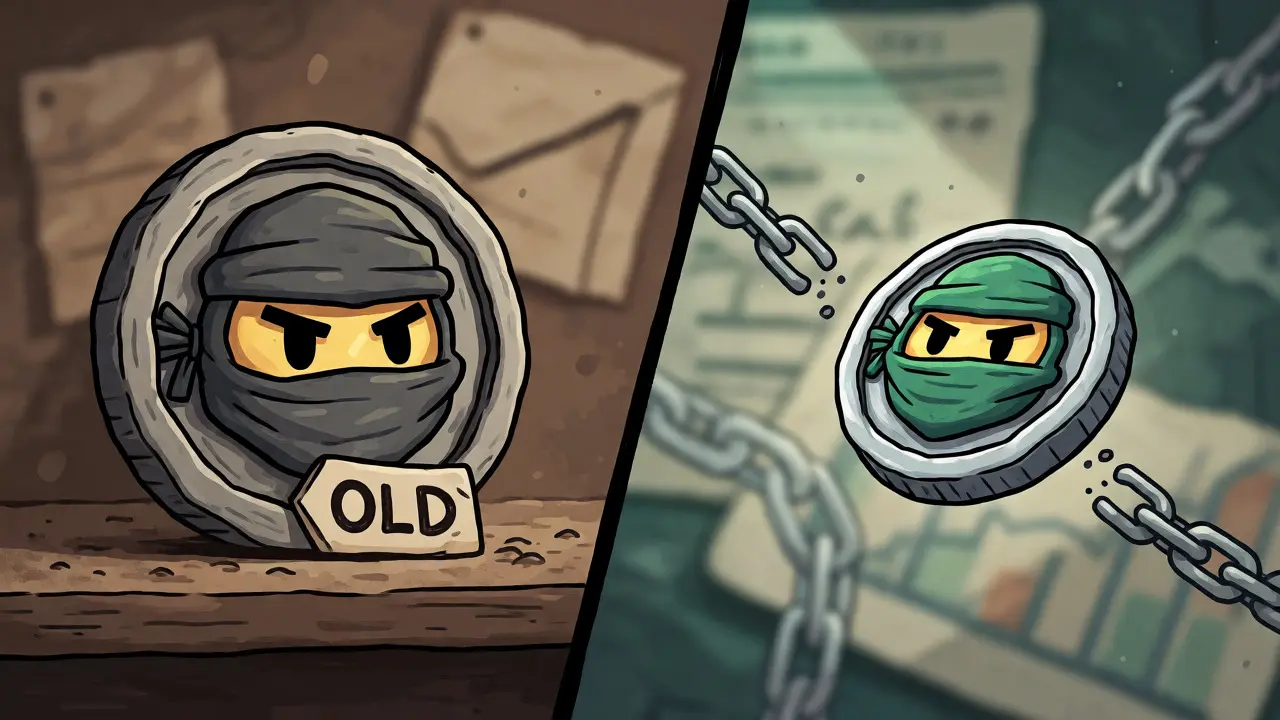
The original documentation states that Yuzu minted 50,000,000 tokens initially. About 2.2 million were dropped to early community members who created artwork or boosted activity on Discord. It was a grassroots start. However, the history gets messy. In June 2021, the token underwent a hard fork. The original token was renamed OLDNINJA, and a new fractional NINJA token was created. If you’re looking up charts from 2021, make sure you aren’t confusing the two. The current NINJA trading on exchanges today is the result of that split and subsequent changes, not the original single block of supply.
Tokenomics: The Numbers Don’t Match Up
If you look at archived docs from 2022, they claimed a total supply of 50 million. Fast forward to late 2026, and data providers like CoinGecko report a circulating supply of roughly 19.997 million. What happened to the other 30 million? The archived notes mention locks and burns, but they also explicitly warn that "tokenomics has gone through major changes." This discrepancy is a red flag for anyone doing due diligence. You can’t rely on old whitepapers when the live data tells a different story.
Here is the breakdown of the intended allocation versus the current reality:
| Category | Archived Plan (2021/2022) | Current Status (Nov 2026) |
|---|---|---|
| Total Supply | 50,000,000 NINJA | ~19,997,000 NINJA |
| Circulating Supply | 11,500,000 (as of Aug 2022) | ~19,997,000 |
| Market Cap | Variable | $9,697.26 |
| 24h Volume | Active Trading | $83.84 |
The most shocking number here isn’t the supply change-it’s the volume. On November 5, 2026, only $83.84 worth of NINJA changed hands in 24 hours. That’s less than the cost of a decent dinner. When liquidity is this thin, buying or selling even a moderate amount can drastically move the price against you.
Utility: What Does NINJA Actually Do?
The pitch for Ninja Protocol was always about utility within a gaming and NFT ecosystem. The plan included three main pillars:
- Ninja-Web: A profile page system for Solana users.
- Ninja-Vision: A blockchain explorer specific to the Solana network.
- Ninja ARPG: An action role-playing game built in Unity, integrating NFTs and crypto rewards.
Holders were promised tiered benefits based on how many tokens they held, including passive rewards, whitelist spots for NFT drops, and voting rights on project decisions. Sounds good, right? Here’s the catch: as of late 2026, there is little independent evidence that these products are actively maintained or widely used. The roadmap language in official docs got stuck in "to be updated" status around 2022. Did the game launch? Yes, technically. Is it driving significant user engagement or revenue? The data doesn’t show it.
Technically, NINJA is an SPL token. This means it lives on Solana’s infrastructure. It benefits from Solana’s fast transaction speeds and low fees compared to Ethereum. However, being an SPL token doesn’t mean Ninja Protocol invented any new consensus mechanisms or scaling solutions. It’s riding Solana’s coattails. If Solana goes down, NINJA goes down. If Solana thrives, NINJA might benefit, but only if people actually use the Ninja apps.
Liquidity and Market Risks
Let’s talk about the elephant in the room: exit risk. With a market cap under $10k and daily volume under $100, NINJA is what traders call a "micro-cap ghost town." You can buy it easily enough on Orca or Raydium, but getting out might be harder than you think.
On Orca, the NINJA/WSOL pair had a depth of about $100 on both sides of the order book. On Raydium, the NINJA/USDC pair had even less depth, around $30. This means if you try to sell $50 worth of NINJA, you might eat through the entire available buy orders, crashing the price temporarily and getting a worse fill rate than the displayed quote. This is known as slippage, and in markets this thin, it’s severe.
Furthermore, both markets were marked "Inactive" with no trades in the last three hours during the snapshot period. This lack of consistent activity makes it difficult to determine a fair market price. Are you holding a valuable asset, or just a number on a screen that nobody wants to trade?

How to Buy NINJA Safely
If you still want to take a gamble, don’t just click "buy" without checking the details. Because of the token forks and similar tickers, verification is critical.
- Verify the Mint Address: Do not trust the ticker alone. Find the verified Solana mint address for the current NINJA token. Cross-reference it on multiple sources like Solscan or Birdeye.
- Use a Solana Wallet: Phantom or Solflare are standard choices. Ensure you have enough SOL for transaction fees.
- Choose Your DEX: Orca and Raydium are the primary venues. Check which one has better liquidity at the moment of your trade.
- Check Price Impact: Before confirming, look at the price impact warning. If it’s above 1-2%, consider splitting your trade into smaller chunks.
- Test Small: Execute a tiny test transaction first. Confirm it lands on-chain and appears in your wallet before committing real funds.
Avoid the temptation to go "all in." In assets like this, preservation of capital is more important than potential gains.
The Verdict: High Risk, Unproven Reward
Ninja Protocol is a classic example of a "zombie chain" project. It exists, it has a token, and it has a history, but it lacks the vibrant heartbeat of active development and user adoption. The anonymous founder, the stale documentation, and the negligible trading volume all point to a project that may have peaked years ago.
Is it dead? Not technically. It’s still listed, and the smart contracts are live. But is it a viable investment for growth? That’s a tough sell. Without a clear path to monetization or a resurgence in community interest, NINJA remains a speculative lottery ticket rather than a solid portfolio piece.
If you’re a collector of obscure Solana tokens or someone who believes in the long-term value of dormant communities, you might find value here. For everyone else, the risks far outweigh the potential rewards. Always do your own research, and never invest money you can’t afford to lose entirely.
Is Ninja Protocol (NINJA) a scam?
There is no evidence of a rug pull or malicious scam. The token was distributed fairly to early supporters. However, the project is considered high-risk due to its anonymous creator, lack of recent updates, and extremely low liquidity. It is more accurately described as abandoned or stagnant rather than fraudulent.
Why did NINJA undergo a hard fork?
In June 2021, the project executed a hard fork to adjust its tokenomics. The original token was renamed OLDNINJA, and a new fractional NINJA token was introduced. This often happens to correct supply issues, reduce inflation, or reset community distribution mechanics.
Where can I buy NINJA crypto?
NINJA is primarily traded on decentralized exchanges (DEXs) on the Solana network. The two main venues are Orca (using the NINJA/WSOL pair) and Raydium (using the NINJA/USDC pair). Centralized exchanges rarely list such low-market-cap tokens.
What is the maximum supply of NINJA?
Historical documents cited a max supply of 50,000,000. However, current market data reports a circulating and total supply of approximately 19,997,000. This discrepancy suggests that a significant portion of the original supply was burned, locked permanently, or removed from circulation following the tokenomics changes.
Does Ninja Protocol have a working game?
The project planned a Unity-based Action RPG called Ninja ARPG. While the game was developed, there is limited verifiable data on its current player base, ongoing maintenance, or economic impact on the token's value as of late 2026. Many early promises remain unfulfilled or unmaintained.