What is Spore (SPORE) crypto coin? The truth behind the meme coin with 31 quadrillion tokens
 Feb, 2 2026
Spore (SPORE) isn't a project. It's not a platform. It's not even really a coin in the way Bitcoin or Ethereum are. It's a number - a massive, almost absurd number - floating on the Ethereum blockchain. As of early 2026, one SPORE token is worth about $0.00000000001016. That’s ten trillionths of a dollar. To own just $10 worth of SPORE, you’d need to hold 984 quadrillion tokens. And you do. Because the total supply? Over 30 quadrillion. That’s not a typo. It’s 30,536,848,494,833,830 tokens in existence.
How did Spore even get created?
No one knows who started it. There’s no team listed. No whitepaper. No GitHub repo. No official website. The only real trace is its contract address on Ethereum: 0x6e7f5c0b9f4432716bdd0a77a3601291b9d9e985 is the ERC-20 smart contract address for SPORE, deployed in early 2021. It was likely created by someone with a sense of humor, or maybe a bot, as part of the endless wave of meme coins that popped up after Dogecoin and Shiba Inu. Unlike those, though, Spore never gained traction. It didn’t build a community. It didn’t launch a product. It just… exists.
Why does anyone trade it?
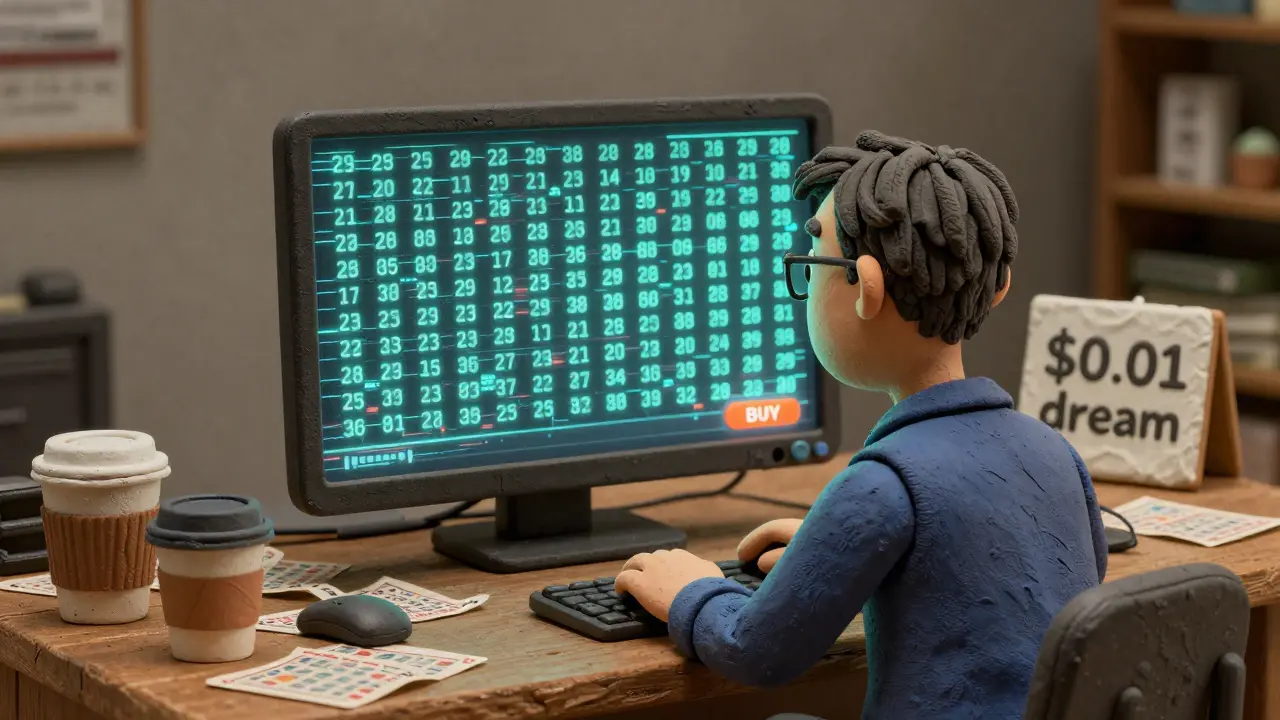
Because of the dream. The same dream that drives people to buy lottery tickets. If one SPORE token is worth a fraction of a penny, then maybe, just maybe, if it hits $0.01, you’ll be rich. That’s the fantasy. $0.01 per token sounds like a 100,000x return. And for someone holding billions of tokens, that sounds like millions. But here’s the problem: that dream ignores reality.
Spore’s market cap is around $491,000. That’s less than the price of a modest used car. Its 24-hour trading volume? $99.37. That’s less than what you’d spend on coffee in a week. When trading volume is this low, prices can be manipulated by a single large buyer or seller. You think you’re buying into the next big thing? You’re probably just buying from a bot or a pump-and-dump group that will vanish the second the price ticks up.
What’s the real trading experience like?
Try to buy $50 worth of SPORE. You’ll find that your order doesn’t go through at the price you see. The spread is huge. Slippage? Often 30% to 40%. That means if you think you’re paying $50, you’re actually paying $70. Why? Because there’s almost no liquidity. There are only four exchanges that list it, and none of them have deep order books. You can’t sell without dragging the price down. And if you try to sell a large amount? Good luck. The market just won’t absorb it.
Adding SPORE to MetaMask isn’t easy. You can’t just search for it. You have to manually enter the contract address, then add the token decimals (18), then hope you typed it right. Most people don’t even know how to do that. And if you do? You’re holding a number so big your wallet app might glitch trying to display it.
Is Spore part of the Avalanche ecosystem?
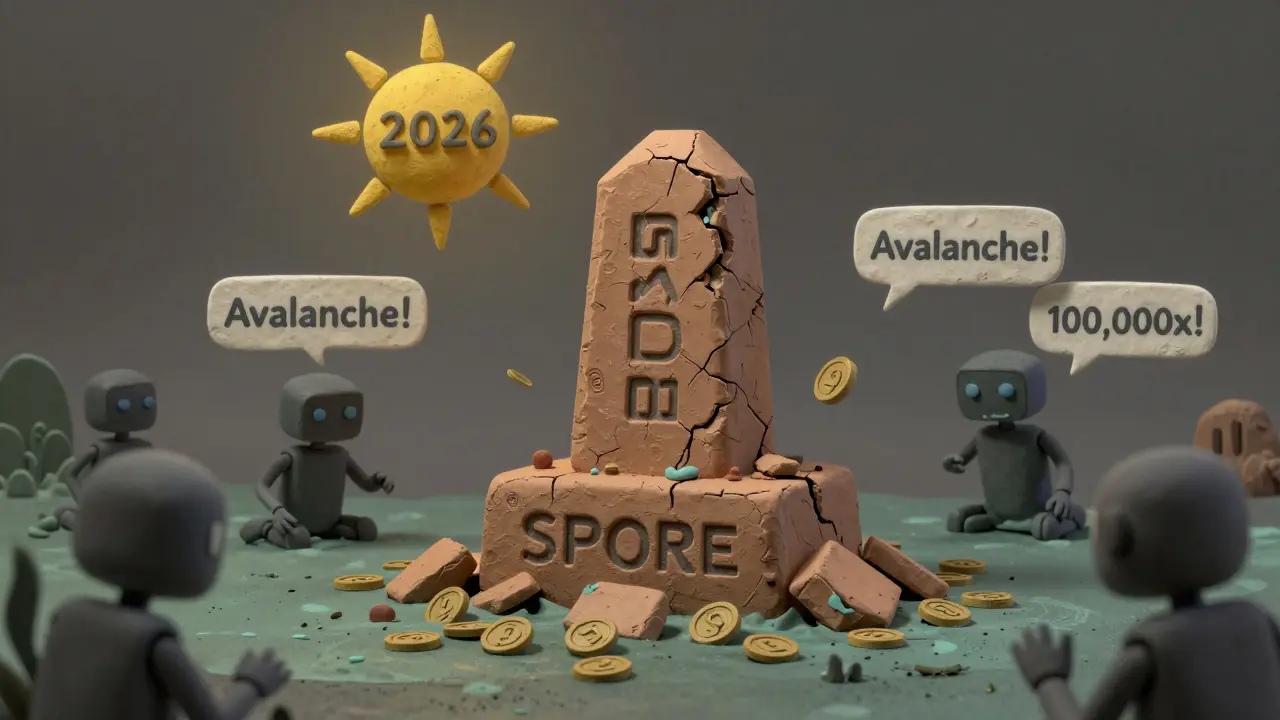
Some sites say yes. Others say no. CoinGecko lists it under Avalanche, but its contract address is on Ethereum. That’s a red flag. It means the data might be auto-generated and inaccurate. There’s no real connection to Avalanche. No team, no integration, no development. It’s just a label slapped on by a bot. This kind of confusion is common with low-cap tokens. They’re often misclassified to make them look more legitimate than they are.
What do the numbers really say?
Let’s look at the data:
- Price: $0.00000000001016 (as of Jan 2026)
- Circulating Supply: 31 quadrillion
- Market Cap: $491,137
- 24-Hour Volume: $99.37
- RSI (14-day): 36.75 (neutral)
- Fear & Greed Index: 23 (Extreme Fear)
- Price Range (7-day): $0.0000000000101370 to $0.0000000000101751
Notice anything? The price barely moves. It’s stuck in a range smaller than a single grain of sand. That’s not volatility - that’s stagnation. The RSI says it’s neutral. The Fear & Greed Index says everyone’s scared. And the volume? Too low to matter. Even the 12% weekly gain? That’s just noise. You’d need a $10 million trade to move the needle. No one has that kind of money to waste on this.
What about those wild price predictions?
You’ll see headlines: “SPORE to hit $0.20 by end of 2026!” That’s a 19 trillion percent gain. That’s not a prediction. That’s fantasy math. If SPORE reached $0.20, its market cap would be over $6 trillion - bigger than Apple, Amazon, and Google combined. And yet, it trades with less volume than a single tweet from Elon Musk. That’s impossible. Analysts at BeInCrypto and CoinDesk call these claims “marketing hyperbole.” They’re designed to lure in new buyers who don’t understand math.
Is Spore a scam?
It’s not technically a scam. No one stole your money. No one promised returns. It’s just a token with no utility, no team, no roadmap, and no future. But that doesn’t make it safe. It’s a trap disguised as opportunity. The SEC has warned about tokens with “artificially inflated supply and negligible utility.” Spore fits that description perfectly. If regulators crack down on low-cap meme coins, Spore will be one of the first to vanish.
Who’s still buying it?
Not institutions. Not hedge funds. Not even serious crypto traders. It’s mostly retail investors chasing the dream. Reddit threads are full of people saying, “I put $10 in hoping for 100x.” They know it’s risky. They just don’t care. That’s the psychology of meme coins. It’s not about logic. It’s about hope. And hope is expensive.
What’s the bottom line?
Spore (SPORE) is a digital ghost. It exists only because the blockchain doesn’t delete things. It has no purpose, no team, no community, and no future. Its price is so low that it’s practically meaningless. Its volume is so low that trading it is like trying to sell a house in a town with one buyer. The only thing it has going for it is the human tendency to believe that more numbers = more value. But 31 quadrillion of nothing is still nothing.
If you’re thinking of buying SPORE, ask yourself: Why? Are you betting on a miracle? Or are you just playing a game where the house always wins? The data doesn’t lie. The market doesn’t care. And the token? It’s just sitting there - unchanged, unloved, and utterly irrelevant.
Should you invest in Spore?
If you have money you’re willing to lose - and you understand that losing it won’t hurt you - then go ahead. But don’t call it investing. Call it gambling. And if you do, treat it like a lottery ticket. Don’t put more in than you’d spend on a scratch-off. And don’t expect to ever cash out.
There are thousands of crypto projects with real teams, real tech, and real use cases. Spore isn’t one of them. It’s a footnote in crypto history - a weird, almost comical footnote - that will be forgotten long before the next bull run.
Is Spore (SPORE) a real cryptocurrency?
Yes, technically. It’s an ERC-20 token on the Ethereum blockchain with a real contract address. But it has no utility, no team, no roadmap, and no community. It exists only as a speculative asset with massive supply and almost no demand.
Can I make money trading SPORE?
It’s possible, but extremely unlikely. The daily trading volume is under $100, meaning even small trades cause massive slippage. Most people who buy it can’t sell without losing 30-40% of their value. The few who profit are usually early buyers or bots. For the average person, it’s a losing proposition.
Why is the price so low?
Because the total supply is over 30 quadrillion tokens. When you spread a tiny market cap across that many tokens, each one ends up worth a fraction of a penny. It’s not about value - it’s about math. Low price doesn’t mean cheap. It means diluted.
Is Spore listed on major exchanges like Binance or Coinbase?
No. Spore is only listed on four obscure exchanges, none of which are well-known or trusted. Major platforms avoid it because of its lack of transparency, low volume, and high risk of manipulation.
Does Spore have a whitepaper or official website?
No. There is no official documentation, no team page, no Discord, and no active Telegram. The only verifiable information is its contract address on Ethereum and its data on CoinGecko. That’s it.
Could Spore ever become valuable?
Theoretically, yes - but only if someone suddenly decided to build a real project around it, which hasn’t happened in over 4 years. The probability is near zero. Tokens like this rarely survive beyond a few years. Most vanish without a trace. Spore is already one of the least traded coins on the entire blockchain.