What is UXD Stablecoin (UXD)? The Truth Behind the Volatile Crypto Stablecoin
 Feb, 24 2026
UXD Stablecoin (UXD) claims to be a dollar-stable cryptocurrency, but its history tells a very different story. If you’re looking for a reliable digital dollar like USDC or USDT, UXD isn’t it. This isn’t just another stablecoin-it’s a high-risk experiment that has swung from $0.05 to over $20, then crashed back down. And despite trading near $1 today, the red flags are everywhere.
How UXD Claims to Work (The Theory)
UXD Protocol says it doesn’t hold dollars in a bank. Instead, it uses complex financial derivatives to stay pegged to $1. Here’s how it’s supposed to work: when you deposit crypto-say, SOL or ETH-into the system, it doesn’t just lock it up. It uses smart contracts to automatically take an opposite position in futures markets. If you mint 1 UXD, the protocol shorts an equivalent value of the crypto you deposited. This creates a delta-neutral position: gains and losses cancel out, so the value of UXD stays flat.
This is different from USDC, which holds real U.S. dollars in reserve. UXD doesn’t hold cash. It holds risk. And that risk has failed before.
Why UXD’s Price Went From $0.05 to $20.49 (And Back Down)
UXD’s price history is a rollercoaster. In October 2022, it hit an all-time low of $0.05252. Then, in September 2025-just five months ago-it surged to $20.49. That’s a 38,800% increase in less than three years. But by February 2026, it had crashed back to around $1.00, losing 95% of that peak value.
What happened? No official explanation exists. But the timing lines up with a major market event: Solana’s price surged hard in mid-2025, and many users likely rushed to mint UXD, betting it would rise. Instead, the derivative hedge broke under pressure. The system couldn’t absorb the volume, and the peg snapped. It took months to recover.
That’s not stability. That’s speculation dressed up as finance.
Where UXD Lives (And Why It Matters)
UXD isn’t on one blockchain-it’s on several, and that’s a problem. CoinGecko and CoinMarketCap list it on Solana. But some sources say Ripio launched a separate UXD on LaChain, a permissioned blockchain focused on Latin America. Are these the same token? No one’s clear.
Here’s what we know for sure: the most traded version runs on Solana. It uses the ERC20 standard (even though Solana doesn’t natively support ERC20), which means it’s likely wrapped or bridged. That adds complexity, delays, and risk. If the bridge fails, your UXD could vanish.
And there’s no single source of truth. CoinStats says circulating supply is 344,731. CoinGecko says 323,598. CoinMarketCap says 1,000,000. Which one’s right? No one knows. That kind of confusion doesn’t belong in a stablecoin.

Trading Volume and Liquidity: A Warning Sign
UXD trades between $1,900 and $2,000 in 24 hours. That’s less than what Bitcoin spends in 30 seconds. For a stablecoin meant to be used for payments, that’s a death sentence.
If you try to sell 10,000 UXD, you’ll likely drag the price down. There’s no deep order book. No market makers. No institutional backing. Just a handful of traders watching a fragile peg.
Compare that to USDT, which trades over $50 billion a day. UXD is a ghost town.
Is UXD Safe? The Non-Custodial Trap
UXD’s biggest selling point? It’s non-custodial. You don’t give your crypto to a company. You lock it in a smart contract. Sounds great, right?
But here’s the catch: if the hedge fails, the smart contract can’t magically create money. It relies on derivatives, funding rates, and liquidation mechanisms-all of which can go wrong during market stress. There’s no reserve. No bailout. No transparency on how the delta-neutral model handles black swan events.
And while CoinFabrik did a security review, it didn’t test the model under pressure. It checked for bugs, not collapse.
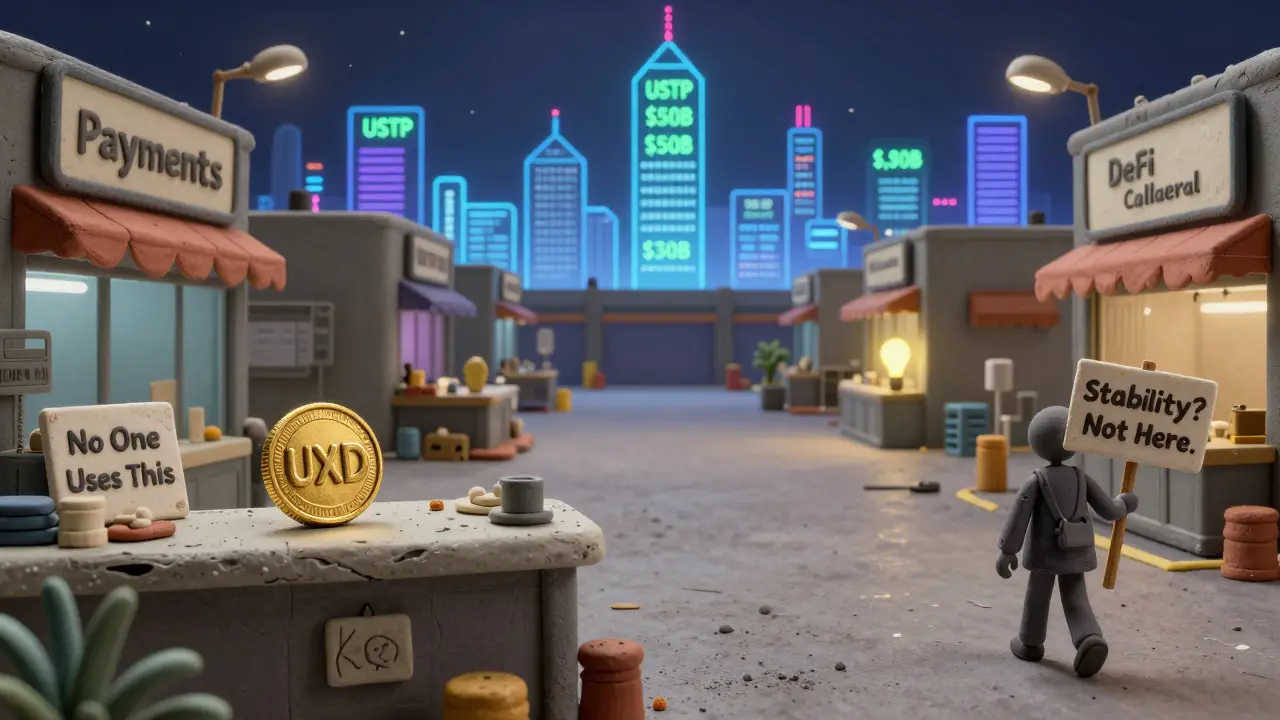
Who Uses UXD? (Spoiler: Almost No One)
UXD’s website says it’s for payments, remittances, and storing value. But no major exchange lists it as a payment option. No merchant accepts it. No DeFi protocol uses it as collateral.
It’s not in Uniswap’s top 100 stablecoins. It’s not in Aave or Compound. It doesn’t show up in any real-world use case. It’s a token with no ecosystem.
If you can’t use it to buy coffee, pay rent, or lend it out, what’s the point?
UXD vs. Real Stablecoins
| Feature | UXD | USDC | DAI |
|---|---|---|---|
| Backing | Derivatives (delta-neutral) | U.S. dollars in bank | Crypto collateral + algorithm |
| Transparency | Low-no public audits | High-monthly attestations | High-on-chain data |
| 24h Volume | $1,900 | $50B+ | $1.2B |
| All-Time High | $20.49 | $1.08 | $1.27 |
| Adoption | Near zero | Widely used | Major DeFi staple |
| Regulatory Status | Unclear | Compliant (Circle) | Decentralized, no issuer |
UXD doesn’t belong in the same category as USDC or DAI. It’s a speculative asset masquerading as a stablecoin. The only reason it trades near $1 today is because the market has stabilized after its collapse-not because the system is robust.
Should You Use UXD?
No-not if you care about safety, liquidity, or real utility.
It’s not a good store of value. It’s not a good payment tool. It’s not even a good investment. The 95% crash in late 2025 proves that. If you’re holding UXD, you’re not hedging risk-you’re taking it.
If you want a stablecoin, use USDC or USDT. If you want decentralization, use DAI. UXD offers none of the benefits of either.
It’s a cautionary tale: just because a project sounds smart doesn’t mean it works. And when a stablecoin’s price swings like a meme coin, you’re not investing in stability-you’re gambling on code.
Is UXD really pegged to $1?
UXD trades near $1 as of February 2026, but it has repeatedly broken its peg. It hit $20.49 in September 2025 and crashed 95% within months. Its stability comes from low trading volume and market exhaustion-not from a reliable mechanism.
Can I use UXD to pay for things online?
No. No major online retailers, payment processors, or DeFi platforms accept UXD. It has zero real-world adoption. Even if it were stable, no one uses it.
Is UXD backed by real assets?
No. UXD doesn’t hold cash or reserves. It uses derivative positions to simulate stability. If the market moves too fast or funding rates spike, the hedge can fail-and there’s no backup.
Why does UXD have so many conflicting supply numbers?
Because there’s no single source of truth. Different platforms track different versions of UXD-possibly from separate chains or bridged tokens. CoinMarketCap, CoinGecko, and CoinStats all report different circulating supplies. This lack of clarity is a major red flag.
Is UXD a good investment?
No. Its price history shows extreme volatility, near-zero liquidity, and no adoption. It’s not a stablecoin-it’s a speculative token with a dangerous mechanism. Don’t treat it like cash.
What happened to UXD in September 2025?
UXD surged to $20.49 due to a combination of speculative buying, Solana’s price surge, and possibly a flaw in its derivative hedge. When the market corrected, the peg collapsed. The system couldn’t handle the imbalance, and the price dropped 95% over the next few months.
UXD Stablecoin isn’t broken-it was never built to last. If you’re looking for stability, go elsewhere.
Jeremy buttoncollector
February 25, 2026 AT 22:59Look, the whole delta-neutral thing sounds elegant on paper but it’s just financial origami folded by guys who think entropy doesn’t apply to crypto.
Derivatives aren’t magic-they’re just bets with more steps. When Solana went parabolic, the funding rates spiked, the hedge got squeezed, and boom-UXD became a meme coin by accident.
It’s not a stablecoin, it’s a volatility arbitrage bot with a website.
And don’t even get me started on the bridged ERC20-on-Solana mess. That’s not innovation, that’s a Rube Goldberg machine built by someone who watched too much DeFi YouTube.
There’s no reserve, no audit trail, no transparency-just smart contracts hoping the market doesn’t sneeze.
Stablecoins aren’t supposed to be experiments. They’re supposed to be the bedrock.
UXD is a house of cards built on a hurricane.
And now it’s trading at $1? Please. That’s not stability, that’s exhaustion.
It’s like a zombie that stopped moving because it ran out of blood, not because it’s alive.
I’ve seen DeFi projects die. This one didn’t die-it just went to sleep with a knife in its back.
Someone needs to write a whitepaper called 'How Not to Build a Stablecoin' and make UXD the case study.
Until then, I’m just gonna keep my dollars in USDC and laugh at the people who thought this was a good idea.
It’s not even risky-it’s just stupidly overengineered.
And yes, I know this sounds like a rant. But if you’ve ever had to explain why UXD isn’t a stablecoin to a new investor… you’ll get it.
It’s not broken. It was never meant to work.
Michelle Xu
February 26, 2026 AT 14:40I appreciate the depth of this analysis. UXD is a fascinating case study in how complexity can mask fragility.
What’s concerning isn’t just the price swings, but the complete lack of clarity around supply, jurisdiction, and redemption mechanisms.
Stablecoins exist to reduce friction-not to introduce new layers of risk.
When users can’t find a single authoritative source for circulating supply, or whether their tokens are on Solana or LaChain, that’s a governance failure, not a technical one.
It’s also worth noting that even DAI, with its overcollateralized crypto backing, has maintained its peg through multiple bear markets.
UXD doesn’t have that resilience-it has spectacle.
And spectacle doesn’t scale.
If this were a bank product, it would’ve been shut down by regulators within a week.
But since it’s crypto, we treat it like a lottery ticket with a whitepaper.
I’d love to see a community-driven transparency initiative-maybe even a public ledger of all derivative positions.
Until then, I’ll stick with USDC for stability and DAI for decentralization.
UXD? Not on my radar.
Not because I’m afraid of innovation-but because I value reliability more than novelty.
Ryan Burk
February 28, 2026 AT 02:28LOL this post is so basic. Everyone knows UXD is a scam. But guess what? It’s still trading at $1. That’s because people are dumb, not because the model works.
Derivatives? Pfft. You think the devs actually understand how funding rates work? Nah. They just copied a DeFi YouTube tutorial and said ‘this’ll do’.
And now you’re telling me it’s ‘not a stablecoin’? DUH. It’s a meme. It’s a pump. It’s a rug pull with a whitepaper.
Who cares if volume is $2k? Who cares if it crashed 95%? It’s crypto. That’s the whole point.
USDC? Boring. DAI? Overcollateralized and slow. UXD? At least it’s wild.
So yeah, it’s not stable. But neither is life. Get over it.
And stop pretending crypto is about ‘utility’. It’s about vibes. And UXD has vibes.
Also, the fact that you’re writing a 2000-word essay on a token that nobody uses? That’s the real problem.
Go touch grass.
Amanda Markwick
March 1, 2026 AT 22:12I actually think UXD is misunderstood.
Yes, it crashed. Yes, the supply numbers are messy. Yes, it’s not on major exchanges.
But what if that’s because it’s still too early?
Think about it-DAI didn’t start with $1.2B in volume either. It started as a weird, under-the-radar project with a lot of skepticism.
Maybe UXD’s model is flawed, but the *intent* is bold.
What if one day, instead of holding dollars or crypto collateral, we just hedge risk with smart contracts? That’s the future.
Maybe the crash wasn’t a failure-it was a stress test.
And yes, the bridge issues, the supply confusion, the lack of audits-all terrible.
But let’s not throw out the baby with the bathwater.
What if we built a community DAO to fund a proper audit? What if we pushed for a single canonical version of UXD on Solana?
It’s not perfect. But perfection shouldn’t be the enemy of progress.
Maybe instead of calling it a scam, we should be asking: how do we fix it?
Because if we keep shutting down every experimental project just because it broke once… we’ll never get to real decentralization.
UXD isn’t a stablecoin today.
But maybe, just maybe, it’s a prototype for something better.
And if we don’t nurture those prototypes, we’re just building more USDC clones forever.
Sriharsha Majety
March 3, 2026 AT 08:41usdc is like a bank but uxd is like a gamble with math
and yeah it crashed hard but so did a lot of things in crypto
maybe its not for everyone but if you understand the mechanics its kind of interesting
also why is the supply number all over the place i have no idea but maybe its because different chains
anyway i still hold some just because i like the idea
not because i think its safe
just because its different
and if it goes to 20 again i wont be mad
but i wont put my rent money in it either lol
Tabitha Davis
March 4, 2026 AT 19:29OMG I CAN’T BELIEVE YOU’RE STILL TALKING ABOUT UXD LIKE IT’S A REAL THING.
It hit $20.49. TWENTY. FOUR. NINE.
That’s not a bug. That’s a feature. A feature called ‘PUMP’.
And now it’s at $1? Oh no! The market is ‘stabilizing’? Please. It’s not stable-it’s just been abandoned.
It’s like watching a drunk person try to walk a tightrope and then they fall, but now they’re just sitting on the ground crying and calling it ‘balance’.
And you people are defending it? ‘Maybe it’s a prototype’? NO. IT’S A SCAM.
Who even made this? A group of 19-year-olds who thought ‘delta-neutral’ sounded like a James Bond villain?
And now there’s a version on LaChain? What is LaChain? Is that a blockchain or a taco truck?
There’s no transparency, no audits, no liquidity, no adoption.
It’s not even a ghost town. It’s a graveyard with a website.
And you want to ‘fix’ it? FIX IT WITH A BAZOOKA.
Stop romanticizing failure. UXD didn’t fail because of market conditions.
It failed because it was built on sand by people who didn’t know what a stablecoin was.
And if you’re still holding it… you’re not a visionary.
You’re just confused.
Go buy USDC.
Or better yet-go take a nap.