Why Running a Node Matters for Blockchain Decentralization
 Jun, 25 2026
Imagine if your bank froze your account because of a typo in their system. Or worse, imagine if a government decided to block all transactions to a specific charity you support. In the traditional financial world, these are not hypothetical nightmares; they are daily realities for millions. This is the cost of centralization. Now, picture a different world where no single entity holds the keys to your money or data. Where the ledger is open, unchangeable, and controlled by thousands of independent computers spread across the globe. That is the promise of blockchain. But that promise only works if people actually run the machines that keep it alive. Those machines are called nodes.
Running a node isn't just a technical hobby for crypto enthusiasts. It is the fundamental act of voting for a free, open, and resilient internet. When you run a node, you aren't just storing data; you are enforcing the rules of the network. You are saying, "I will not accept fake transactions," and "I will not allow anyone to rewrite history." Without enough independent nodes, the entire concept of decentralization collapses into a centralized server farm disguised as a blockchain.
The Backbone of Trust: What Actually Is a Node?
To understand why running a node matters, we first need to strip away the jargon. A blockchain node is simply a computer connected to the network that maintains a copy of the ledger. Think of it like a group project where everyone gets their own photocopy of the final document. If one person loses their copy, the others still have it. If one person tries to scribble out a paragraph on their copy, the others compare notes and reject the change. That is how trust is built without a boss watching over your shoulder.
In the early days of Bitcoin, created by Satoshi Nakamoto in 2008, this peer-to-peer architecture was revolutionary. Before this, every transaction relied on a central authority-a bank, a payment processor, or a government registry. These central points are vulnerable. They can be hacked, corrupted, or shut down. By distributing the ledger across thousands of nodes, the network eliminates that single point of failure. Today, major networks like Bitcoin, Ethereum, and Dash rely on this exact principle. The more independent nodes there are, the harder it is for any single actor to control the narrative.
There are different types of nodes, but the most critical for decentralization is the full node. A full node downloads the entire history of the blockchain. For Bitcoin, this means storing hundreds of gigabytes of data. It validates every transaction against the protocol's rules from scratch. Lighter clients, which many mobile wallets use, trust other nodes to do the heavy lifting. While convenient, relying solely on light clients creates a dependency chain. If the few servers those light clients connect to go rogue, users won't know until it's too late. Full nodes break that chain of trust.
Security Through Redundancy: Why One Computer Isn't Enough
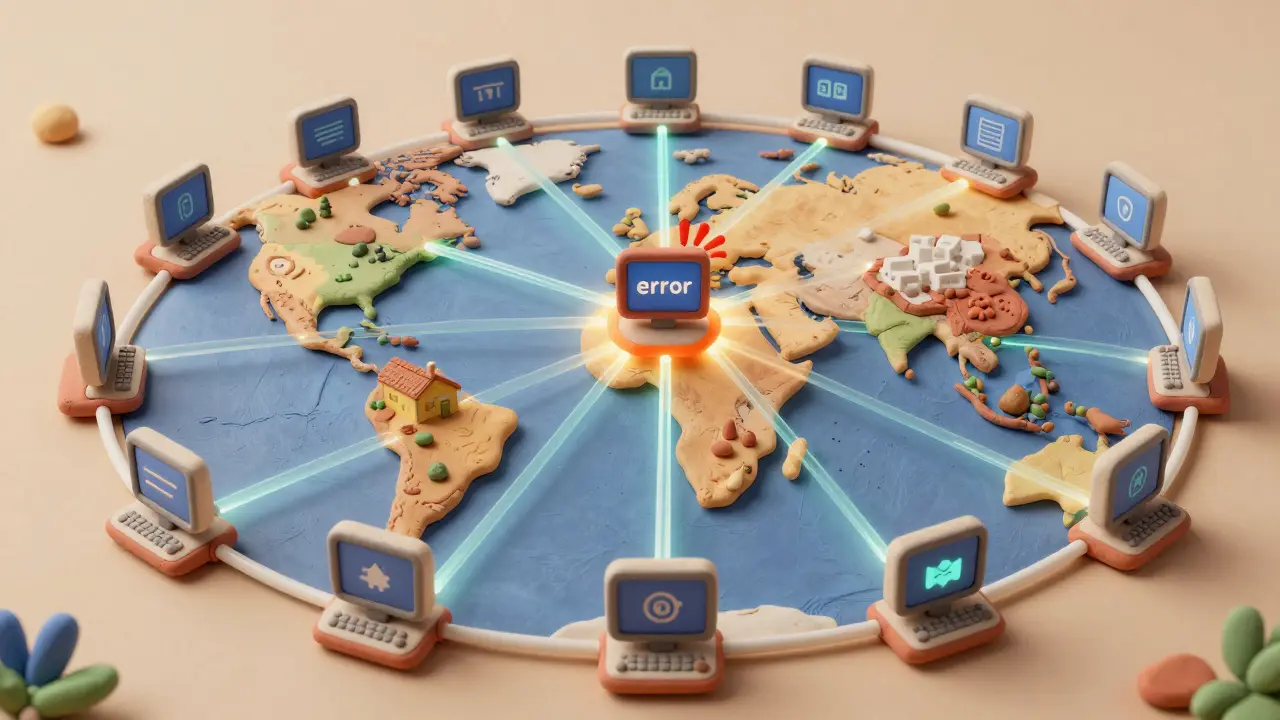
Let’s talk about security. In a centralized system, hackers target the main server. If they breach it, they can alter balances, steal funds, or erase records. In a decentralized network, there is no main server. There is only the consensus of the nodes. To attack a blockchain, you would need to compromise more than 50% of the hashing power (in Proof of Work systems) or stake (in Proof of Stake systems) simultaneously. This is known as a 51% attack.
For large networks like Bitcoin, this is practically impossible. The computational resources required are astronomical, and the cost would far exceed any potential gain. But here is the catch: this security model only holds if the nodes are distributed geographically and operationally. If 90% of Bitcoin nodes were hosted in a single data center in Virginia, a power outage or a targeted physical attack could cripple the network. That is why running your own node at home, or in a diverse set of locations, matters. It ensures that the network survives even if entire regions go offline.
This redundancy provides resilience against censorship and downtime. Centralized services suffer outages when servers crash or when governments issue takedown orders. Decentralized networks continue to operate as long as a minority of nodes remain online. During periods of high volatility or political unrest, this reliability becomes invaluable. Users can transact and verify ownership without waiting for a central authority to approve their actions.
| Feature | Centralized System | Decentralized Node Network |
|---|---|---|
| Data Storage | Single location (vulnerable) | Distributed across thousands of nodes |
| Trust Model | Trust the provider | Verify independently (trustless) |
| Censorship Resistance | Low (provider can block) | High (requires majority collusion) |
| Uptime | Dependent on server health | Resilient to individual failures |
| Transparency | Opaque (black box) | Fully auditable by anyone |
Governance and Voice: Voting with Your Hardware
Many people think running a node is passive. You turn it on, and it sits there. But in many blockchain ecosystems, nodes are active participants in governance. This is where the rubber meets the road for decentralization. Who decides what changes get made to the software? Who approves funding for development? In a centralized company, the CEO decides. In a decentralized network, the node operators often have the final say.
Take Dash, for example. Its masternodes vote on treasury proposals and network upgrades. Decred uses a hybrid model where ticket holders vote on policy changes through their nodes. Even in MakerDAO, token holders interact with the protocol to adjust interest rates and collateral types. These mechanisms ensure that the evolution of the network reflects the interests of its users, not just a small group of developers or venture capitalists.
If you don't run a node, you are effectively outsourcing your voice to someone else. You are trusting that the node operator you rely on votes according to your best interests. History shows us that proxies often fail. By running your own node, you retain the ability to validate that the network is following the rules you agreed to. If a proposed upgrade violates privacy standards or increases fees unfairly, you can reject it. Your node becomes your ballot box.
Economic Incentives and the Cost of Participation
So, why would anyone bother doing this work? Time, electricity, and storage space are not free. The answer lies in economic incentives and ideological commitment. Some networks, like Ethereum (historically) and various Proof-of-Stake chains, reward validators who secure the network with new tokens. Others, like Bitcoin, do not pay direct rewards to full node operators, but they provide immense value in the form of sovereignty.
For businesses and institutions, running a node offers significant advantages. It reduces reliance on third-party APIs, which can be expensive, rate-limited, or unreliable. By connecting directly to the blockchain via their own node, companies can build faster, cheaper, and more secure applications. This disintermediation cuts out the middleman fees associated with traditional financial infrastructure.
Moreover, there is a growing sense of ownership among node operators. Economists describe this as "skin in the game." When you invest hardware and bandwidth into a network, you become a stakeholder in its success. You are less likely to tolerate poor governance or security lapses. This active participation fuels a healthier ecosystem. It transforms users from passive consumers into active guardians of the network's integrity.

Censorship Resistance: The Ultimate Freedom
Perhaps the most profound reason to run a node is censorship resistance. In an era where digital platforms can de-platform users, freeze assets, or hide content at the click of a button, blockchain offers a refuge. Because the data is replicated across thousands of nodes globally, no single entity can delete it. To censor a transaction, an attacker would need to convince the majority of the global node network to ignore it. This is incredibly difficult to achieve without exposing their malicious intent.
This feature is crucial for identity management and supply chain transparency. Imagine a refugee whose proof of identity is stored on a blockchain. If they flee a conflict zone, they can access their identity anywhere in the world, provided they have internet access. No border guard or bureaucrat can revoke that record. Similarly, in supply chains, nodes can verify the origin of goods, ensuring that products are ethically sourced without relying on a corporation's self-reported data.
As regulatory pressures mount worldwide, the importance of decentralized nodes will only grow. Governments may attempt to restrict access to certain protocols or mandate compliance measures. Independent node operators serve as a check against these overreachs. They ensure that the technology remains neutral and accessible to all, regardless of geography or political affiliation.
Challenges and the Future of Node Operation
It is not all smooth sailing. Running a node requires technical knowledge. You need to manage updates, troubleshoot connectivity issues, and ensure your hardware stays up to date. Storage requirements are also increasing. Bitcoin's blockchain grows by roughly 1-2 GB per day. Ethereum's state size is similarly expanding. This poses a barrier to entry for casual users.
However, the industry is responding. Layer-2 solutions, such as Lightning Network for Bitcoin and rollups for Ethereum, reduce the load on base-layer nodes while maintaining security guarantees. Software improvements are making node setup easier, with one-click installers and cloud-hosted options becoming more common. Additionally, initiatives like "node-as-a-service" allow users to rent node capacity, though purists argue this reintroduces centralization risks.
The future of blockchain decentralization depends on balancing scalability with accessibility. If nodes become too resource-intensive, only corporations can afford to run them, leading to centralization. The goal is to keep the bar low enough for individuals to participate while ensuring the network remains robust. As technology advances, we expect to see more efficient consensus mechanisms and optimized storage techniques that make running a node as easy as running a web browser.
Do I need a powerful computer to run a blockchain node?
Not necessarily. For many modern blockchains, a standard laptop or even a Raspberry Pi can suffice. However, for larger networks like Bitcoin or Ethereum, you will need a dedicated machine with several hundred gigabytes of SSD storage and a stable internet connection. Mining requires specialized hardware, but running a full node primarily requires storage and bandwidth.
Is running a node profitable?
Direct profitability varies. In Proof-of-Stake networks, validators earn rewards. In Proof-of-Work networks like Bitcoin, full node operators do not receive direct monetary rewards for validation, but miners do. The primary benefit is non-financial: enhanced security, privacy, and contribution to network decentralization. Businesses may save money by avoiding third-party API fees.
What happens if my node goes offline?
Nothing catastrophic. The network continues to function because other nodes maintain the ledger. When your node comes back online, it will sync with the latest blocks and update its local copy. However, frequent offline status reduces your contribution to network redundancy and may limit your ability to participate in time-sensitive governance votes.
Can I run a node on a mobile device?
Most mobile devices cannot run full nodes due to limited storage and processing power. Instead, they use "light nodes" or SPV (Simplified Payment Verification) clients. These rely on full nodes to provide summaries of transactions. While convenient, light nodes offer less security and independence than full nodes.
How does running a node protect my privacy?
When you send transactions through a third-party wallet service, that service sees your IP address and transaction details. By running your own node and broadcasting transactions directly from it, you prevent intermediaries from tracking your activity. This adds a layer of anonymity and ensures your data isn't being sold or monitored by corporations.
John Curry
June 27, 2026 AT 00:20It is profoundly ironic that we have built a system designed to liberate us from institutional control, yet most people still outsource their sovereignty to centralized wallets. The philosophical weight of running a node is often ignored in favor of quick gains, but without the active participation of individuals who value freedom over convenience, the entire structure crumbles into the very centralization it seeks to destroy. We are not just storing data; we are curating the integrity of a new social contract.
Melissa L
June 28, 2026 AT 08:46i tried setting up a node on my old laptop and it was soo confusing lol like why do i need so much storage space for just checking transactions??
Rob Morton
June 30, 2026 AT 02:54The technical barrier is real, but consider the alternative: trusting a third party with your financial identity. When you run a node, you are essentially saying that you trust the code more than you trust human institutions. It shifts the paradigm from faith-based finance to verification-based reality. That shift requires effort, yes, but the reward is absolute autonomy over your own economic existence.
Routh Middaugh
July 1, 2026 AT 05:03You make a valid point about the effort required! However, one must also consider the environmental impact of maintaining these servers constantly online... Is it truly sustainable for everyone to run a full node? Or does this create a new class divide between those with resources and those without? These are important questions to ponder as we move forward.
Trent Erman1
July 2, 2026 AT 10:52Great question about sustainability! Many modern setups use low-power hardware like Raspberry Pis or efficient SSDs which consume minimal electricity compared to mining rigs. Plus, many nodes are run by enthusiasts who already have computers on 24/7 anyway. It's not about mass production energy consumption but rather distributed resilience. Think of it like keeping a backup generator at home; it sits idle until you need it, then it saves the day. 🌱💻
Fiona Ellis
July 3, 2026 AT 00:18I find it fascinating how this technology mirrors the evolution of the printing press. Just as Gutenberg didn't intend to overthrow the church but did so by democratizing information, blockchain developers might not intend to topple banks, but the mechanism forces decentralization. Running a node is the modern equivalent of owning a printing press-powerful, dangerous to the status quo, and essential for truth. 🖨️📜
Nicole Woessner
July 4, 2026 AT 04:47in japan we have a strong culture of community responsibility and i see running nodes as similar to participating in local neighborhood associations its not about profit its about ensuring the community infrastructure remains robust and trustworthy for everyone especially during crises when traditional systems fail
Jon Milton
July 5, 2026 AT 11:12Stop romanticizing the 'community' aspect if you aren't actually doing the work. If you rely on light clients because you're too lazy to allocate 500GB of storage, you are actively contributing to centralization. Your convenience is the enemy of decentralization. Wake up and take responsibility for your own security instead of hiding behind excuses about hardware costs.