Removing Intermediaries with Blockchain: How to Cut Costs and Speed Up Transactions
 Jun, 15 2026
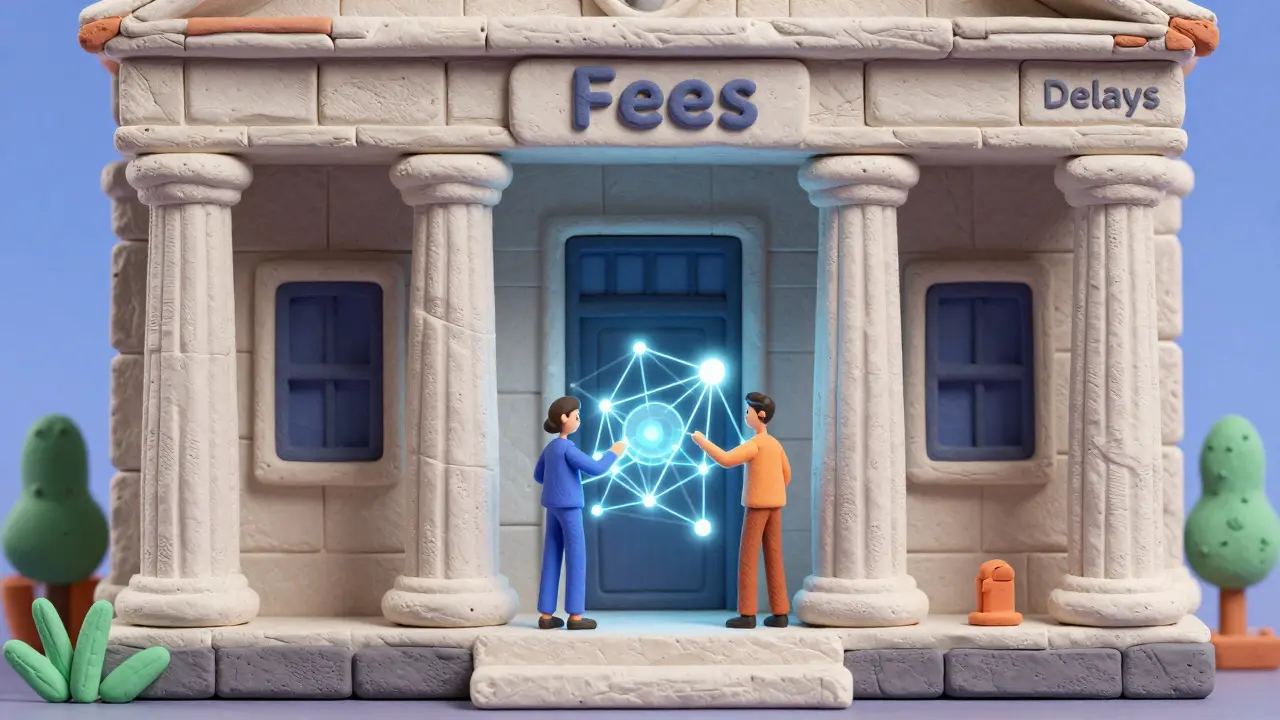
Imagine sending money to a supplier in another country without paying a bank $45 in fees or waiting three days for the transfer to clear. That is exactly what happens when you remove the middleman from the equation. For decades, we have accepted that banks, payment processors, and clearinghouses are necessary evils. They hold our data, charge us fees, and slow down our business. But Blockchain technology is a decentralized digital ledger that allows direct peer-to-peer transactions without central authority, changing that reality. By cutting out these intermediaries, businesses can slash transaction costs by up to 80% and settle payments in seconds rather than days.
This shift isn't just theoretical anymore. It is happening right now in payroll systems, supply chains, and international trade. If you are still relying on traditional banking rails for cross-border operations, you are likely overpaying and underperforming. Let’s look at how removing intermediaries actually works, where it saves the most money, and what pitfalls you need to avoid.
The Core Mechanism of Disintermediation
To understand why blockchain removes intermediaries, you first need to understand what those intermediaries actually do. In a traditional system, a bank acts as a trusted third party. It verifies that you have funds, records the transaction, and updates its internal ledger. This requires massive infrastructure, compliance teams, and security protocols, all of which cost money. You pay for that infrastructure through fees.
Blockchain replaces this centralized trust with cryptographic verification. Instead of asking a bank if you have enough money, the network checks the public ledger. Every participant sees the same record. When you send a transaction, it is digitally signed with your private key and verified by the network using your public key. No human needs to approve it. No single company controls the record.
This concept originated with Satoshi Nakamoto’s 2008 Bitcoin whitepaper, which proposed a trustless system for transferring value. Today, that concept has expanded far beyond currency. It applies to contracts, ownership records, and identity verification. The result is a system where trust is built into the code, not borrowed from an institution.
| Feature | Traditional System (e.g., SWIFT) | Blockchain Network (e.g., Ethereum 2.0) |
|---|---|---|
| Settlement Time | 2-5 Business Days | Under 15 Seconds |
| Average Fee | $45+ per transfer | Under $1 (using stablecoins) |
| Transparency | Opaque; only parties see details | Immutable; visible to authorized nodes |
| Intermediaries | Correspondent banks, clearinghouses | None (Peer-to-Peer) |
Real-World Impact: Payroll and Cross-Border Payments
The most dramatic example of removing intermediaries is in cross-border payroll. Companies like Bitwage have shown how powerful this can be. Before blockchain, paying an employee in a different country meant routing money through multiple correspondent banks. Each bank took a cut, converted currencies at poor rates, and added delays. The average cost was 5-7% of the transaction value, plus significant time loss.
With blockchain-based solutions, that cost drops to 0.5-1%. Bitwage processes these transfers using stablecoins-cryptocurrencies pegged to fiat values like the US Dollar. This avoids the volatility of assets like Bitcoin while keeping the speed and low fees of the blockchain. Their 2023 data shows they process cross-border payroll for under $1 per transfer. Compare that to the traditional wire transfer fee of $45, and the savings are obvious.
It is not just about saving money. It is about speed. Ripple’s xCurrent system processes international payments in 3-5 seconds. SWIFT takes days. For a small business owner waiting for an invoice payment, that difference between Tuesday morning and next Friday can mean the difference between buying inventory or going broke.
Smart Contracts: Automating the Middleman
If blockchains handle the money, Smart contracts are self-executing programs stored on the blockchain that automatically enforce agreement terms. These are the real game-changers for removing human intermediaries. Think of them as vending machines. You put in money and select an item. The machine doesn’t need a clerk to check your ID or approve the sale. It just executes the code.
In a traditional supply chain, a seller ships goods, sends an invoice, waits for the buyer to receive them, then manually requests payment. This process involves lawyers, accountants, and dispute resolution teams. With smart contracts, the release of payment can be triggered automatically when a shipment reaches a specific GPS coordinate or scans a QR code. The code executes instantly. No arguments. No delays.
According to Deloitte’s 2023 Blockchain Survey, implementing smart contracts reduces processing times from days to minutes. This automation eliminates the need for manual reconciliation, which is one of the most expensive and error-prone tasks in finance. Gartner predicts that by 2026, blockchain will automate 30% of manual reconciliation processes in financial services. That is a huge chunk of overhead disappearing overnight.
Technical Trade-offs: Speed, Energy, and Scalability
Removing intermediaries sounds perfect, but there are technical constraints you cannot ignore. The biggest issue is the "blockchain trilemma." This theory states that a blockchain can only optimize for two of three properties: decentralization, security, and scalability. You rarely get all three.
For example, Bitcoin uses Proof of Work (PoW). It is highly secure and decentralized, but it is slow and energy-intensive. Digiconomist’s May 2024 data shows each Bitcoin transaction consumes approximately 707 kWh of energy. Validation takes 10-60 minutes. That is too slow and expensive for everyday retail transactions.
Ethereum solved this by switching to Proof of Stake (PoS) after its "merge" in 2022. PoS consumes 99.95% less energy and validates transactions in under 12 seconds. However, even Ethereum struggles with high-volume spikes, leading to higher gas fees. Newer chains like Solana offer peak speeds of 65,000 transactions per second (TPS), compared to Visa’s 24,000 TPS average. But Solana has faced criticism for occasional network outages, raising questions about reliability.
Enterprise solutions like Hyperledger Fabric take a different approach. They are private, permissioned blockchains. They sacrifice some decentralization for speed and privacy, achieving 3,500-10,000 TPS. They require more hardware (minimum 8GB RAM, 4-core processors) but offer the control large corporations need. Choosing the right platform depends on whether you prioritize public transparency or private efficiency.
Regulatory Landscape and Compliance Risks
You cannot remove intermediaries without considering the law. Governments love intermediaries because they provide choke points for tax collection and anti-money laundering (AML) checks. Removing those choke points creates regulatory uncertainty.
As of mid-2024, only 28 of 130 surveyed countries have comprehensive crypto regulatory frameworks, according to the World Bank. This patchwork makes global expansion tricky. However, things are improving. The EU’s Markets in Crypto-Assets (MiCA) framework, fully implemented in June 2024, has created clear rules for stablecoins. Bitwage CEO Jon Schlinkert called MiCA "critical for payroll blockchain adoption" because it provides legal certainty for companies holding user funds.
The Financial Stability Board released a roadmap in July 2023 to reduce friction in cross-border payments. The Bank for International Settlements’ Project mBridge demonstrated that central bank digital currencies (CBDCs) could settle transactions 24/7, potentially removing correspondent banks from 88% of cross-border deals. These developments suggest that regulators are moving toward integration rather than prohibition.
Still, you must be careful. MIT’s Neha Narula warned in 2023 that "blockchain solutions often recreate the very intermediaries they seek to eliminate in the form of specialized wallet providers and exchange platforms." While the protocol is decentralized, the tools you use to access it might not be. Always verify who holds your private keys.
Implementation Challenges for Businesses
Adopting blockchain is not as simple as flipping a switch. The learning curve is steep. Finance teams typically need 40 hours of training to manage blockchain payroll systems. IT staff may need over 120 hours to configure integrations with legacy HR software.
Integration is the biggest hurdle. Mapping old ISO 20022 message formats to new smart-contract schemas is difficult. PwC’s survey found that 68% of early adopters struggled with this step. Additionally, security is paramount. If you lose your private key, your money is gone forever. There is no customer support line to call. Seventy-two percent of companies now implement multi-signature wallets as a minimum standard to prevent theft or loss.
User experience is another barrier. A 2023 Small Business Blockchain Adoption Survey found that 78% of small businesses had trouble explaining blockchain transactions to their customers. People are used to seeing "Bank of America" on their statements. Seeing "Ethereum Wallet" causes confusion. Successful implementations require strong communication strategies to educate both employees and clients.
Future Outlook: Where Does This Lead?
The trend is clearly toward disintermediation. The global blockchain in payments market is projected to grow from $5.9 billion in 2023 to $35.6 billion by 2028, according to MarketsandMarkets. McKinsey estimates that blockchain could unlock $1.7-$2.4 trillion in value across supply chains and finance by 2030.
We are seeing a convergence of technologies. Central Bank Digital Currencies (CBDCs) are being integrated with enterprise blockchains. 130 countries are exploring CBDCs. This means the future may not be purely decentralized cryptocurrencies, but hybrid systems where government-backed digital money runs on efficient, transparent ledgers.
For businesses, the choice is no longer whether to adopt blockchain, but how. Start with high-fee corridors. If you are paying international freelancers or suppliers, test a pilot program. Use stablecoins to avoid volatility. Partner with platforms that offer robust documentation and support. The goal is not to become a tech company, but to use technology to strip away unnecessary costs and delays.
Is removing intermediaries with blockchain safe for my business?
Yes, if implemented correctly. Blockchain uses advanced cryptography that is generally more secure than traditional databases. However, the risk shifts from institutional failure to user error. You must secure your private keys. Using multi-signature wallets and reputable enterprise platforms like Hyperledger Fabric or regulated stablecoin providers significantly reduces risk. Always conduct a security audit before full deployment.
How much can I save by using blockchain for payments?
Savings vary by use case, but Deloitte reports a 40-80% reduction in transaction costs. For cross-border payroll, companies like Bitwage show fees dropping from $45+ to under $1 per transfer. This represents a cost reduction of over 97% in specific scenarios. For high-volume B2B transactions, the cumulative savings can be substantial.
Do I need to hire blockchain developers to start?
What are the main risks of disintermediation?
The primary risks are regulatory uncertainty, technical complexity, and irreversible transactions. Unlike banks, blockchain transactions cannot be reversed if sent to the wrong address. Additionally, laws regarding crypto-assets vary by country. Ensure you comply with local AML/KYC regulations and consider using stablecoins to mitigate price volatility risks.
Which blockchain is best for business transactions?
It depends on your needs. For public, transparent transactions, Ethereum or Polygon are popular due to their ecosystem and security. For high-speed, low-cost transfers, Solana or Stellar are strong options. For private enterprise data where confidentiality is key, permissioned ledgers like Hyperledger Fabric or R3 Corda are often preferred. Many businesses use a hybrid approach.
Will blockchain replace banks entirely?
Not immediately. Banks are adapting by building their own blockchain networks (like Visa B2B Connect). While blockchain removes the need for correspondent banks in settlement, traditional banks still play roles in credit issuance, fraud prevention, and customer service. The future is likely a hybrid model where banks use blockchain infrastructure to become faster and cheaper, rather than disappearing completely.
Terry Hyland
June 16, 2026 AT 17:59you think this is about saving money but its really about control. the banks are just the middlemen for the government to watch you. now they want you on a blockchain so every transaction is permanent and visible to everyone who has the key. there is no privacy here only surveillance with a fancy name. people are too stupid to see that they are handing over their freedom for cheap fees. the system wants to know where your money goes at all times. it is not technology it is a trap.
Monica Pathammavong
June 18, 2026 AT 10:07i have been working in fintech for years and let me tell u this article is missing some crucial points about gas fees during peak hours which can skyrocket costs way above traditional banking methods. also the integration part is understated most legacy systems cant handle the api calls needed for real time settlement without major refactoring. dont believe the hype until you see the actual code implementation details because many of these platforms are just wrappers around centralized databases anyway. i saw a company try this last year and they lost millions due to smart contract bugs that were not caught in testing. be careful out there.
Tim Lefebvre
June 19, 2026 AT 16:44hey guys i actually used bitwage for my remote team and it was pretty smooth honestly. the fees were low like under a dollar per transfer which saved us a lot compared to wire transfers. we did have to spend some time setting up the wallets but once it was done it worked well. just make sure you keep your private keys safe because if you lose them you are stuck. overall good experience though and much faster than waiting days for bank approvals. give it a shot if you pay freelancers abroad.
Grace Newman
June 21, 2026 AT 02:35It is imperative to consider the regulatory implications before adopting such decentralized technologies as the lack of oversight poses significant risks to financial stability and consumer protection. The notion that intermediaries are merely obstacles ignores their critical role in enforcing anti-money laundering protocols and ensuring compliance with international tax laws. Without these safeguards the financial system becomes vulnerable to illicit activities and fraud which ultimately harms the broader economy. One must question whether the pursuit of efficiency justifies the erosion of established legal frameworks designed to protect citizens from exploitation.
Annemarie Fitzgerald
June 21, 2026 AT 04:24the nature of trust itself is being redefined by these digital ledgers but what happens when the code fails or is manipulated by those who wrote it. we are trading human judgment for algorithmic determinism which strips away the nuance and empathy required in true economic exchange. it feels cold and mechanical like reducing human interaction to mere data points on a screen. i wonder if we are losing our souls in the process of optimizing for speed and profit margins. the silence of the blockchain speaks volumes about our desire to disconnect from responsibility.
Kenneth Riley
June 21, 2026 AT 17:07you guys are sleeping on the potential here this is the biggest shift since the internet came out and anyone saying otherwise is either ignorant or paid to stay silent. the trilemma is being solved daily by new layer two solutions that offer insane speeds and negligible costs while maintaining security. look at the adoption rates in developing countries where traditional banking is broken blockchain is the only option that works. stop complaining about regulation and start building because the future belongs to those who embrace decentralization now. wake up sheeple.
Sonya O'Brien
June 21, 2026 AT 23:06I find it interesting how different perspectives highlight both the technical benefits and the philosophical concerns surrounding blockchain adoption, and I believe that finding a balance between innovation and regulation will be key to sustainable growth in this space. While the cost savings are undeniable especially for cross-border transactions the learning curve and security responsibilities cannot be overlooked as they require significant investment in training and infrastructure. It seems that hybrid models might offer the best path forward allowing businesses to leverage blockchain efficiency while still benefiting from the protective measures provided by traditional financial institutions. This collaborative approach could help mitigate risks while maximizing the advantages of disintermediation.