Crypto Exchange Restrictions: Why Some Platforms Block Coins and How It Affects You
When a crypto exchange removes a coin you own, it’s not just a technical update—it’s a legal decision. crypto exchange restrictions, rules enforced by exchanges to comply with government laws, often removing coins tied to privacy, anonymity, or regulatory risk. These restrictions are growing, not fading, and they’re changing how you access and use digital assets. You can’t trade Monero on Binance anymore. You can’t use Tornado Cash on Coinbase. Even small tokens like SOS or MPWR vanish from listings because they don’t meet compliance standards. This isn’t about whether a coin is good or bad—it’s about whether the exchange can legally list it.
privacy coins, cryptocurrencies designed to hide transaction details like sender, receiver, and amount. Also known as anonymity-focused tokens, they’re the main target of exchange restrictions. Monero and Zcash aren’t banned because they’re useless—they’re removed because regulators say they enable money laundering. The same goes for crypto mixers, tools that obscure the trail of cryptocurrency transactions. Tornado Cash was sanctioned by the U.S. government in 2022, and even after a court reversed the ban, exchanges still avoid it. Why? Because the developers are still under prosecution, and exchanges fear legal fallout. Even if you’re not using these tools for illegal purposes, the risk to the exchange is too high. They’d rather lose a few users than risk a fine or shutdown.
It’s not just privacy coins. Exchanges also pull tokens with no clear team, no audits, or no trading volume—like CashTelex or SkullSwap—because they’re seen as scams or liabilities. If a coin doesn’t have a working product or regulatory paperwork, exchanges drop it. This isn’t always about security. It’s about survival. In Germany, exchanges need BaFin licensing. In Singapore, they must follow MAS rules. In Algeria, crypto is outright illegal. Every country adds its own layer of rules, and exchanges have to pick which ones to follow. That’s why you might find a coin on MEXC but not on Kraken.
What does this mean for you? Your favorite coin might disappear overnight. Your wallet might stop working on a platform you trusted. You might need to move assets to a non-KYC exchange or a self-custody wallet just to hold them. That’s not a bug—it’s the new reality. The days of universal access are over. Now, your access depends on where you live, which exchange you use, and whether the coin meets the latest compliance checklist. The posts below show you exactly which coins got cut, why, and what alternatives still work in 2025. You’ll see real cases—from Algeria’s total ban to Iran’s mining loophole—and learn how to protect your holdings when the next restriction hits.
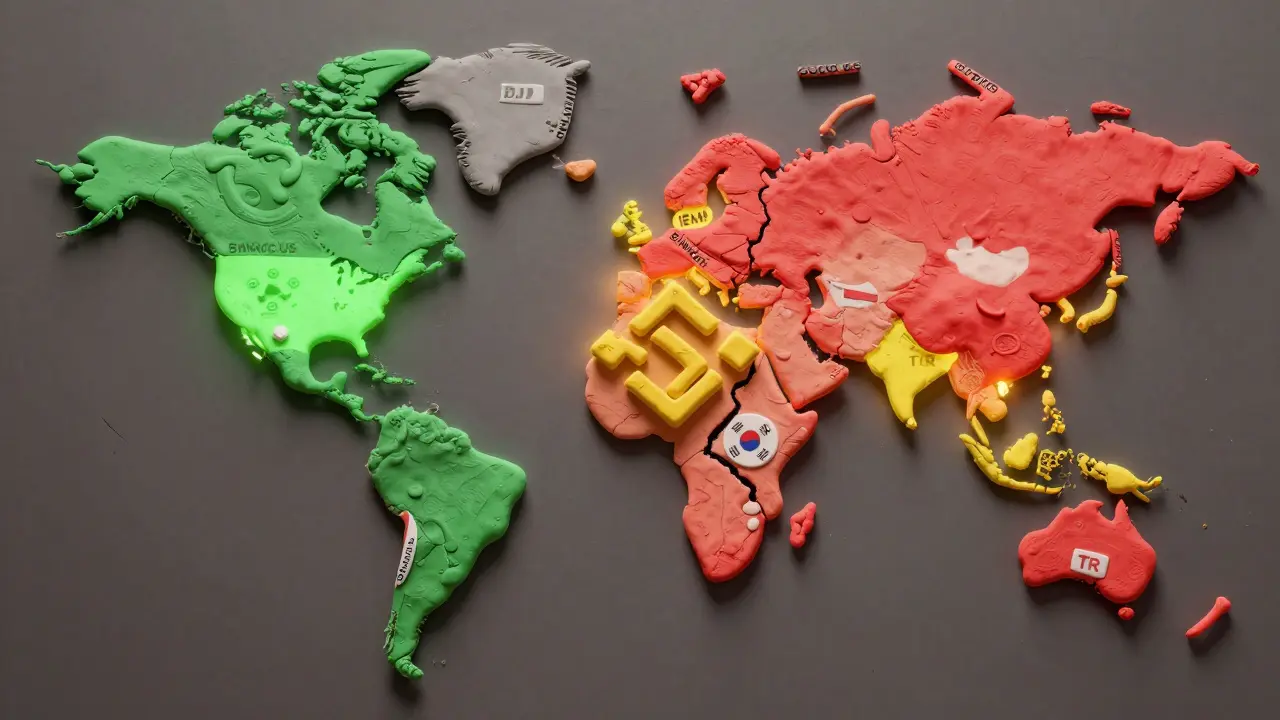
Crypto Exchange Availability by Region Worldwide: Where You Can and Can't Trade
Crypto exchange availability varies widely by country due to regulations. Binance is blocked in the U.S. but operates regional versions. Ukraine and Moldova lead adoption, while strict rules limit access in many nations.